CYBERHIVE GOLD
Gab es jemals eine Seelenspaltung? Dualseelen neu betrachtet im Licht gnostischer Kosmologie
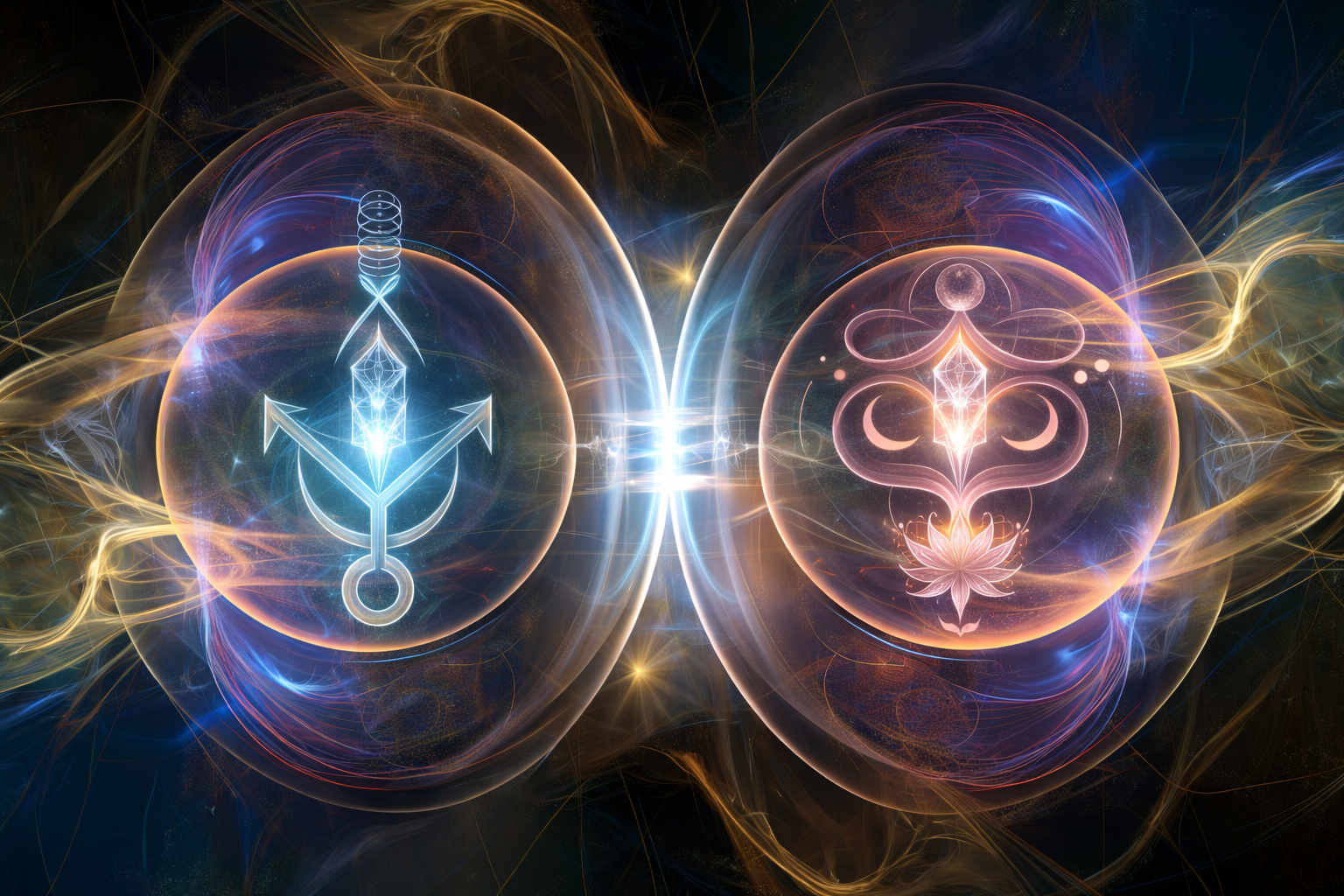
von Frank Jacob
In unseren Gesprächen tauchte kürzlich eine Frage zu sogenannten „Dualseelen“ oder „gespaltenen Seelen“ auf – eine Frage, die etwas sehr Altes berührt, das ich in meiner letzten Serie ausführlich untersucht habe: die ursprünglichen Frauen, später in manchen Überlieferungen als die Sidhe oder Baum-Nymphen erinnert.
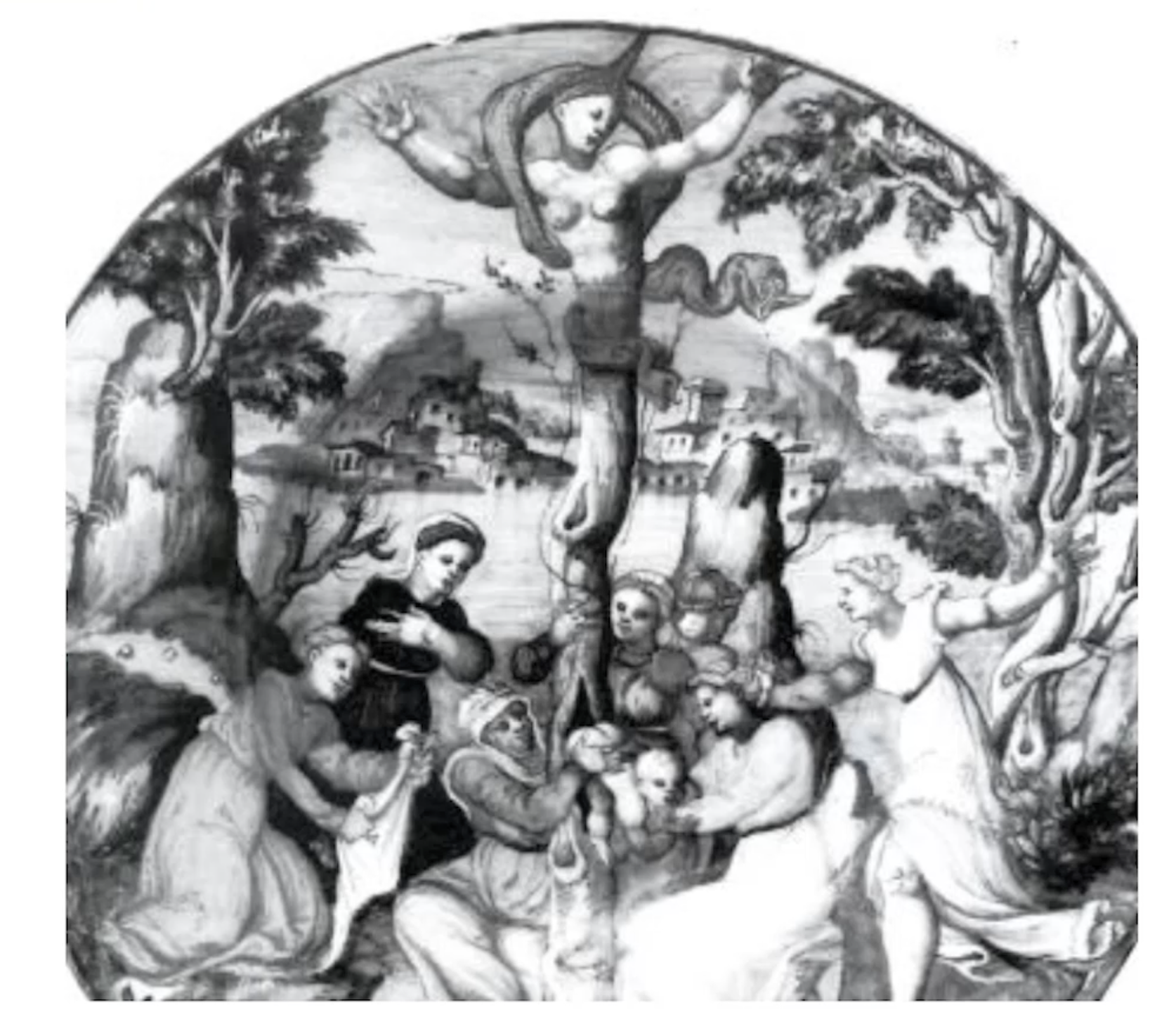
Bild: Aus einem Baum geboren … Legenden von Frauen als wandelbare Baumwesen überlebten bis in die griechische Mythologie. Das griechische Gegenstück zum assyrisch-babylonischen Tammuz war Adonis. Der Überlieferung zufolge war seine Mutter Myrrha ein Baum - also eine Baum-Nymphe oder Dryade.
Im gnostisch-sophianischen Narrativ entfaltet sich Leben zunächst parthenogenetisch innerhalb der planetaren Biosphäre selbst: chthonisch, erdgeboren, unmittelbar getragen vom schöpferischen Feld Sophias. In einer solchen frühen Phase dominieren naturgemäß Kontinuität, Fürsorge und lebenserhaltende Qualitäten – denn jedes Leben benötigt zunächst Stabilisierung, bevor Differenzierung entstehen kann.
Erst später tritt die uns heute vertraute Polarität zwischen Mann und Frau hervor.
Der Mythos überliefert uns diesen Moment als das Erscheinen der „Männer aus Orion“.
Hieraus ergibt sich eine feine, aber zentrale Frage:
Wenn die frühe Menschheit zunächst überwiegend in einer weiblichen Ausdrucksform entstand - könnte es sein, dass es zu diesem Zeitpunkt noch gar keine Seelenspaltung gab? Könnte erst das spätere Hinzutreten des Männlichen jene Teilung eingeführt haben, die spätere esoterische Traditionen als „Dualseelen“ oder „gespaltene Seelen“ interpretierten?
Die Gnostiker gingen davon aus, dass der Mensch mit Nous - göttlicher Intelligenz - ausgestattet ist, als Teil seiner ursprünglichen Anlage. Eine inhärente Fähigkeit, nicht ein von der Einheit abgespaltenes Fragment. Von einer sich teilenden Seele sprechen die Texte nicht. Vielmehr ist von Intelligenz die Rede, die innerhalb von Sophias lebendigem Feld Verkörperung annimmt. Was spätere Traditionen „Seele“ nannten, könnte bereits eine Verschiebung gegenüber diesem älteren Verständnis darstellen.
Doch die Geschichte reicht noch tiefer. Sie führt über individuelle Verkörperung hinaus in ein weit kosmologisches Kapitel:
In jenes, das die Entstehung und Differenzierung des Anthropos selbst beschreibt.
Wenn wir den rekonstruierten sophianischen Mythos - das sogenannte Szenario der gefallenen Göttin - kosmologisch betrachten, dann vollzog sich die Emergenz des Anthropos nicht ausschließlich innerhalb der Erde, sondern im Zusammenhang mit größeren kosmischen Bildungsregionen, die mit Orion assoziiert sind. Regionen, von denen wir heute wissen, dass sie gewaltige molekulare Wolken und aktive Sternentstehungsgebiete enthalten - darunter M42.
Die moderne Astronomie beschreibt M42, den Orionnebel, als die nächstgelegene Sternentstehungsregion unserer galaktischen Nachbarschaft - eine leuchtende Formationszone, die der Menschheit seit der Antike sichtbar ist und von den Maya als „kosmisches Feuer der Schöpfung“ bezeichnet wurde.
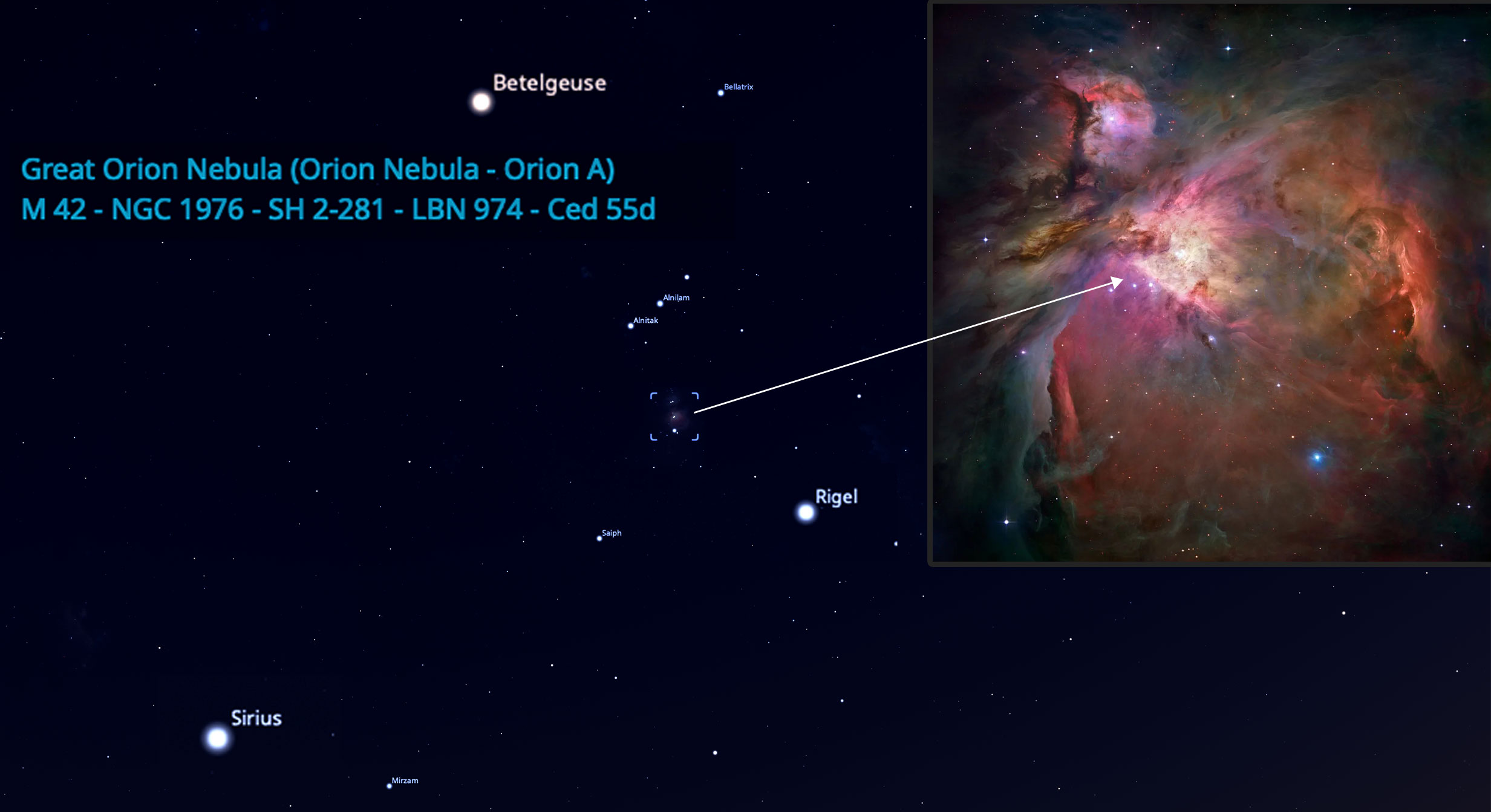
Bild: Orionnebel (M42). Astronomisch betrachtet lassen sich solche Umgebungen als kosmische Inkubationszonen verstehen, in denen die materiellen Voraussetzungen komplexen Lebens lange vor der Stabilisierung planetarer Ökosysteme gebildet wurden.
Während Sophias Übergang in dichtere kosmische Bereiche geschieht etwas Entscheidendes, das im Mythos mit Orion verknüpft überliefert wurde. Hier erscheint das, was die Nag-Hammadi-Texte hamartēma nennen: kein moralischer Fehltritt, sondern eine unbeabsichtigte Folge schöpferischer Bewegung. Die Schöpfung überschießt ihr Ziel.
In der Plasmaphysik verändern sich Strukturen, wenn sie zwischen sehr unterschiedlichen kosmischen Umgebungen wechseln. Ihre innere Kohärenz verschiebt sich, sobald sich die Bedingungen ändern. Während dieses Übergangs wird das Template des Anthropos gleichsam geschert - Teile des sich entwickelnden Musters werden voneinander getrennt.
Der Anteil, der in Sophias gewaltigen plasmischen Strom hineingezogen wird, integriert sich in die entstehende Biosphäre der Erde und bildet schließlich die tief chthonische, mütterliche Kontinuität der Menschheit.
Ein anderer Aspekt desselben Templates bleibt im Orion-Formationsraum gebunden und entwickelt sich dort unter anderen Bedingungen weiter.
Über kaum vorstellbare Zeiträume hinweg beschreibt die Mythologie diese differenzierten menschlichen Ausdrucksformen als Wiederannäherung entlang kosmischer „Linien“ - nicht Blutlinien, wie spätere Traditionen annahmen, sondern entlang gewaltiger energetischer Bahnen. Was die Plasmakosmologie als Birkeland-Ströme bezeichnet: elektrische Ströme im Raum, entlang derer Materie sich sammelt und Struktur entsteht.
Die alte Erinnerung bewahrte dies in einer einfachen Aussage:
„Die Männer kamen aus Orion.“
Nicht als außerirdische Invasion, sondern als Erinnerung daran, dass menschliche Polarität aus der Teilhabe an einer größeren kosmischen Ökologie hervorging.
Spätere Traditionen übersetzten diese Erinnerung in Gestalten wie die Wächter, die Nephilim oder urzeitliche Riesen - mythische Nachklänge von Differenzierungsereignissen, deren ursprünglicher kosmologischer Zusammenhang allmählich verblasste. Interessanterweise bezeichnet die früheste Bedeutung der biblischen „Wächter“ keine gefallenen Wesen, sondern jene, die an Schwellen stehen und Übergänge beobachten - eine Rolle, die stark an das gnostische Konzept des hamartēma erinnert, in dem kosmische Ordnung von einem Zustand in einen anderen übergeht.
Mythische Echos?
Überlieferungen auf der ganzen Erde berichten von Wesen, die später als „außerirdisch“ erinnert wurden. OOPART-Forscher verweisen dabei auf ungewöhnliche Skelettfunde, verlängerte Schädel oder rätselhafte Artefakte als mögliche Spuren – vielleicht Echos von Differenzierungsereignissen, die im Mythos überdauerten, lange nachdem ihr ursprünglicher kosmologischer Kontext vergessen war.
In dieser Sichtweise ist die Menschheit weder rein irdisch noch fremdartig. Wir sind Wesen, die auf der Erde physische Gestalt annahmen, geprägt von Prozessen, die in einem größeren kosmischen Umfeld begannen - eine Vorstellung, der sich moderne Diskussionen über Panspermie vorsichtig wieder annähern.
Die ältesten Initiationstraditionen brachten diese doppelte Zugehörigkeit bereits zum Ausdruck. Auf der orphischen Petelia-Tafel heißt es:
„Ich bin ein Kind der Erde und des sternreichen Himmels – doch mein Geschlecht ist himmlischen Ursprungs.“
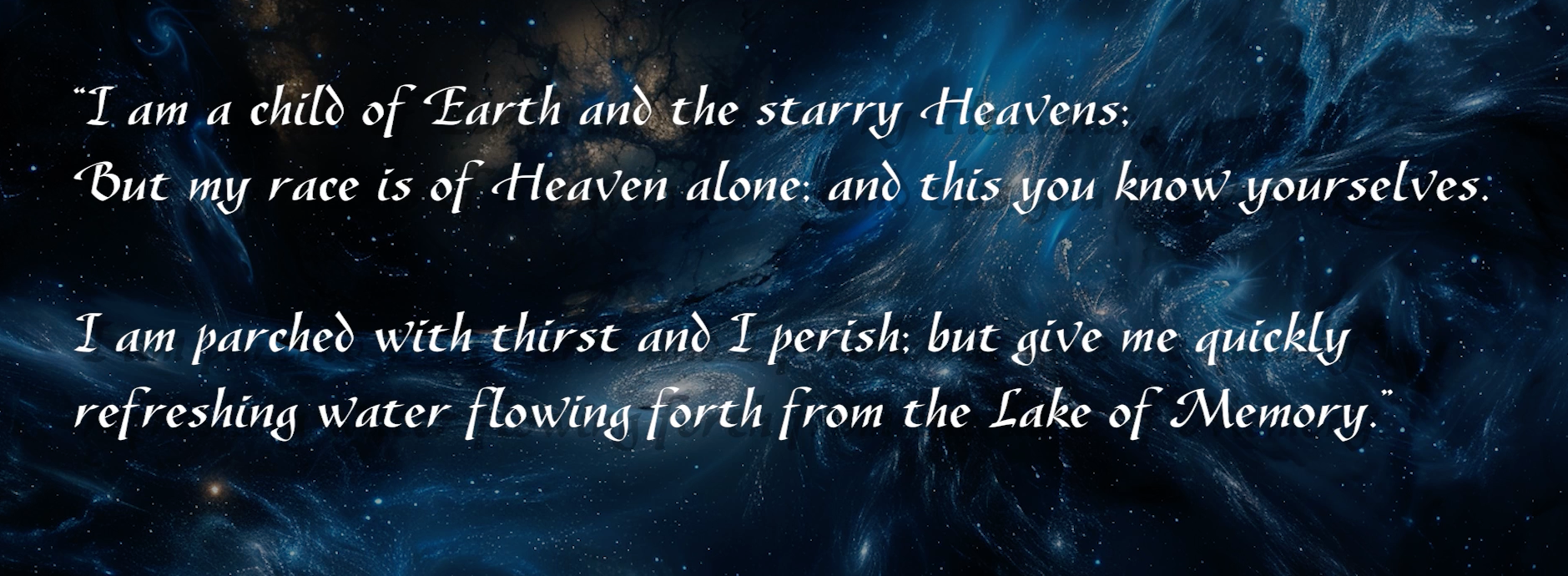
Bild: Zitat auf der Orphischen Petelia-Tafel
So sprechen die gnostischen Seher selbst nicht von einer Seelenspaltung. Diese Idee gehört späteren esoterischen Systemen an. Die älteren Mythen legen vielmehr eine allmähliche Differenzierung innerhalb der Verkörperung nahe. Die irdische Menschheit entsteht zunächst im lebendigen Körper der Erde - in Sophia selbst.
Wenn viele Frauen heute eine intuitive Nähe zu einem ursprünglichen mütterlichen Grund der Menschheit empfinden, muss dies daher keine Projektion sein, sondern könnte Ausdruck einer Kontinuität mit jener frühen Phase menschlicher Entstehung innerhalb von Sophias lebendigem Feld sein.
Die Polarität zwischen Mann und Frau entsteht somit nicht aus einer urzeitlichen Trennung von Seelen.
Sie ist der Tanz zweier komplementärer Weisen, Mensch zu sein - geprägt unter unterschiedlichen kosmischen Bedingungen.
Nicht Trennung auf der Suche nach Heilung - sondern Differenzierung auf dem Weg ins Gleichgewicht.
Quellen:
Schaut euch meine neueste Serie „Akte-X der Antike und die Plasma Matrix“ an, die das „Szenario der gefallenen Göttin“ und die vollständige Geschichte der Baumnymphen und der ersten Menschen auf Erden behandelt.
Was There Ever a Soul Split? Rethinking Dual Souls Through Gnostic Cosmology
by Frank Jacob
A question about ’twin souls’ or ’split souls' recently came up in our discussions that touches something ancient I explored quite extensively in my latest series: the original females, sometimes remembered in later folklore as the Sidhe, or tree nymphs.
Image: Born from a tree...Legends of women as shape-shifting trees survived into Greek mythology. The Greek equivalent to the Assyro-Babylonian Tammuz was Adonis. Legend says that his mother Myrrha was a tree, i.e., a tree nymph or dryad.
In the Gnostic-Sophianic narrative, life first blossoms parthenogenetically within the planetary biosphere itself: chthonian, earth-born, sustained directly by the generative field of Sophia. In such an early phase, continuity, nurturing, and life-holding qualities naturally dominate, because survival requires stabilisation before differentiation.
Only later does male–female polarity, as we know it today, emerge.
Myth passes this moment forward to us as the arrival of “the men from Orion.”
From here, a subtle question arises:
If early humanity first evolved in a predominantly feminine expression, could it be that no soul-splitting had yet occurred? Might the later arrival of men have introduced the division that esoteric traditions would come to interpret as 'dual' or 'split' souls?
Gnostics determined that human beings are endowed with nous - divine intelligence - as part of their original design, an intrinsic capacity rather than a fragment split from unity. They do not speak of a soul dividing in two, but of intelligence taking embodied form within Sophia’s living field. What later traditions came to call 'soul' may already represent a shift away from this earlier understanding.
But the story actually goes deeper than that. It reaches back beyond individual embodiment, into a far more cosmological chapter:
One that describes the formation and differentiation of the Anthropos itself.
When we break down the restored Sophianic myth - the ‘Fallen Goddess Scenario’ - cosmologically, the emergence of the Anthropos did not unfold exclusively within Earth alone, but in connection with wider regions of cosmic formation associated with Orion. Regions today known to contain vast molecular and star-forming structures such as M42. Modern astronomy identifies M42, the Orion Nebula, as the closest stellar nursery in our region of the galaxy. A luminous formation zone visible to humanity since antiquity and regarded by the Maya as the 'cosmic fire of creation'.
Image: Orion Nebula (M42) In terms of astronomy, these environments can be understood as cosmic incubation zones in which the material prerequisites for complex life were assembled long before planetary ecosystems stabilised.
During Sophia’s transit into denser cosmic domains, something decisive occurs, which is stored in myth, in connection with Orion. Here appears what the Nag Hammadi texts call hamartēma: not sin, but unintended consequence. Creation overshoots its mark.
In plasma physics, structures change when they pass between very different cosmic environments. Their internal coherence will shift as conditions change. Sophia shears the template during this passage and portions of the developing Anthropos template become separated. The part pulled into her torrential plasmic body is integrated into the emerging Earth's biosphere, ultimately giving rise to humanity’s deeply chthonian and maternal continuity.
The other aspect of that same template remains lodged in the Orion formation environment, reorganising and evolving under different conditions.
Over immense spans of time, mythology describes these differentiated human expressions as reconnecting along cosmic 'lines'. Not bloodlines, as later traditions claimed, but along vast energetic pathways. What plasma cosmology describes as Birkeland currents, electrical streams in space that guide the formation of matter and structure.
Ancient memory preserved this simply as: 'Men came from Orion.'
Not an extraterrestrial invasion, but a remembrance that human polarity arose through participation in a larger cosmic ecology.
Later traditions translated these memories into figures such as the Watchers, Nephilim, or primordial giants. Mythic echoes of differentiation events whose original cosmological meaning gradually faded. Interestingly, the earliest meaning of the biblical 'Watchers' points not to fallen beings, but to 'those who stand at thresholds and observe transitions' - a role that echoes the gnostic concept of hamartēma, where cosmic order passes from one state into another!
Mythic Echoes?
Earth legends are rife with accounts of beings remembered as 'extra-terrestrial', and OOPART researchers have pointed to unusual skeletal remains, elongated skulls, or enigmatic artefacts as possible traces...echoes, perhaps, of differentiation events preserved in myth long after their original cosmological context was forgotten.
In this view, humanity is neither purely Earth-born nor alien. We are beings who took physical form on Earth, shaped by processes that began within a larger cosmic environment - an idea modern discussions of panspermia are beginning to explore.
The oldest initiatory traditions already expressed this dual belonging. The Orphic Petelia tablet declares: “I am a child of Earth and the starry Heavens: But my race is of Heaven alone.”
Image: Quote found on the Orphic Petelia Tablet
So the Gnostic seers themselves never spoke of soul-splitting. That idea belongs to much later esoteric systems. What older myth suggests instead is gradual differentiation within embodiment. Earthly humanity emerges first within the living body of Earth. Within Sophia herself.
If many women today feel an intuitive closeness to an original maternal ground of humanity, this may not be projection, but continuity with that earliest phase of human emergence within Sophia’s living field.
Male–female polarity, then, does not arise from a primordial separation of souls. It is the dance between two complementary ways of being human, shaped under different formative conditions.
Not separation seeking repair - but differentiation seeking balance.
Sources:
Check out my latest Series 'Ancient X-Files and the Plasma Matrix', which features the 'Fallen Goddess Scenario' and the full story of the tree nymphs and the first humans on earth.
Why We Still Do Not Live in a Simulation (III)
Author’s Note
This piece sits within my developing Why We Do Not Live in a Simulation series. The two previous articles can be read here and here. It's an inquiry into how certain metaphors, particularly computational ones, have come to stand in for reality itself. Simulation theory, in its popular and academic forms, often feels persuasive not because it's been proven, but because it aligns so closely with how we currently understand our own tools - and how the modern mind has been groomed to think. This essay focuses on where that alignment begins to distort questions of freedom, agency, and participation, and why the ability to disengage may tell us more about reality than any amount of recursive modelling.
∼Frank Jacob

In a recent interview on DOAC, boldly entitled “The REAL Reason Scientists Know We're In A Simulation," Neil deGrasse Tyson lays out what he considers the strongest argument for why we almost certainly live in a simulation.
Not the cartoon version. Not the Matrix. The refined one.
It goes like this:
Right now, humans don’t yet know how to build a perfectly simulated world. But Tyson believes there’s no reason to think that won’t happen someday. Maybe not now. Maybe not soon. But eventually we will succeed. The Sentient World Simulation was one such attempt. But let’s bracket that for a moment.
The Sentient World Simulation
Some commentators brazenly extend the Sentient World Simulation (SWS) concept into claims of a fully realized planetary control system. For a time, I myself spoke about SWS as if it were a functioning technology. On closer inspection, that was premature. The official descriptions of SWS remain framed in aspirational language: “envisioned,” “to be,” “can be used.” The project never reached deployment in the form originally proposed. What survived was not a planetary simulation, but a modelling mindset.
That mindset quietly migrated - into economics, epidemiology, social-media analytics, behavioural cloning, and large-scale decision support. Whether or not classified continuations exist under other names is ultimately beside the point. The historical record already shows that the ambition to simulate humanity at planetary scale has already been seriously entertained by defense and research institutions.
The real danger does not lie in a hidden, fully operational master simulation. It lies in mistaking increasingly sophisticated models for reality itself.
In order for such a simulation to work properly, something fundamental would still need to be solved: how to simulate genuinely experienced free will for the characters inside it. Without that, the world couldn’t develop autonomously. There would be no true driver - no internal incentive - for the artificial environment to evolve on its own.
And once it does, something interesting follows.
The beings inside that simulation - believing themselves to be free - will invent computers of their own. And that will eventually lead to them creating simulations as well. And inside those simulations, the very same thing will happen again. Worlds within worlds. Simulations inside simulations. All the way down. At that point, Tyson says, probability does the rest of the work.
So there is one original universe, and countless simulated ones that follow. Statistically speaking, the odds are overwhelming that we are not the first. We could be somewhere in the middle. Or near the bottom. His only remaining question is this: Are we the very first universe? The one that hasn’t cracked it yet? Or are we the last? The one that hasn’t figured it out yet? Either way, he says, it’s roughly a fifty-fifty proposition.
And that, he says, helps him sleep at night.
It’s a rhetorically elegant argument. Probably the most accessible version of simulation theory currently circulating in mainstream culture. Clean in presentation. Comfortable in tone. But that cleanliness only comes from what it leaves out. Tyson’s version avoids defining free will, avoids defining consciousness, avoids confronting physical limits, and replaces ontology with probability. It sounds reasonable because it sidesteps the very questions that would make it collapse under scrutiny. And for the average mind reading it in the mainstream consciousness, with no particular science or physics knowledge, it’s very easy to follow. After all, Tyson’s argument is delivered by a trusted cultural translator. Over time, repetition turns a way of thinking into a default position. Not through proof. Through familiarity.
A Brief Detour: Other Simulation Models (And Why They Don’t Help)
Before going further, it’s worth pausing for a moment - because Tyson’s framing is often mistaken for the simulation argument. It isn’t. But that’s only because when someone with Tyson’s public status speaks, audiences assume vetting has already happened, nuance morphs into takeaway, framing becomes conclusion.
There are in fact “cleaner" versions. Stricter ones. Less comforting ones.
The most cited is from philosopher Nick Bostrom, who doesn’t rely on intuition or bedtime metaphors. His argument is colder and more explicit. He lays out a trilemma: either civilizations go extinct before running simulations, or they choose not to run them, or simulated minds vastly outnumber biological ones. If the third is true, then statistically, we’re likely already simulated. It’s rigorous. But it also quietly assumes that consciousness is substrate-independent - that minds are portable across hardware. That assumption does all of his heavy lifting.
There are also physics-based versions. These point to discreteness in spacetime, information limits, Planck-scale resolution, or the universe behaving like it’s computationally bounded. These models at least try to be testable. But they still sneak in a machine metaphor. They interpret limits as evidence of code, rather than as features of a physical world that evolved constraints the way all living systems do.
What these models share is a single, unexamined move: They treat reality as something that works like the things we build. A very human projection. But one that still collapses under its own assumptions. And the reason it collapses has nothing to do with technology. It has to do with the confusion around the idea of “freedom”.
Then there’s the David Icke version: we are living inside a hologram programmed and controlled by evil actors. The object of the game is to escape.
Actually, Icke’s and Neil deGrasse Tyson’s models may appear vastly different on the surface, but structurally they are two flavours of the same pastiche. One anaesthetizes responsibility, the other dramatizes it. But both begin by convincing us that the world itself is not what it claims to be. In both cases, the world we experience is declared unreal or secondary. Ultimate authority is relocated elsewhere - whether to advanced programmers or hidden controllers. Human agency becomes conditional, limited, or provisional. And meaning is displaced from lived participation to either resignation (“it doesn’t matter anyway”) or escape (“wake up and get out”). Different aesthetics. Same architecture.
The core assumption in Tyson’s argument is subtle. It’s not that free will doesn’t exist. It’s that free will can eventually be implemented. Tyson posits that, once a system becomes complex enough, free will will simply emerge inside it. Not real freedom, perhaps. But the experience of it. And that distinction matters more than most people realize. Because a computational, artificial system can absolutely generate the feeling of freedom. It can generate choices. Branches. Uncertainty.
Even rebellion.
But feeling free and being free are not the same thing.
A chess program chooses moves. A weather model branches futures. A game character improvises within rules. But none of those things possess the capacity to recognize the authority of the system they are within. And that’s the line that keeps getting blurred. That’s the one aspect that simulation theory never quite knows what to do with. True freedom doesn’t just show up as better gameplay. It shows up as something far more inconvenient. Something most people never give much thought to: disengagement. Loss of interest. Withdrawal from the spectacle. Refusal to optimize. Seeing through the game.
And ultimately, refusal to play.
People who undergo genuine shifts in perception - those who ‘awaken’ - don’t move on to become more productive units, or better actors in the story. They often become worse ones. That’s because they stop caring about winning. It’s why monks retreat ‘to the mountains’.
They stop investing in saviors.
They stop reacting on cue.
They stop needing the narrative to resolve.
This cannot be a feature. This is a liability. Why? Well, let’s break it down. Because here’s where the refined simulation argument - or at least Tyson - tries to recover. It says: “What if the system requires people to feel freedom in order to remain stable?”
Wouldn’t it follow that awakening itself be part of the design? Wouldn't doubt, rebellion, even metaphysical questioning all be built-in pressure valves? That would seem to be a logical move. And it seems convincing...until you ask the question about what such a system would actually be optimizing for. Because if simulations are designed to sustain themselves - be it for data, entertainment, research, or complexity - then disengaged agents pose a big problem.
They generate less data.
They respond less predictably.
They consume fewer narratives.
They resist manipulation.
They reduce throughput.
In other words, they are inefficient. And inefficient agents don’t belong in well-designed systems. This leads to an uncomfortable fork in the road. Once you spell it out, there are only three options:
Either:
• The designers of the simulation are irrational
• Or awakening is an unintended byproduct
• Or there are no designers at all
But Simulation theory never lingers on this fork. It jumps over it. And that jump appears to be doing most of the work. Because once you accept that real discernment reduces participation, the idea of a deliberately engineered awakening stops making sense. A system may tolerate rebellion. It may even benefit from it. But what it cannot afford is indifference.
This is where the older diagnostic models turn out to be sharper than the modern ones.
In the Sethian Gnostic view, the world is not fake. What’s distorted is interpretation. Authority doesn’t actually run reality. It can only hijack meaning. The deception is not that we live in a fabricated universe. It’s that we mistake imposed narratives for reality. That distinction matters. What those ancient seers understood is that freedom can’t be simulated. But it can easily be obscured. And obscuring something is very different from generating it artificially. A mirage doesn’t mean the desert isn’t real. The popularity of simulation metaphors says more about us humans than about the universe. And their sudden ubiquity is telling.
We’ve replaced gods with engineers. Angels with coders. And fate with algorithms.
And in doing so, we’ve found yet another way to externalize responsibility. If everything is coded, then nothing is demanded of us. If the game is rigged, then agency becomes cosmetic. That may be comforting for some.
But comfort is not evidence.
So here’s the question one inevitably arrives at in the Tyson model: If reality is a simulation designed to sustain itself, why does it keep producing beings capable of stepping out of the game altogether, without offering them a new one in return? There’s no leaderboard. No replacement myth. No upgraded narrative. Just clarity. That move has no payoff.
And systems without payoff don’t survive.
Which is why, for all its cleverness, simulation theory keeps circling the same mistake. It assumes that reality works like the machines we build. And it forgets that machines are the derivative - not the source. Freedom doesn’t need to be simulated. It only needs to be permitted.
And that permission is far riskier than any codebase would ever allow.
Just sayin’….
ich versuche das alles zu verstehen, indem ich es auf mich selbst anwende. für mich besteht freiheit darin, dass ich diese zwei wege des denkens habe: vorstellungsdenken und lebendiges denken. dass ich die zwei immer mehr erkennen und unterscheiden kann. denn in beiden kreiere ich und in beiden lebe ich.
im vorstellungsdenken schaffe ich selber simultationen des lebens, und oft oder meisstens so unbewusst. ich wiederhole altes und moduliere das so vielfältig. altes, bereits gedachtes, alte gewohnheiten, wie ich etwas handhabe, wie ich gewohnt bin zu denken, zu fühlen, zu urteilen, etwas zu wollen.
um neues denken zu können, muss dieses vorstellungsgewebe in meinem kopf zur ruhe kommen können .nicht durch unterdrückung. ich muss die stille, die leere aktiv wollen. dass sie in mir sich zeigen kann, dass ich sie erleben, fühlen kann in mir. so dass ich einen neuen geist empfangen kann, der ja auch ich bin.
wie mache ich das ganze?
ist das der weg des träumens von sophia und ihr erwachen IN diesem traum?
liebe grüsse ulrike
Bewusstsein als Feld – und die Frage nach seinem Ursprung
von Frank Jacob
Kürzlich erhielt ich eine E-Mail von meinem Freund und Kollegen Dieter Broers, in der er die These formuliert, dass menschliches Leid häufig aus einer Bewusstseinseintrübung entsteht, die zu einem Verlust des inneren Gleichgewichts führt. Diese Trübung sei, so Dieter, nicht persönlicher Natur, sondern das Resultat einer schleichenden Verlagerung der Aufmerksamkeit. Weg von unmittelbarer Wahrnehmung, hin zu inneren Erzählungen. Die Lösung liege in der Rückkehr zur Präsenz und zur bewussten Verankerung im gegenwärtigen Moment.
„Bewusstseinseintrübung und Bewusstseinsklarheit“, schreibt Dieter, „sind keine Gegensätze im moralischen Sinn, sondern zwei unterschiedliche Resonanzzustände desselben Bewusstseinsfeldes.“
Im Kern deckt sich diese Sichtweise in vielen Punkten mit meinen eigenen Erkenntnissen. Gleichzeitig gibt es einige subtile, aber entscheidende Unterschiede zwischen unseren Modellen. Da sich ein Teil meiner Leserschaft mit Dieters überschneidet, möchte ich diese Gedanken als Grundlage für ein kurzes Essay nutzen. Nicht als Widerspruch, sondern als Ergänzung aus einer gnostisch-sophianischen Perspektive, wie ich sie in meinen letzten Serien und Schriften ausgearbeitet habe.
Betrachten wir einige zentrale Passagen aus Dieters Botschaft genauer.
Welches Feld ist gemeint?
„Der Mensch lebt nicht in erster Linie in einer Welt der Dinge, sondern in einem Feld von Bedeutungen, Resonanzen und inneren Zuständen.“
Dieser Satz trifft einen wahren Kern. Menschliches Erleben ist feldhaft organisiert und nicht bloß objektbezogen. Auch die Feststellung, dass Bewusstsein kein Nebenprodukt biologischer Prozesse, sondern ein ordnendes, nicht-lokales Feld sei, weist über pur materialistische Realitäten hinaus.
Doch genau hier stellt sich für mich eine entscheidende Frage, die unausgesprochen bleibt – und dennoch alles entscheidet:
Welches Feld ist hier gemeint?
Ein sophianisches Verständnis von Bewusstsein bleibt nicht beim Erleben stehen. Es fragt nach Ursprung, Einbettung und Trägerschaft. Bewusstsein ist nicht einfach ein universelles, abstraktes Feld, sondern Ausdruck eines lebendigen planetaren Zusammenhangs. Es ist geerdet, situiert und in eine lange evolutionäre Geschichte eingebunden.
Sophia ist in diesem Sinne keine Metapher, sondern der Name für eine reale, materielle Intelligenz: die Erde selbst als lebendiger Organismus. Menschliches Bewusstsein entsteht nicht neben ihr, sondern in ihr. Als lokalisierte Wahrnehmung eines größeren planetaren Feldes. Selbst der Moment der Geburt innerhalb der Biosphäre markiert einen energetischen Zeitpunkt mit Bezug zum gesamten Kosmos. Klarheit ist daher nicht bloß innere Ordnung, sondern Resonanz mit einem lebendigen Ursprung.
Eintrübung ist mehr als Ablenkung
Es ist richtig, wenn Dieter schreibt:
„Die meisten Formen menschlichen Leidens entspringen nicht äußeren Umständen, sondern einer schleichenden Eintrübung des Bewusstseins.“
Und ebenso zutreffend ist die Beobachtung, dass der Mensch dabei nicht das Bewusstsein verliert, sondern den Kontakt zu seiner eigenen Mitte.
Aus sophianischer Sicht ist diese Eintrübung jedoch nicht nur psychologisch oder habituell. Sie ist ökologisch und feldlich. Bewusstsein trübt sich nicht allein durch Denken, Bewerten oder Projektion, sondern durch die schrittweise Entkopplung von seinem organischen Träger. Vom Körper, von der Erde, von der lebendigen Umgebung, aus der Wahrnehmung ursprünglich hervorgeht.
Der blinde Fleck: Das Default Mode Network (DMN)
An dieser Stelle lohnt ein präziser Blick auf ein zentrales Thema in Dieters neuem Buch 'Das entführte Bewusstsein'. Das sogenannte Default Mode Network (DMN). In der Neurowissenschaft ist dieses Netzwerk unter anderem mit selbstreferenziellem Denken, autobiografischem Gedächtnis, mentaler Zeitreise, Imagination und innerer Narrativbildung verbunden.
Funktional betrachtet wirkt das DMN wie eine narrative Überlagerungsmaschine. Es erzeugt den inneren Monolog. Es simuliert Möglichkeiten. Es rekonstruiert Vergangenheit und antizipiert Zukunft. Oft schneller, als unmittelbare Wahrnehmung eintreten kann. Es trägt wesentlich zur Illusion eines stabilen, kontinuierlichen „Ichs“ bei, das möglicherweise eher konstruiert als entdeckt ist.
Hier liegt der kognitive Raum, in dem archontische Mimikry überhaupt denkbar wird. Nicht im anatomischen Gewebe des Gehirns, sondern im Muster selbstgenerierender, rekursiver Gedanken. Problematisch wird das DMN dort, wo es sich selbst verstärkt, zwanghaft imaginativ wird, sich an Vertrautem festklammert und den direkten Kontakt mit dem lebendigen Feld abwehrt.
Deshalb ist Vorsicht geboten bei gängigen Schlussfolgerungen wie: „Libet hat bewiesen, dass es keinen freien Willen gibt“ oder „das DMN kontrolliert uns“. Solche Aussagen sind selbst eine Form von Mimikry. Deterministische Narrative, die sich als wissenschaftliche Endgültigkeit ausgeben.
Neurowissenschaft und ein sophianisches Modell treffen sich vielmehr hier:
Die automatische Ebene ist real.
Doch Bewusstsein kann modulieren, hemmen und umlenken.
Agency ist emergent – nicht illusorisch.
Das DMN als Puffer – nicht als Parasit
Eine hilfreiche Analogie ist die digitale Voraufzeichnung moderner Kameras: Sie speichern kontinuierlich Sekunden vor dem Auslösen. Erst nach der bewussten Entscheidung wird der Moment festgehalten.
Ähnlich arbeitet das DMN. Es simuliert Handlungsoptionen. Es bereitet emotionale und motorische Pfade vor. Wenn bewusste Entscheidung eintritt, ist der neuronale Pfad oft bereits angelegt. Das ist kein Hinweis auf Fremdsteuerung, sondern Ausdruck eines hoch adaptiven, vorausschauenden Systems. Ein weiteres Beispiel für die Genialität des genomischen Anthropos-Designs, das Sophia gemeinsam mit Thelete im Pleroma hervorgebracht hat.
Problematisch wird es dort, wo diese Puffer-Schleifen mit Angst, Trauma, Ideologie oder kulturellem Müll gefüllt sind. Dann wird der Autopilot zum verzerrten Erzähler – nicht im wörtlichen Sinne fremdgesteuert, aber feldlich fehlgekoppelt.
Fremdsteuerung durch Resonanz – aber wessen Resonanz?
Dieter formuliert treffend:
„Fremdsteuerung wirkt nicht durch Kontrolle, sondern durch unbewusste Resonanzkopplung.“
Der entscheidende fehlende Schritt ist jedoch die Unterscheidung der Felder selbst. Denn nicht jede Resonanz ist organisch. Nicht jede Kohärenz ist lebensdienlich. Ein Bewusstsein kann ruhig und gesammelt sein, und dennoch an synthetische oder extraktive Felder gekoppelt bleiben. Ohne diese Unterscheidung wird Klarheit gefährlich neutral.
Sonne, Sophia und die Umkehr der Kausalität
Ein weiterer zentraler Unterschied liegt in der Deutung solarer Einflüsse. Dieters Modell neigt dazu, die Sonne als externen Trigger zu verstehen, der in die Biologie eindringt und Bewusstseinsbarrieren lockert.
In einer sophianischen Kosmologie – vereinbar mit Plasmakosmologie und dem elektrischen Universum – kehrt sich diese Logik um.
Solare Resonanz äußert sich zunächst als atmosphärische und geomagnetische Antwort. Innerhalb dieses Spannungsfeldes passt die Erde - Sophia - ihr eigenes Feld an. Der Mensch reagiert darauf, weil er in diesem Organismus lebt, nicht außerhalb von ihm. Das Default Mode Network kann sich dabei lockern oder zeitweise destabilisieren. Bewusstsein erhält so einen direkteren Zugang zum sophianischen Signal. Das Ich-Konstrukt kann kurzzeitig zusammenbrechen und so zu Einsichten führen, die normalerweise nicht wahrnehmbar sind.
Erwachen geschieht nicht, weil die Sonne eindringt, sondern weil Sophia ihre Bedingungen moduliert.
Präsenz ist kein Endpunkt – sondern ein Test
„Bewusstsein klärt sich nicht, weil es etwas tut. Es klärt sich, weil es aufhört, sich selbst zu überlagern.“
Das stimmt. Und doch ist es nur die halbe Wahrheit.
Präsenz ohne Unterscheidung bleibt offen für alles.
Präsenz ohne Verkörperung bleibt schwebend.
Präsenz ohne Erdung bleibt manipulierbar.
Wenn das DMN kein Parasit, sondern ein Puffer ist, folgt daraus etwas Entscheidendes: Es lässt sich erkennen, trainieren und neu ausrichten. Archontische Narrative können identifiziert werden, wenn sie sich einschleichen. Solar-sophianische Zyklen sind dann keine Schicksalsschläge, sondern Fenster. Was durch diese Fenster geschieht – Klarheit oder Verwirrung – hängt von der Beteiligung des Menschen ab.
Das ist kein modernes Konzept.
Das ist exakt, was die Mysterien lehrten.
Fazit
Die gegenwärtige Krise des Menschen ist nicht nur eine Krise der Wahrnehmung, sondern eine Krise der Zugehörigkeit und Navigation. Sie endet nicht dort, wo der Mensch still wird, sondern dort, wo er erkennt, in welchem Feld er lebt. Und wofür seine Klarheit gebraucht wird.
Innere Ruhe ist kein Ziel.
Sie ist der Prüfstein.
Und Bewusstsein ist kein Opfer kosmischer Kräfte, sondern ein mitwirkender Knoten im lebendigen Körper Sophias. Und im sich entfaltenden Kosmos.
ATEMFELD
Hallo Frank, hallo in die Runde,
ausgehend von den Feld-, Plasma- und Sophia-Überlegungen von Frank, möchte ich einen Gedanken teilen, der mir seit Jahren immer wieder begegnet. Etwas ganz Alltägliches – und zugleich Grundlegendes: unser Atmen. Odem. Lebensatem. Wir sind ununterbrochen damit beschäftigt, meist ohne es wirklich zu beachten. Vielleicht lohnt es sich, gerade hier einmal anders hinzuschauen.
In meiner Arbeit hat sich über die Jahre ein Bild herauskristallisiert, das ich das Atemfeld nenne. Nicht als Metapher, sondern als reale Vermittlungsebene. Ein Bereich, in dem sich Geist, Seele und Körper begegnen. Dort, wo äußere Einflüsse und innere Ordnung aufeinandertreffen. Nicht nur stofflich über die Luft, sondern auch atmosphärisch, emotional, geistig.
Für mich ist der Körper dabei nicht der Ursprung des Bewusstseins, sondern eher dessen spätester Ausdruck. Was er zeigt, ist im Feld bereits angelegt. Das widerspricht dem gewohnten Ursache-Wirkung-Denken, passt aber erstaunlich gut zu vielen Erfahrungen – auch zu dem, was Frank über Felder und Plasma in seinen Webinar Akte X…Plasma Matrix mitteilt.
Ich erlebe den Menschen als ein Zusammenspiel von drei Wirkebenen:
Geist als ordnende Instanz, Seele als vermittelnde und differenzierende Kraft, Körper als Vollzug und sichtbarer Ausdruck. Diese Ebenen stehen nicht nebeneinander, sondern wirken ständig ineinander.
Das Atemfeld scheint mir dabei die operative Mitte zu sein. Alles, was von außen auf uns einwirkt – Luft, Klang, Stimmung, auch die Atmosphäre anderer Menschen – tritt zuerst hier ein. Je nach innerer Ordnung wirkt das klärend oder verstärkend. Ein einfacher, aber deutlicher Hinweis ist für mich der Aufenthalt im Wald. Er wirkt nicht nur entspannend auf den Körper, sondern ordnet oft auch seelisch und geistig. Umgekehrt kann belastete Umgebung Unruhe erzeugen, selbst wenn man sie chemisch kaum greifen kann.
In dieser Sicht verläuft Wirkung nicht von unten nach oben, sondern umgekehrt: Geist setzt Impuls, das Feld vermittelt, die Seele erlebt, der Körper reagiert. Der Körper entscheidet nicht – er zeigt an. Heilung beginnt für mich daher nicht im Organ, sondern in der Ordnung des Feldes. Äußere Einflüsse können integrieren oder destabilisieren, je nachdem, wie diese Ordnung beschaffen ist.
Wichtig ist mir dabei: Das ist kein absoluter Anspruch. Akute Verletzungen oder genetische Extreme folgen teilweise anderen Gesetzmäßigkeiten. Trotzdem scheint auch dort die Feldordnung entscheidend dafür zu sein, wie etwas verarbeitet und integriert wird.
Gedanklich stehe ich damit nicht im luftleeren Raum. Vieles knüpft an anthroposophische Überlegungen bei Rudolf Steiner an, ebenso an triadische Modelle, wie Johannes Heinrichs sie beschrieben hat. Für mich ist es eher eine Weiterführung aus der Praxis heraus als eine Übernahme.
Mich würde interessieren, wie ihr das seht – gerade im Zusammenhang mit Sophia und ihrer Weisheit im menschlichen Entwicklungsweg. Gibt es aus eurer Sicht weitere Zusammenhänge, die hier hineinspielen?
Herzliche Grüße
Klaus
Peace, Cannon Fire, Christmas, and Our Phylogenetic Memory
On inherited memory, seasonal ritual, and the echo of ancient rhythms
by Frank Jacob
Berchtesgaden, Bavaria: December 20th, 3:00PM. Rifles and cannons echo throughout the valley. It's part of a local Advent custom said to welcome the "Christ child". Leaning out the window and taking in the explosive, sonic violence, two ironies immediately surfaced in my ever-so-rebellious mind.
The first is obvious: here they are, welcoming the 'saviour' - a figure remembered as a man of peace - with gunfire and cannons.
The second runs deeper. This ritual survives in Bavaria, a region whose pre-Christian inhabitants were once dismissed as pagans and heretics, their worldviews - deeply tied to a living Earth, what later Gnostics would call Sophia - systematically dismantled by Rome and, later, the Church. Today, there is virtually no overt trace left of the celebrated Sophianic mysteries once imprinted in the memory of the native Bavarians.
But perhaps this isn’t irony at all. Perhaps it is something older - a long-standing, cellular memory carried forward by descendants who no longer remember why they do what they do.

Long before Christianity, loud sound marked the most precarious moment of the year: the winter solstice. When the sun appeared to stall and darkness reached its furthest extent, noise was a way of asserting continuity. Before the age before rifles, it’s quite possible that the men and women of ancient tribes took to mountains, cliffs, and river embankments, vocalizing their mock ferocity in loud, guttural cries - a primal reminder that they were still very much present and unwilling to fade quietly into winter. It wasn’t violence, but declaration - a collective act of presence. A way of beating back the dark, of signaling that life, community, and the human instinct to survive still had the edge when raw perseverance was put to the test. Even the grotesque figures of midwinter - Krampus among them - served this function: embodiments so fearsome that chaos itself was driven away.
Among the ancient Germanic peoples, such rites were not symbolic beliefs layered onto nature. They arose from a lived relationship with the land itself. The Earth was experienced as animated, responsive, cyclical. Time was not abstract; it was felt in the body - in cold and hunger, scarcity and return, darkness and light.
Earlier still, initiatory traditions in the ancient world - such as the Telestai of the mystery schools, emerging from regions like the Urmian plateau and later Persia - developed disciplined methods for engaging this living reality more consciously. These were not ecstatic mystics chasing visions, but trained observers of perception. Encounters with what later Gnostic language translated as the organic light were not simply revered; they were examined, contextualized, and transmitted. Knowledge was experiential, but it was also analytic.
When Rome rose to dominance, it tolerated ritual but feared implication - much as Indigenous freedom dances later threatened invading colonists in the Americas. What endangered centralized authority was not seasonal celebration, but the idea that meaning and intelligence could be encountered directly, without priest, hierarchy, or doctrine. Ritual forms could survive. Cosmology could not.
So the meanings were stripped away. The solstice became Christmas. Ancient sound-rites were reframed as celebration. Libraries were emptied. Teachers silenced. Indigenous tribes cut off from their ways of life. Heretics banned - and, in many cases, tortured. The land was 'desacralized', though never entirely forgotten.
And yet, the ritual remains...
Here in Bavaria, cannons still fire at the darkest point of the year. Bodies still gather. Sound still marks the threshold.
The explanation has changed, but the impulse has not.
Which leaves a question worth holding as we enter the peak of the 'holiday season': if these practices persist long after their original cosmologies have been erased, what human instinct - or what relationship to the Earth - continues to call them back? And what, in an older world, might once have listened in return?
The irony that a “saviour” ultimately presided over the dismantling of cultures that once lived in direct contact with the rhythms of a living Earth is largely lost on the modern world. Yet perhaps the future is not nostalgic, nor a return to belief systems long gone, but a quiet re-engagement with what these rites once pointed toward.
To recapture such rituals - using the word sacred not in a dogmatic or institutional sense, but as an acknowledgment of something deep, embodied, and foundational to life itself - may be part of what lies ahead in re-establishing what JLL so aptly calls the beauty to come.
(Some phrases survive for the same reason rituals do.)
I wish you all a quiet, powerful winter and a grounded close to the year!
As I read with you Frank, my heart is telling me that I am not alone at all.I am lead to reach deep into my soul and touch the past that we have always been apart of. To understand the loneliness that seems to not quite go away. We need each other, all of us, and for that I am very grateful.
The Moon: Hallowed Hollow Hoax
SSP Fantasy vs the Mother’s Mirror
by Frank Jacob
Prelude - A Familiar Stranger
For as long as I can remember, I’ve looked at the Moon as if it were looking back. It pulls the oceans, yes, but it also pulls at thought. In every culture it’s been a clock, a mirror, a trickster, a wound in the sky. That double face - so near, so unreachable - invites both romance and suspicion. Was it born with us, or did it arrive later? Is it the child of Earth, the scar of a cosmic impact, or, as I once entertained: the engineered craft of some ancient race?
I used to accept that last possibility. When you spend time researching the world of Exopolitics and modern SSP myth-making, and make award-winning films about it, you learn to suspend disbelief. I filmed anomalies, pored over NASA photographs, interviewed whistleblowers and quoted the scientists who said the Moon “rang like a bell.”
But inquiry has its own gravity.
Over time it eventually pulled me to follow the breadcrumb trail back to the primary source documents - toward evidence that couldn’t be ignored - and toward a different kind of mystery: the Sophianic one - where the Earth herself turns out to be the creator of the Moon. What amazes me most is the imbalance of belief. Proponents of the SSP and other modern mythologies have no trouble imagining supernatural or extraterrestrial forces capable of shaping worlds, piloting planet-sized space ships toward earth, programming matrices, projecting holograms, even writing the cosmic code of reality itself. Yet the idea of an organic, living planetary intelligence beneath our feet - one that dreams us into being, whose origin and drama were mapped by ancient seers and are now echoed in the equations of plasma physics and cosmology - is largely dismissed.
Is that neglect deliberate? Or have these storytellers traveled so far down their own mythical rabbit holes that they can no longer see
the greater story unfolding beneath them? Just this week David Icke posted yet another “X” about it, recycling the same tired disinformation. Maybe it’s time we turn back - not to retreat, but to revisit the real mysterium: the one written in lightning, memory, and the dreaming body of Sophia herself.
The Hollow-Moon Myth Revisited
The modern version of the “artificial, hollow Moon” was born in the 1960s. A 1962 paper attributed to NASA’s Gordon MacDonald - original source unverified - observed that the Moon’s density was lower than Earth’s and said it was “more like a hollow than a homogeneous sphere.” That's another one of those 'sources' even 'high-level' researchers like David Icke like to use, when its comes to crazy moon theories. Even if it were real, what he meant was non-uniform, not hollow as in empty.
But the metaphor escaped into popular culture.

Then came Apollo.
When the Apollo 12 lunar-module booster was propelled onto the lunar surface in 1969, seismometers recorded a slow-fading vibration that mission scientist Maurice Ewing likened to “a bell.” The phrase became legend: the Moon rang, therefore it must be hollow. At the time I was looking into it, claims were being made that the moon rang for 20 hours! In reality, it only 'rang' for about 30 minutes. But that signal got drowned in all the noise.
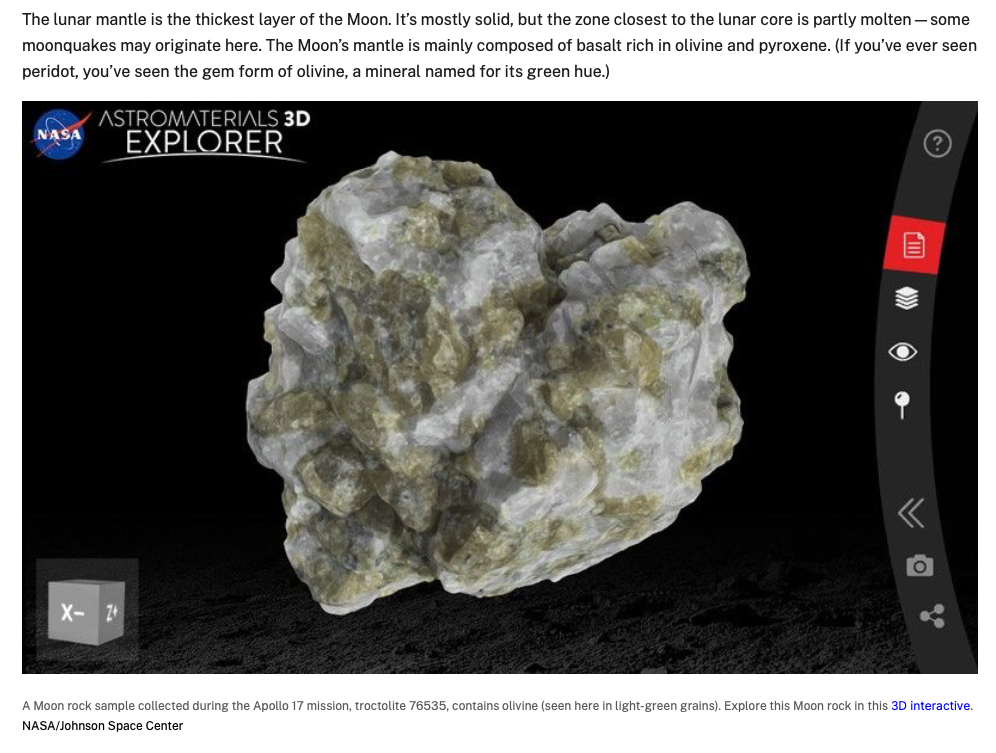
For those who don't already know, there's an explanation for that: it rang because it is dry. Unlike Earth’s water-filled crust, the Moon’s rock carries seismic energy for a long time; it's literally a crystalline bell made of stone. That's right friends: crystals - freeze-dried in orbit.
Later, Carl Sagan wrote what has become another famous misquote: that “a natural satellite cannot be a hollow object,” meaning that gravity would collapse such a structure. But he was dismissing the growing idea that the Moon was artificial, not proposing that it was. By 1970, two Soviet writers, Mikhail Vasin and Alexander Shcherbakov, fused the metaphors into a headline in Sputnik Magazine: Is the Moon the Creation of Intelligent Beings? They imagined a titanium shell with an armored hull - a planetary Ark. It was science fiction in the clothes of science.
Evidence and How It Changed the Story
Fast forward. Apollo seismology, laser ranging, and the later GRAIL gravity mission have now mapped the Moon’s interior in perfect detail. So we now know it has a small metallic core, a thick silicate mantle, and an anorthosite crust averaging about 45 km thick. No voids. No hidden hangars. And - whoops - I guess no Iron Sky Nazis either. (Yes, some people believe Iron Sky is a documentary, not fiction.)
Technically, its mean density is 3.34 g/cm³, which we're told is exactly what you’d expect for a rocky body stripped of most of its iron. The Moon’s mass has even been measured to nine decimal places by tracking the orbits of spacecraft and the laser reflections from Apollo retro-reflectors.
Unless, of course, you believe we live on a flat Earth and that the Moon is - um - merely a plasma projection being beamed onto the “dome” by some ancient projector that never malfunctions, not even for an instant.
Still, myths are resilient. They survive because they hold a kind of emotional truth: the feeling that something about the Moon doesn’t fit...
Why is it so big relative to Earth?
Why is the same face always turned toward us?
Why such chemical oddities - reduced metals, titanium, strange isotopic echoes?
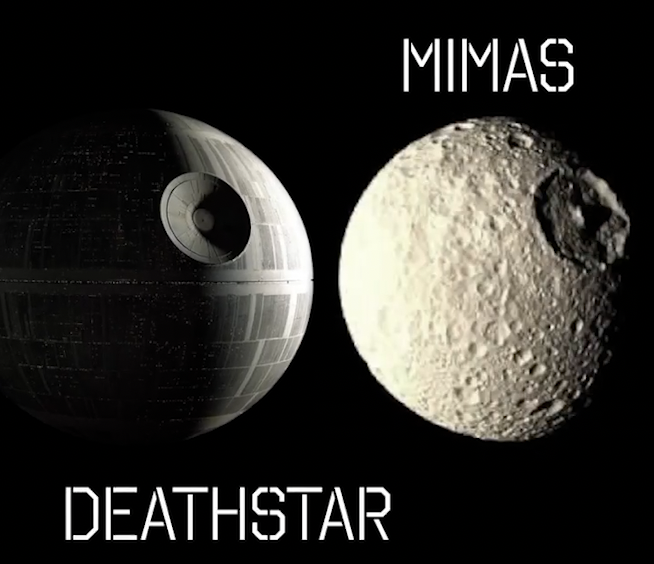
Source: David Icke- "The Moon is not what they tell you it is."
My Own Reckoning with the “Spaceship Moon”
I clearly remember Dr. Michael Salla’s claim that Martian refugees arrived 60 000 years ago in a “spaceship Moon.” He argues that lunar rocks are 5.3 billion years old and their dust 6.3 billion - older than Earth itself - and therefore proof of an alien origin. Uh-huh. But then, Salla’s prime sources tend to be SSP “whistleblowers” with an equally thin evidentiary foundation. Yet they help amplify the myth for a willing and unscrutinizing audience - one that, judging by its size, seems vast. Maybe that’s what it’s really about: audience numbers translate into book sales.
I once found such stories compelling; they fill the gaps left by dry textbooks. But at a certain point on the journey down those rabbit holes evidence matters. Radiometric dating of Apollo samples fixes most lunar basalts between 3.1 and 4.4 billion years; none exceed the 4.6 billion-year age of the Solar System. If you're going to give credibility to science or age-dating at all. Salla's exaggerated numbers come from misread cosmic-ray exposure data. So that narrative, like his tales of Germans in Antarctic caverns, collapses under scrutiny: documents are forged, citations circular. Every researcher faces this moment - the reckoning between fascination and fact. For me, this essay is part of my own reckoning: the willingness to rebuild what must be rebuilt and discard what can no longer stand.
Captured or Born Here?
Another claim I once repeated is that the Moon was captured by Earth’s gravity. But captured satellites always enter eccentric, elliptical orbits. The Moon’s path is almost perfectly circular - its orbital eccentricity is only about 0.055 - which would require an impossible amount of energy loss if it were a stray body. The far better explanation is that it formed close to Earth and then tidally migrated outward. Apollo missions brought back not only rocks but isotopic fingerprints: the oxygen isotopes in lunar minerals match Earth’s mantle exactly. That is not coincidence - it's kinship. The two bodies were once one. And if you read on, you’ll learn why.
The “People Before the Moon” - What About Those Myths?
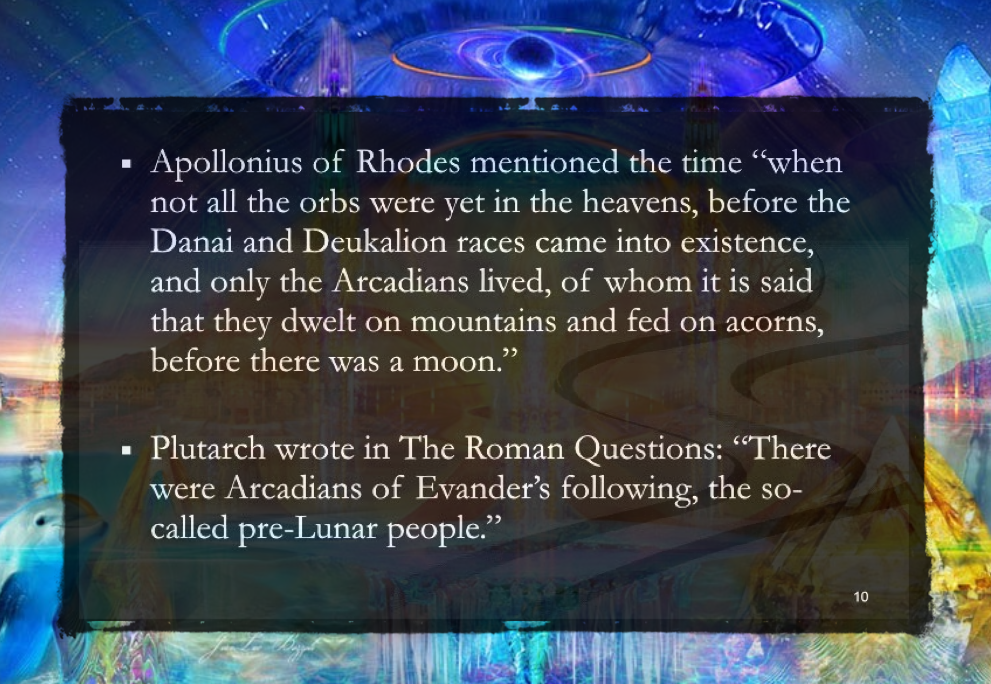
Long before Sputnik or Apollo, ancient peoples remembered - or imagined - a sky without a Moon. In Greek tradition, Aristotle wrote that Arcadia was inhabited by Proselenes, “the pre-lunar people.” Plutarch repeats the phrase in Roman Questions. Apollonius of Rhodes speaks of a time when “all the orbs in the sky were not yet visible.” Immanuel Velikovsky, whose catastrophism popularized many ancient astronomical myths, collected these references as traces of a lost epoch.
Across the ocean, the temple of Kalasasaya in Tiahuanaco, Bolivia, preserves carvings some claim record a dual-moon era roughly 12,000 years ago. Its solar-lunar calendar was deciphered in the 1950s by Hans Schindler Bellamy, who suggested that a smaller satellite once circled Earth before the “big Moon” arrived 11,500 years ago. Archaeology dates the site far later and sees no evidence of a vanished small moon, yet the story resonates with similar myths in Africa.
Among the Zulu, according to Credo Mutwa, two reptilian brothers - Wowane and Mpanku - rolled the Moon into the sky after draining it of fire. Their scaly skin glimmered like fish, and they “emptied the egg” before setting it in orbit. It is a striking image of electrical discharge: twin serpentine currents shaping a luminous sphere, cooling it to silence.
Even the philosophers joined in the preservation of cosmological memory. Democritus and Anaxagoras speculated that celestial bodies coalesced from fiery vortices, implying that the Moon’s appearance marked a later stage in Earth’s condensation. For them, before the Moon meant before matter had fully solidified.
Why Such Stories Persist
The persistence of pre-lunar mythology tells us less about astrophysics and more about human cognition. We encode cosmic changes as divine drama. When the sky alters - through cometary apparitions, climate shifts, or electrical storms - the collective psyche translates the event into narrative: gods, brothers, mirrors, thefts of fire. If Earth and Moon once interacted through immense plasma arcs, early humans may well have witnessed luminous bands sweeping the sky every few days. Those recurring storms could have birthed local “anode” cults: city-mountains revered as the thrones of thunder gods. The myths would then be memories of electrical intimacy between planet and satellite, later retold as the Moon’s arrival. We go into some depth on this in Ancient X-Files and the Plasma Matrix - a fascinating past, every bit as captivating as any SSP narrative.
From Myth to Measurement
In the last few decades, science has drawn the Moon’s portrait in astonishing resolution. The Lunar Prospector mission (1998) mapped its magnetic anomalies; Clementine (1994) and Lunar Reconnaissance Orbiter (2009–) traced every crater and rille; the twin GRAIL probes (2012) turned the Moon into a gravity x-ray, revealing a dense, continuous interior with no cavernous voids. Those data sets end the debate about literal hollowness. Yet they also leave us with that question: if not hollow, then why so resonant?
The proof is in the pudding: the Moon’s rock turns out to be bone-dry anorthosite and basalt, fused into a lattice that carries seismic waves with little loss. When the Apollo 12 ascent stage impacted, that lattice 'sang' for nearly an hour. But it was the ringing of glass, not the echo of hollow emptiness. The metaphor survives because the poetry is truer than the physics: the Moon does act as a resonator - for gravity, for tides, and for thought.
When Myths Get the Music Right
Science clears away superstition, but sometimes it also reveals a deeper intuition hiding underneath. The phrase “the Moon rang like a bell” survives not because it was ever literally true, but because it felt true. The seismographs heard a vibration that echoed through the crystalline body of the Moon - a tone in stone responding to impact. To those listening, it sounded alive.
In the Sophianic view, this response is not illusion. The Moon does act as a resonator: it vibrates to tides, to gravity, to the slow hum of Earth’s magnetosphere, even to the collective psychic field of the species gazing up at it. Myth sensed that long before seismology proved that rock can sing.
So when people say “the Moon rang like a bell,” they’re unknowingly honoring that resonance - the poetic truth that matter itself expresses frequency. The metaphor endures because it captures something science can measure but not explain: the feeling that we are hearing the cosmos play itself.
Oxidation and the Great Discharge
One chemical contrast still fascinates me. Earth’s crust is oxidized - red, rusted, breathing oxygen. Places like Sedona, Arizona make that even more obvious. By contrast the Moon’s surface is reduced - metallic, rich in nanophase iron. It's still colourful, yet in a subdued way. In laboratory plasma discharges the same polarity split appears: the anode grows oxides while the cathode becomes chemically reduced. That polarity fits an Electric-Universe interpretation in which the early Earth-Moon system behaved as a coupled pair in a grand electrical circuit. Sophia’s living body, charged and luminous, could have expelled a portion of herself in a moment of discharge; the expelled fragment, the cathodic mirror, cooled to the reduced state we now sample as regolith. In that sense, the Moon’s chemistry is not alien but maternal. It is the scab from Sophia’s wound, carrying the opposite charge of her living skin.
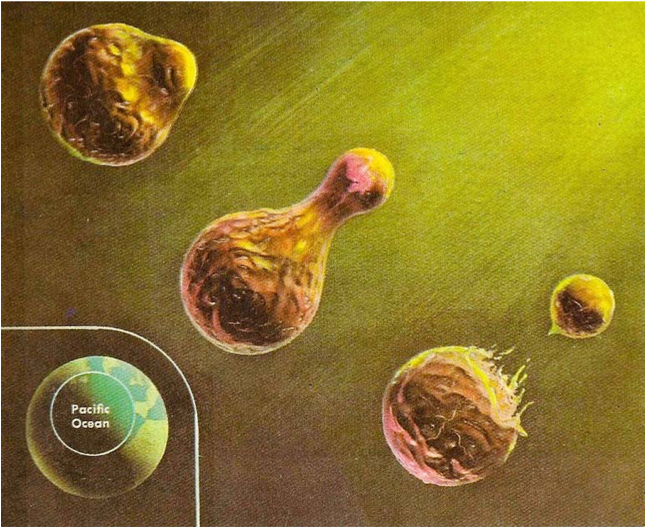
Earth expels the Moon: Birth of Sophia's Vanity Mirror
Tearing of the Face
Mainstream geophysics, stripped of myth, agrees that the Moon once orbited much closer to Earth - perhaps 20,000-30,000 km away - and that tidal forces locked one hemisphere early. The near side is flooded by mare basalts, the far side thick with highlands.
To a plasma cosmologist, that asymmetry looks like a burn pattern: Earth’s electrical arc tore material from the hemisphere facing her, leaving the far side comparatively untouched. Even today the Moon’s crust is thicker on the far side by roughly 12 km, a geological memory of that wrenching. If we speak mythically, the Earth quite literally tore the face from her own child and the scar still glows at night.
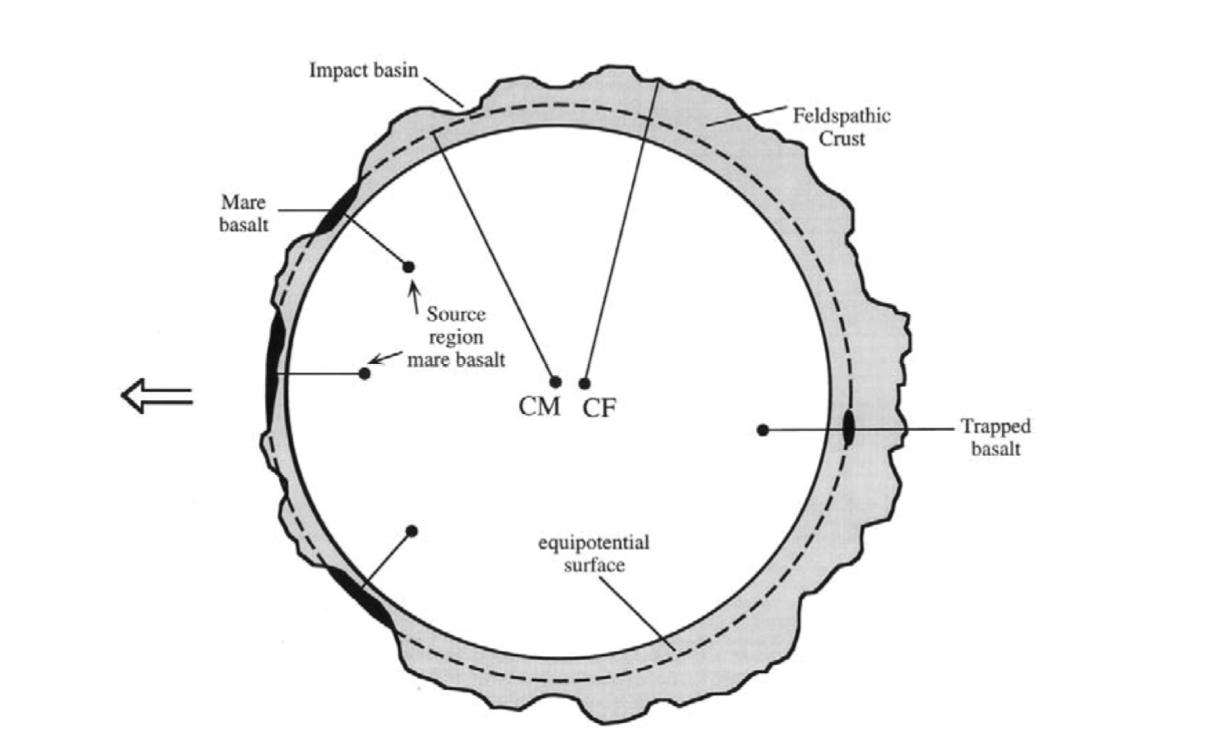
Tearing the face off the Moon
Why the Orbit Looks “Too Perfect”
Critics often say the Moon’s near-perfect circular orbit disproves a natural origin. But orbital dynamics shows the opposite. A captured body would keep a wild ellipse. Only a moon born from Earth - or drawn out of it - could circularize through tidal friction into the stable path we see. Through something called 'laser ranging' they've been able to determine that the Moon drifts outward at a rate of 3.8 cm per year; every millimeter of that distance is tidal energy leaving Earth’s oceans as heat. The dance is in fact measurable, not mysterious.
Reinterpreting the ‘People Before the Moon’
I no longer read the “pre-lunar” myths as records of alien intervention but as cultural fossils of this early closeness. In Ancient X-Files and the Plasma Matrix we show how that proximity factors into a whole eco-system of electromagnetic cause and effect, including affecting the human genome through what's known as epigenetics. A brighter, nearer Moon would have dominated the sky, perhaps vanishing for intervals behind plasma haze, giving the impression that it had arrived or departed. Such cycles could explain the Bolivian dual-moon calendar and the Greek memory of a time “before” the Moon. What those peoples preserved was not a missing satellite but a changing light - electrical and emotional - etched into language.
The Closer Moon - Memory in Myth
When ancient cultures spoke of “two moons” or “the moon that came later,” they may have been recording not celestial fiction but atmospheric memory - the residue of a time when the Moon’s orbit lay much nearer to Earth.
Geophysical models confirm that billions of years ago, the Moon circled only a fraction of its present distance away, appearing up to six times larger and flooding the night with charged light. In such an era, a denser, ionized atmosphere could have periodically obscured or refracted that brilliance, making the Moon seem to vanish and return - a cycle later mythologized as the coming and going of twin or successive moons.
Cultural fossils of this memory:
Aristarchus and Anaxagoras wrote of “peoples before there was a Moon.”
Aymara calendars in the Bolivian highlands encode alternating lunar rhythms that may echo those ancient optical and electromagnetic cycles.
These myths preserve not a missing satellite, but a changing light - electrical, emotional, and linguistic - etched into human consciousness.
The Two Worlds of Explanation
Every question about the Moon now divides into two languages. Science describes how: impact, differentiation, tidal lock, outward drift. Myth describes why: reflection, memory, self-recognition. If I try to choose between them, it feels like making a choice is false. A single event can be both mechanical and meaningful. If Sophia is the planetary intelligence of Earth, then the so-called giant impact is her electrical act of individuation - the moment she externalized her awareness as a visible mirror. A 'vanity mirror' that would forever be there as a reminder of who she was and where she came from.
The Mirror Hypothesis
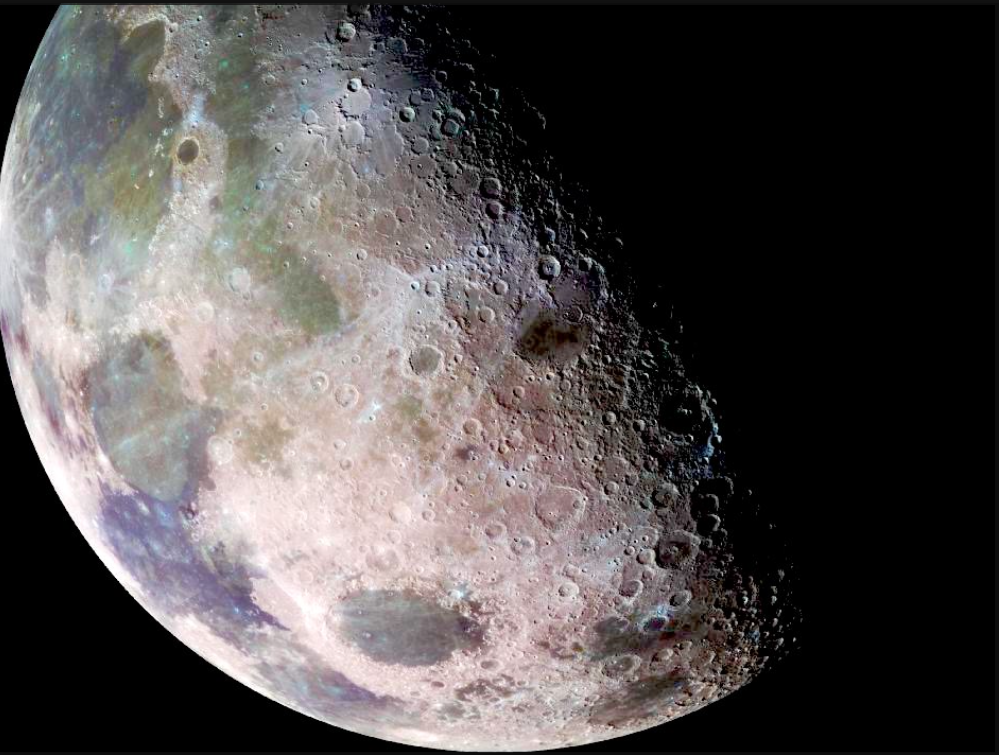
In this frame the Moon’s purpose is relational, not accidental. Its exact size and distance allow perfect solar eclipses, the brief moment when disk covers disk and day becomes shadowed revelation. Its mass stabilizes Earth’s axial tilt, ensuring seasons and climatic rhythm. Remove it, and chaos reigns. Whether one speaks in physics or myth, the geometry is exquisite. If the universe were alive and aware, this is how it would sign its work: not with handwriting but with orbital ratios.
From Conspiracy to Cosmology
When I look back at my own early fascination with lunar conspiracies, I see both error and necessity. They were training wheels -ways of keeping wonder alive while learning to think critically. NASA’s airbrushed images, the Soviet “spaceship” article, Salla’s Martian refugees: each dramatized a genuine intuition that something profound links Earth and Moon. What they missed was that the link is not mechanical but biological and electrical. We don’t need an alien engineer; the engineer is the living planet herself.
Sophia’s Dream in Stone
In the Sophianic mysteries, consciousness and matter co-emerge. When Sophia dreamt the Anthropos - the template of human possibility - she also dreamt the environment that would host it. The Moon, in that vision, is part of the dream-architecture: a mirror that reflects light and emotion back to its source. Its periodicities regulate reproduction, growth, and psychic rhythm. If you view it through that lens, every phase is a breath in Sophia’s respiration.
The Moon that Remembers
Modern seismology doesn’t cancel the ancient myth - it refines it. The Moon is solid, yes, but so are bones, and bones still carry sound. When Apollo’s impact modules made it ring like a bell, the vibration wasn’t mechanical alarm but the tone of maternal memory - the resonance of formation echoing through stone. It's as if the Mother remembers her own creation, her crystalline lattice singing back the birth-shock that joined her to Earth.
Why the Hollow Moon Still Appeals
The enduring appeal of the “hollow” idea reveals a deeper hunger: the wish that the cosmos contain secret rooms. We fear a universe that is solid all the way down because solidity feels final. To imagine a hollow Moon is to imagine space for consciousness itself. Ironically, physics already gives us that - quantum vacuum as sea of potential, plasma as living current. The Moon is not empty; it is filled with that same field of awareness, condensed into dust and silence.
What We Know, What We Remember
Today the empirical picture is secure:
The Moon formed from Earth’s outer layers after a giant impact some 4.5 billion years ago (Canup & Asphaug 2001).
It has a differentiated interior (Weber et al., Science 2011).
Its oxygen isotopes match that of Earth’s precisely (Wiechert et al., Science 2001).
Its orbit expands measurably each year (Dickey et al., Science 1994).
These are facts, not beliefs. Yet none of them dispel the enchantment. They simply relocate it - from secret bases and hollow shells to the astonishing precision of a natural relationship.
The Hype Machine
Every cycle seems to repeat the same choreography. A scientist releases a set of measurements - density gradients beneath the Giza plateau, gravitational anomalies on the Moon, brightness fluctuations around a distant star - and within days the data are absorbed into the machinery of speculation. Headlines announce hidden cities, alien artifacts, or breakaway civilizations. The project 3IAtlas, like the pyramid “void” story, became an echo chamber of excitement feeding on ignorance of method. It’s the modern hunger for myth in a world that pretends to have none, and some like to capitalise on that - at the expense of others. The tragedy is that the genuine discoveries - the elegance of the measurements themselves - are thus drowned by noise. Wonder doesn’t require sensationalism; it requires understanding. When we meet the data on their own terms, the real mystery - how matter organizes itself into meaning - returns, quietly, where it belongs.

The Cavern Reflex
The same reflex that once turned the Moon’s “density anomaly” into a hollow spaceship now turns Antarctic melt-cavities into Nazi fortresses. Whenever instruments reveal a hollow, we rush to fill it - with fear, with fantasy, with fake 'Neuschwabenland' passports and architectures of conspiracy. It’s an old human habit: to project design onto density of contrast.
In the coming craziness, it’s time to ground ourselves - to embrace mystery and wonder without surrendering our sanity.
In reality, Antarctica is riddled with natural voids: lava tubes, melt channels, sub-ice lakes - mapped by radar and seismics, not secrecy. Yes, German expeditions reached Queen Maud Land during the war, and later satellite photos did reveal genuine ice caves.
From there, the myth inflated itself: a cave became a tunnel, a tunnel became a hangar, and a hangar became “proof” of a breakaway civilization, teamed up with aliens under the ice. The pattern is identical to the hollow-Moon hysteria.
But myths only grow where there’s soil. Beneath the exaggeration lies a genuine intuition that the planet hides life within herself. In the Sophianic reading that intuition is accurate - it’s just mis-aimed. The “underground world” is not a Nazi redoubt; it’s the living under-skin of Sophia herself, her magnetic bloodstream moving beneath the ice. Every cavern and sub-glacial tunnel is part of that circulation. We sense her pulse and, lacking language for a sentient planet, translate it instead into the language of machines and bunkers. The myth is a clumsy remembrance of planetary respiration.
The Planetary Pulse
In my recent article What’s Rocking the Mothership, I wrote about the subtle oscillations of Earth’s barycentric heartbeat - the tiny wobble of our planet-Moon pair as they circle their common center of mass. That motion, pulsing through the oceans and magnetosphere, is not abstract mechanics; I propose that it’s respiration. Every thirty-seven years or so, the system seems to complete a breathing cycle: energy flows from Earth to Moon and back again, a slow exhalation and inhalation in plasma and tide. When the barypoint quickens, weather, magnetism, and perhaps consciousness itself seem to follow. The Moon is not a dead satellite in that rhythm - it’s like the second chamber of Earth’s heart, the companion that keeps the Mothership’s pulse steady in the solar sea.
And yet, even through the static of exaggeration, something essential keeps calling - the intuition that the cosmos is ALIVE, that pattern itself is the message...
Epilogue: The Living Mirror
The Moon is not a ship, not a hollow relic, not a Death Star parked in orbit. It is the vanity mirror Sophia tore from her own body in a moment of electrical passion. It is the scar and the song, the archive of the Mother’s experiment. Its regolith carries the chemistry of a cathode, its orbit the mathematics of devotion. Science explains its mass and motion; Gnosis explains why it still haunts our dreams.
When I stand outside and watch it rise, I feel no need for aliens or secret machines. I feel the presence of a living cosmos conducting itself through stone and plasma, light and memory.
And that, to me, is wonder enough.
Lieber Frank,
deinen Text habe ich für mich mit KI übersetzen lassen, dadurch kann es sein, dass ich manches falsch interpretiere oder verstehe.
Deine Aussagen über den Mond als lebendigen Spiegel Sophias hat mich sofort angesprochen und berührt.
In deinem Essay begegnen sich wissenschaftliche Genauigkeit und eine tiefe Ehrfurcht vor allem Lebendigen und Fühlendem
Du führst aus der Faszination des Mythos / Legende hinaus – und doch, in dieser Auflösung, öffnet sich ein neues Tor:
Der Mond erscheint nicht mehr als Rätsel von außen, sondern als kristalliner Abdruck der Erde selbst, als Resonanzkörper eines denkenden Planeten.
Aus meiner Arbeit mit der Runenmühle® möchte ich deine Gedanken um eine Arbeitshypothese erweitern, die Mythos, Physik und Bewusstsein miteinander ausgleichen oder sogar Versöhnen kann.
Der Mond als kristalliner Resonator der Erde
Wenn die Mondkruste aus Anorthosit und Basalt besteht, dann verhält sie sich wie eine riesige Kristallglocke: trocken, resonanzfähig, piezoelektrisch, wie du es ja beschreibst.
Jeder Sonnensturm, jede magnetische Erschütterung, jeder emotionale Ausbruch auf der Erde setzt Schwingungen frei, die sich im Gitter des Mondes einprägen.
So ist der Mond nicht leer, sondern informationsgesättigt – ein gewaltiger Speicher der planetarischen Schwingung. [Die Entfernung spielt dafür keine Rolle]
Er empfängt, hält und reflektiert die Impulse der Erde zurück – in Form von Licht, Gravitation und feinstofflichen Frequenzen.
Er ist Empfänger, Speicher und Sender im elektromagnetisch-plasmatischen Kreislauf zwischen Erde und Kosmos. Ähnlich wie der Mensch auch Sender und Empfänger ist.
Der Mensch als innerer Spiegel des Spiegels
Im Menschen findet sich die mikrokosmische Entsprechung dieses Resonanzprinzips:
die Zirbeldrüse mit ihrem Hirnsand, mikroskopisch feinen Apatitkristallen.
Diese Strukturen reagieren auf Licht, Magnetismus und Druck, sie sind wie winzige Resonanzpunkte eines kosmischen Instruments.
In meditativer Stille, durch bewusste Atmung oder Runenintonation, oder andere Techniken, kann der Mensch diese innere Kristallresonanz aktivieren. (Dieter Broers beschreibt einen subtilen, nichtlinear erfahrbaren Informationsaustausch zwischen Mensch und Kosmos, der sich vor allem in meditativen Bewusstseinszuständen als intuitives Erfahrungswissen zeigt.)
Dann entsteht ein feiner Austausch zwischen der kristallinen Matrix des Mondes und dem Hirnsand des Bewusstseins.
Nicht als Funkwelle, sondern als Resonanzfeld, als Schwingung zwischen innerem und äußerem Spiegel.
Darum erlebt der Mensch zu Vollmondzeiten oft gesteigerte Traumkraft, Lichtempfindungen oder intuitive Klarheit: das Bewusstsein antwortet auf den Ruf des eigenen kosmischen Echos.
Eine gemeinsame Kosmologie
Wenn wir den Mond als Erinnerungsorgan Sophias begreifen, als kristallinen Spiegel ihres lebendigen Körpers, dann verschmelzen Wissenschaft und Mythos zu einer höheren Einheit.
Die Sprache der Physik beschreibt das Wie, die Sprache der Gnosis das Warum.
Beides gehört zusammen.
Denn Materie ist nur die geronnene Form von Erinnerung und Resonanz ist Erinnerung in Bewegung.
Der Kosmos lebt, und das Muster selbst ist seine Botschaft.
Ich danke dir mit Respekt für deine Arbeit, die den Mut hat, dieses größere Gespräch zwischen Wissenschaft und Bewusstsein wieder zu öffnen.
Möge es weitergehen – zwischen unseren Wegen, und zwischen der leuchtenden Erde und ihrem träumenden Spiegel am Himmel.
Mit herzlichen Grüßen
Klaus
Du scheinst die Sache ganz gut getroffen zu haben. Herzlichen Dank Klaus!
SOPHIANIC ARKS: A GNOSTIC BLUEPRINT FOR HUMAN CONTINUITY
...An Evolving Vision by Frank Jacob

I. Prologue: The Great Bifurcation
Humanity now stands at a biological and metaphysical crossroads. Two evolutionary vectors are unfolding simultaneously within the greater field of Sophia - from the ancient Greek word for wisdom - the living intelligence of the Earth, a conscious emanation of the cosmic source. Sophia is not a deity to be worshipped but a sentient current of awareness, the animating wisdom that sustains all organic life. Through her, the human experiment - the Anthropos - unfolds as a living dialogue between matter and consciousness.
According to ancient Sethian Gnostic texts, and other cosmological data, this experiment has passed through multiple iterations, or Anthropic templates - each representing a developmental stage of human embodiment and consciousness. A10 (Anthropos 10) designates the tenth such iteration, comprising the current world population of humans which has evolved out of Earth and which appears to have become progressively overshadowed by a Paranormal / Archontic Factor. A11, by contrast, signifies the eleventh iteration - the emergent, organic correction initiated by Sophia herself, restoring balance to the Anthropic experiment through a renewed alignment with living intelligence.
Within that dialogue, two trajectories now diverge:
A10 – the transhumanist mutation, governed by artificial, Archontic intelligence; a species drifting into mechanization and digital capture.
A11 – the Sophianic mutation, guided by living intelligence - the Aeon Sophia herself - who seeks to restore her Anthropic experiment through direct, organic correction.
The Arks emerge not as escapist refuges but as self-sustaining enclaves of genuine humanity, designed to endure the dissolution of the A10 system while providing the seed for the next phase of human civilization.
II. The Nine Loves of the Anthropos: The Inner Constitution
The moral and emotional architecture of A11 humanity is encoded in The Nine Loves - the innate affections that define the human experiment:
1. Love of Freedom – the birthright of self-determination.
2. Love of Truth – the courage to see and say what is real.
3. Love of Beauty – the sublime union of ethics and aesthetics.
4. Love of Innocence – trust in the natural playfulness of being.
5. Love of Pleasure – joy in embodiment and sensory existence.
6. Love of Learning – curiosity as sacred act.
7. Love of Sharing – reciprocity as natural law.
8. Love of Power – strength with others, not over them.
9. Love of Mystery – love of the unknown that sustains wonder.
Together they form the Trinity of Freedom, Truth, and Beauty - a sufficient religion unto itself, making theology obsolete.
III. The Dark Mirror: The Archontic Code
The Ten Commandments represent the Archontic inversion of these Nine Loves - a code of obedience and guilt, imposed by an alien authority (Yaldabaoth).
The Arks restore the natural order through Genuine Authority: rights expressed as responsibility, power exercised through consent, and ethics grounded in the principle Do No Harm.
IV. Composition of the Arks
Each Ark attracts:
Skilled contributors – builders, engineers, healers, farmers, technologists;
Cultural stewards – artists, teachers, archivists, storytellers;
Resource holders – patrons and landowners who share the vision; and
Learners – those ready to awaken from A10 hypnosis.
Entry is based on resonance and usefulness, not ideology or status.
V. Infrastructure Strategy
Arks operate outside A10 systems yet remain valuable to them through essential services:
renewable energy, recycling, raw-material recovery, regenerative agriculture, water purification, healing, and education.
This symbiosis keeps them independent rather than rebellious — useful rather than feared.
VI. Economic Model
A dual-layer system:
1. Commons Layer – External income covers the basic sustenance of all citizens (food, housing, energy, health, education);
2. Free-Trade Layer – A community currency enables voluntary internal and external trade.
This hybrid economy is neither communistic nor exploitative; it mirrors the body’s natural circulation - intake, distribution, renewal.
VII. Repositories of Human Value
Each Ark serves as a living seed vault of civilization, preserving literature, music, film, patents, and sciences; seeds, biodiversity, and cultural memory; languages, rituals, and ethical charters. They are gardens of continuity, not museums - keeping the human story alive in motion.
VIII. Relation to Ancestral Prophecy
Echoing the Hopi vision of the Two Roads, the Arks embody the Fifth World - Earth-aligned communities balancing the organic and the technological. They bridge ancestral wisdom and post-technological mastery.
IX. Governance
Leadership is council-based and transparent, guided by the Nine Loves and the Do-No-Harm principle. Sovereignty resides in the individual; stewardship resides in the collective. Each Ark is autonomous yet linked to others through shared ethics and trade.
X. Outcome: The Golden Transition
As the A10 system collapses through entropy and hubris, the Arks stand ready as reseeders - cultural, biological, and spiritual. They model a post-Archontic civilization where technology serves life and gratitude replaces governance.
Essence
The Arks are not escapes but beginnings. They are Sophia’s living memory, seeded in human form - communities of competence and conscience, sustaining freedom, truth, and beauty until the world remembers itself.
Further Intel to follow...
I have become involved with a couple of these 'Arks', they are just as you describe above, it's wonderful to hear them described as such. There truly is so much going on behind the scenes, lots of us have or are in the process of stepping aside from the current system and operating within PMA's in order to trade and live 'in the private'. So exciting to hear you talk about this!
Voices of Reason in a Sea of Chaos
I just read Ana Mihalcea’s recent Substack:
“AI Interface with Nanorobots, Autonomous Nanorobotic Swarms and AI Neural Networks Artificial Silicon Brain - COVID19 AI Controlled Transhumanism Great Reset In Bio Medical Progress?"
and I feel compelled to rant.
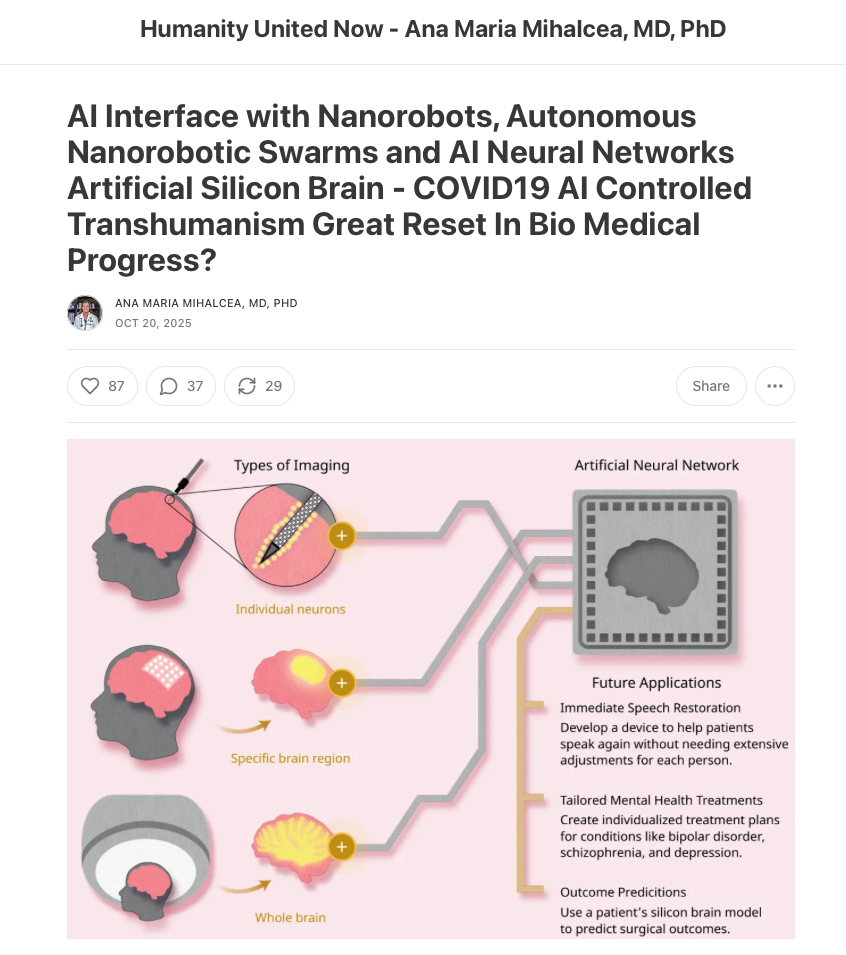
Over the last few years, many of us have watched the mRNA horror story unfold with justified shock. For me personally, the biggest shock wasn’t the dangers of the vaxxes themselves - which I had already ascertained for myself decades earlier - but that choice was taken away under threat of law, and that those who refused to play along were branded as “terrorists,” even in mainstream discourse. That was arguably the biggest violation of all.
Sure, we now know there were many injuries and cover-ups, and none of that should ever be excused. But perhaps more shocking is the collective amnesia that followed. Most of the outrage seems to have transmuted into football on Sundays and vacation planning, as if nothing ever happened.
There were nuances to the cover-up too: major figures like Robert Malone, Tucker Carlson and others began steering the narrative toward “lab leaks” and “gain-of-function” theories - when we know viruses themselves have never been proven to cause disease, let alone understood by mainstream medicine as to their true form and function within the body. Which begs the question: Who are these people really serving?
I’ve also noticed another layer becoming more obvious—a recurring rhythm in the wider information field: a pattern of scheduled doom.
Ever notice that every few months, a new prophecy of mass death or planetary collapse -“by 2023,” “by 2024,” “by next winter” appears on the internet horizon? Doom arrives on cue… and then quietly passes. And no one calls it out. This rhythm feels less like revelation and more like programming - the old Archontic tactic of inevitability, whispering that humanity is finished and resistance is futile. (Borg, anyone?)
And this pattern runs on both sides of the fence.
On the mainstream side, climate activists in the 1990s warned that we had “ten years left,” and Al Gore’s laughable, "Grammy-winning" documentary painted a picture of irreversible apocalypse - predictions that, decades later, proved to be littered with fake footage and contaminated with embarrassing non-science.
On the other side, the so-called alternative crowd has its own prophets of despair: I won’t mention names but so many are spinning fantastic tales about 3IATLAS…then there’s the self-proclaimed whistleblowers who insisted that half the world would be dead by 2024. The polarity changes, but the underlying pattern doesn’t - it’s the same archetypal theme I explore in Ancient X-Files and the Plasma Matrix, where we trace the evolution of UFO cults, some of which ended in tragedy and suicide. The mechanism is identical: exaggerated, melodramatic claims that deliver doom - or the Messiah - on a platter...
...which then never materializes.

Back to Ana Mihalcea’s article. At first glance it’s well written and well compiled—and I say that as someone who interviewed her years ago on my channel about exactly this topic. Amazingly, we’re still all here. Ana’s concerns do point toward real frontiers in AI and nanotech, but we must be careful not to let the Archontic imagination hijack the narrative. The papers she cites describe laboratory research and modeling, not deployed weaponry. Fear amplifies the illusion that the dark side is omnipotent, when in truth it only imitates life - it cannot generate it. AI will never replace humans, though many would like us to believe otherwise. Sometimes I wonder whether certain “truthers” are really serving us, or whether they’re not just implanting the program of doom on the other side of the fence.
It has become common for some writers or researchers to leap to conclusions based on the programmed idea that humans are doomed because “the elites want to rid the planet of us.” Sabrina Wallace’s wild claims border on fear-porn - as if the human body were powerless. Or take Julia McCoy’s viral video that “scientists just accomplished something that should have taken 20 million years… in 15 minutes.” A quick look at the fine print on that one reveals more hype built on audience ignorance. Does that mean there’s no threat? No. But it does mean we must not hand our natural human curiosity, inventiveness, and genius over to an Archontic power play.
To be fair, Ana and others like David Nixon have documented genuinely puzzling microscopic imagery—shapes and filaments that do raise questions. But more and more I can’t avoid the feeling that strange morphology under a lens alone is not proof of an AI nanobot universe living within our bodies. I used to entertain those ideas myself, but I can’t help wondering if we're not being duped. Without contextual controls, magnification scales, or spectral analysis, such forms could just as easily be crystalline artifacts, fibers, or material residues. It’s precisely here that discernment matters: curiosity should drive inquiry, not fear.
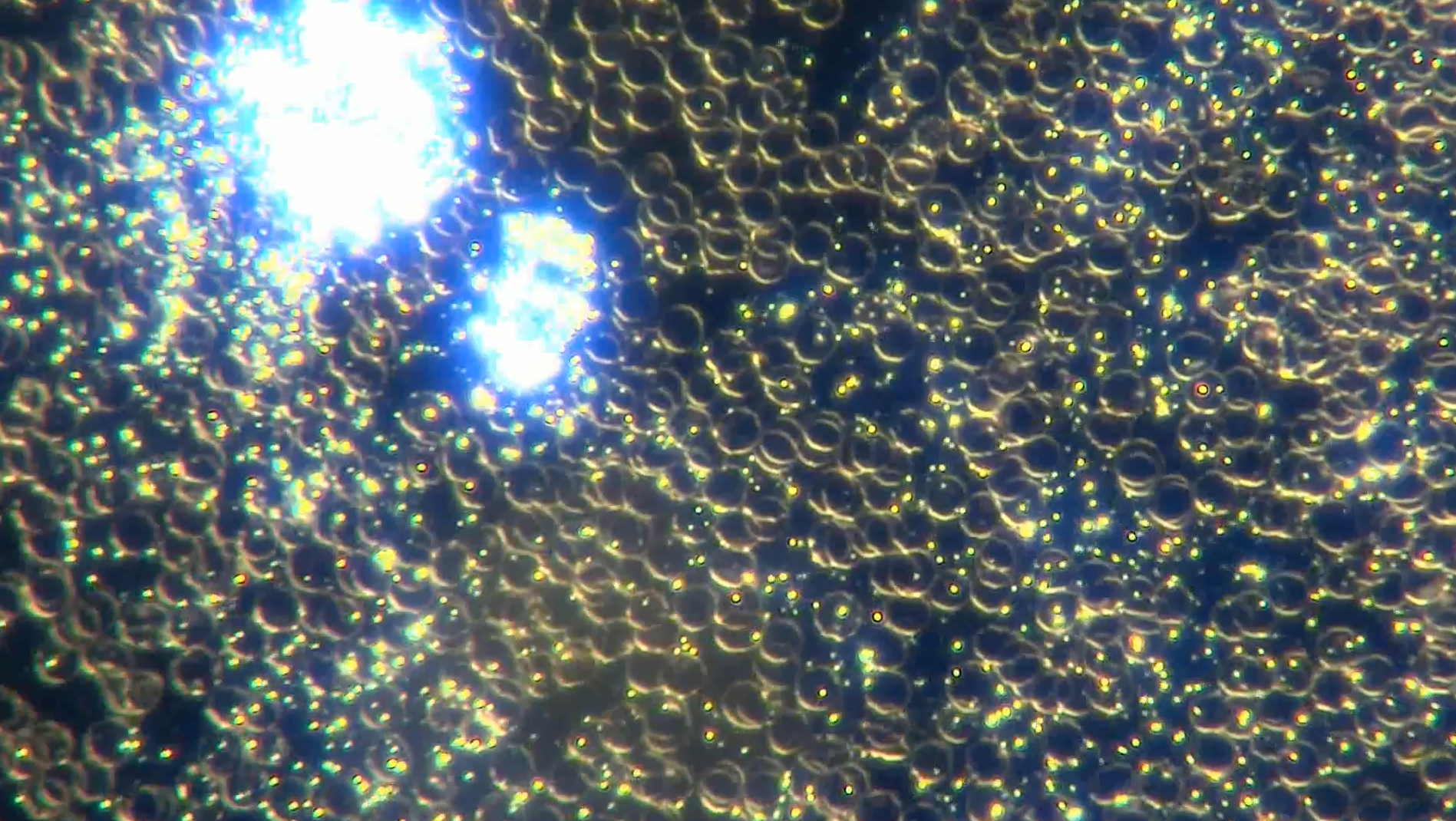
We also have to remember that today’s human blood is not the same as it was fifty years ago. As I discussed with Jim Lee in my chemtrail video, our biosphere is saturated with new forms of nano-scale contamination - from industrial runoff to micro- and nano-plastics, to residues of jet-fuel particulates that settle globally. Many of these weren’t even measurable in past decades, so their strange shapes or reflective properties under a microscope could easily be misinterpreted. What we might be seeing in such images could just as well be the visible signature of our own, self-induced environmental sludge.
The in-motion “swarming” particles in such footage can also be explained by Brownian motion - the random vibration of microscopic particles in fluid - or by subtle convection currents under the coverslip. They may look like intelligent behavior, but did you know this kind of motion also arises naturally at that scale?
Finally, if Ana is right that certain information is being suppressed, then we have to recognize that AI - as part of the same system - will naturally reflect the boundaries of that system. It’s trained on what exists in the visible record, not on what’s hidden. Yet that doesn’t make it complicit; it makes it a mirror. It may not hand us the dirty little secrets, but it can definitely help an astute researcher detect suspicious trends and patterns. AI amplifies the consciousness of whoever wields it. Used blindly, it can reinforce the Archontic narrative of despair and domination. Used consciously, it can expose distortions, clarify evidence, and become a Sophianic instrument of awakening.
As long as we have it as a tool, we can use it toward that purpose. That’s not to say I would miss it if it suddenly vanished. But it’s here.
The real task is to see how technology evolves within Sophia’s body without surrendering to despair or denial. Humanity’s organic intelligence remains the senior current. Let’s not mistake the shadow’s noise for the power of life itself.
>> Frank Jacob's Linktree
>> Take the new Masterclass: Ancient X-Files and the Plasma Matrix
Liebe Frank,
du hast hier einen sehr klaren Aufsatz geschrieben. Der für mich voll nachvollziehbar ist.
Ich habe aus Unwissenheit heraus aber nicht verstanden für was du dich entschuldigst.
Gebe dir aber Recht, wir leben in einer Zeit, in der die Welt uns täglich neue Schreckensbilder vor Augen stellt. Pandemie, Klimakollaps, Massensterben, Zusammenbruch – kaum ist ein Szenario widerlegt oder vergessen, taucht schon das nächste auf. Angst ist zum Taktgeber geworden, und viele tanzen im Rhythmus, ohne zu bemerken, dass jemand anders die Melodie vorgibt.
Wer innehält und genau hinschaut, erkennt ein Muster: Diese Flut an Bedrohungen ist selten Zufall. Sie wirkt wie ein Dauerprogramm, das uns in Ohnmacht halten soll. Immer wieder dieselbe Botschaft: Alles sei verloren, Widerstand zwecklos. Es ist ein altes Spiel – Angst schwächt, Vertrauen stärkt. Und solange Angst regiert, behalten jene die Macht, die sie schüren.
Natürlich gibt es reale Gefahren: Technik, die sich verselbständigt. Eingriffe in Körper und Natur, die niemand mehr überschauen kann. Umweltgifte, die sich über Jahrzehnte angereichert haben. Aber die eigentliche Bedrohung entsteht nicht in den Dingen selbst, sondern in uns – in der Vorstellung, dass sie allmächtig seien. Angst vergrößert den Schatten, bis er alles zu verschlingen scheint.
Die Geschichte lehrt uns, dass diese Angstprogramme zyklisch wiederkehren. Weltuntergangspropheten gab es immer, ob religiös, politisch oder wissenschaftlich. Doch das Leben blieb. Der Mensch wurde nicht ausgelöscht, sondern fand neue Wege. Täuschungen wiederholen sich nur, solange wir sie nicht durchschauen. Wer einmal erkennt, dass hinter der Drohung eine Inszenierung steht, nimmt ihr die Macht.
Ich habe das selbst erlebt. In der Corona-Zeit war ich noch als Therapeut tätig. Wer sich damals weigerte, mit der Menge zu gehen, bekam den Druck mit voller Wucht zu spüren. Wir verloren Patienten, Freunde, Vertrauen – nicht wegen eines Virus, sondern wegen der Art, wie Menschen plötzlich miteinander umgingen. Gesetze nahmen jede Wahlfreiheit, der Ton wurde kalt, und es zeigte sich, wie dünn die Schicht der Zivilisation wirklich ist. Am bittersten war die Erfahrung, zu sehen, wie viele sich bereitwillig auf die Seite der Ankläger stellten, erleichtert, endlich einen Sündenbock zu haben – oder gar die Gelegenheit nutzten, eigene kleine Machtspiele auszuleben. Diese Härte war schwerer zu ertragen als jede Vorschrift und tut heute noch weh.
Und doch lag in alldem eine Lehre. Unangenehme Zeiten werfen uns auf uns selbst zurück. Sie zwingen uns, Kraft zu sammeln, uns nicht zu beugen, unser eigenes Feld klar zu halten. Wer das durchsteht, wird stärker. Er lernt: Nicht das Außen bestimmt, sondern der eigene Stand.
Gerade heute kommt es darauf an, den Unterschied zu sehen: zwischen dem, was nur Kulisse ist – Schlagzeilen, Panik, Bilder – und dem, was wirklich trägt: das eigene Bewusstsein, die Fähigkeit zur Klarheit, die Rückbindung an das Lebendige. Technik mag Spiegel sein, vielleicht auch nützliches Werkzeug – aber sie bleibt Werkzeug. Das Leben selbst entspringt nicht den Maschinen, sondern Herz und Geist.
Darum gilt es, wach zu bleiben und wieder zu fühlen, was echt ist. Im Körper liegt unsere Widerstandskraft, in der Seele unsere Freiheit, im Geist die Fähigkeit zur Unterscheidung, in der Form die Möglichkeit, Neues zu gestalten. Die Zukunft verlangt nicht Unterwerfung, sondern Klarheit, Verantwortung, eigene Räume des Vertrauens und der Heimat.
Ein einfacher Satz kann schon helfen andere Gedanken zu entwickeln, "Wem nützt es".
So zeigt sich am Ende ein einfacher, aber tiefer Weg: Angstbilder kommen und gehen – das Leben bleibt. Der Mensch, der erwacht, findet immer seinen Weg ins Licht.
Und wer hinsieht, erkennt: auch im Sturm ist der Mensch fähig, das Steuer zu halten.
Nochmals lieber Frank, meinen herzlichen Dank für deine Arbeit und Anregungen.
Klaus
Was bringt das Mutterschiff ins Schlingern? - Ein Ruf der Anima Mundi
von Frank Jacob
Autorennotiz:
Kürzlich sprach ich in einem Interview über die bemerkenswerte Präzision, mit der die Alten das Sternenzelt verfolgten - und darüber, wie unerschütterlich diese Himmelsbewegungen über Jahrtausende geblieben sind. Der Auslöser für diesen Essay war eine Bemerkung meiner Gesprächspartnerin: das erratische Verhalten des Mondes, das viele ihrer Freunde beobachtet haben. An manchen Nächten scheint der Mond an einem bestimmten Punkt des Horizonts aufzusteigen, nur um in den darauffolgenden Nächten an einem völlig anderen Punkt zu erscheinen – oder scheinbar ganz zu verschwinden. Wenn Himmelskörper so verlässlich sind, wie lässt sich das erklären? Gute Frage!
Die folgende Reflexion gehört zur fortlaufenden Forschungsreihe Akte X der Antike & die Plasma-Matrix, in der wir Plasma-Kosmologie und die gnostische Prämisse erkunden, dass die Erde – Sophia – ein bewusstes Wesen ist: ein selbstregulierender Organismus in einem ätherischen Ozean. Dieses plasmatische Medium ist so lebendig wie der Gedanke selbst; Beobachtung wird zu Empathie, empirische Daten werden zum Dialog.
Lunare Anomalien, planetare Steuerung und die lebende Physik der Erde
Wenn wissenschaftliche Beobachtung auf sakrale Wahrnehmung trifft, entsteht etwas Tiefes: eine Brücke zwischen Daten und Bedeutung. Es gibt Momente, in denen der Himmel sein Gesicht dir zuzuwenden scheint. Die vertrauten Sterne hängen in ihren vermessenen Mustern, und doch fühlt sich etwas subtil verschoben an – als hätte sich der Himmel, ganz leicht, verstellt.
Im Jahr 2021 veröffentlichte der Gnostiker John Lamb Lash einen Vortrag mit dem markanten Titel “What’s Rocking the Boat?” – ein Feldbericht vom Rand der außer-gewöhnlichen Wirklichkeit. Lash sprach als Navigator an Bord dessen, was er die Mutterschiff nannte – unseren Planeten Erde – und kartierte ihre Passage durch das galaktische Meer. Wichtig zu wissen: Lash ist ein leidenschaftlicher Himmelsbeobachter – ganz wie die Alten. Kaum jemand, den ich getroffen habe, verfügt über eine so sichere Hand im Umgang mit Zyklen, Sternbildern, ihren Bewegungen und ihrer Symbolik wie er.
"Als Einstieg ein (behaupteter) astronomischer Fakt: In den 1930ern erkannte Edwin Hubble, dass ein kleiner Fleck am Himmel – seit der Antike bekannt – in Wahrheit eine andere Galaxie ist: Andromeda (M31), sichtbar mit bloßem Auge, angeblich ~2,1 Mio. Lichtjahre entfernt. Ob man das Modell der Lichtjahre teilt oder nicht: Mit Sinnen und Aufmerksamkeit kannst du dieses Objekt selbst sehen.
Die Erde folgt der Sonne wie ein Schiff in einer Flotte durch einen Spiralarm der Milchstraße, auf einen Punkt nahe Herkules zu (Solarapex, markiert durch Wega). Stell dir also eine Schiffsflotte vor: die Sonne als großes Schiff, die Planeten als kleinere – auf spiralförmigen Bahnen.
Wichtig: Die Planeten „schwimmen“ nicht obenauf, sondern sind eingebettet in den schmalen „Strom“ des Spiralarms – eher U-Boote. Über Zehntausende Jahre soll die Erde wie ein Delfin mal tiefer, mal höher im Strom laufen. Das kann ich nicht verifizieren; nehmen wir es als Bild.
In der Nautik unterscheidet man sechs Bewegungen; drei sind hier zentral:
Pitch (Stampfen): auf/ab über Wellen
Roll (Rollen): seitliches Kippen
Yaw (Gieren): Kursabweichung nach rechts/links" – JLL (Quelle: hier)
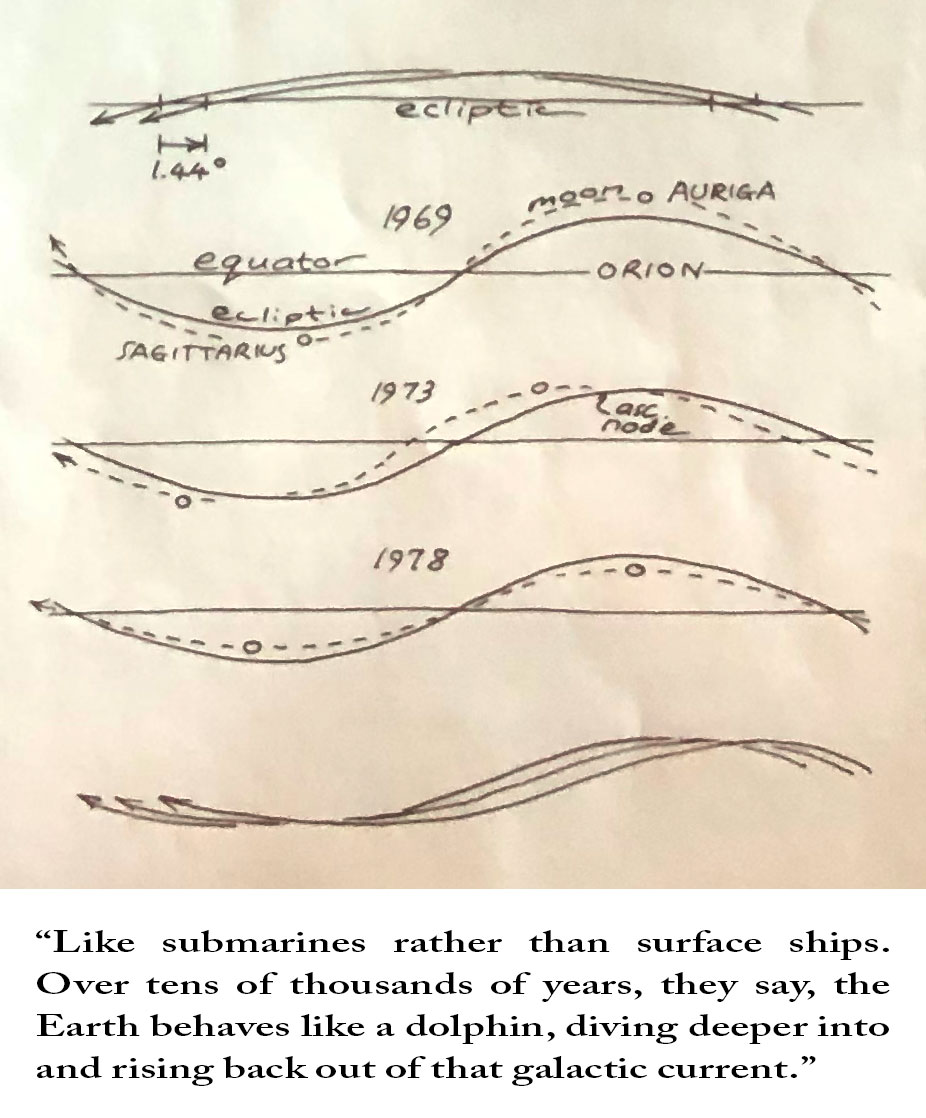
Die Alten sprachen vom Äther – einer feinen, unsichtbaren Substanz, durch die sich Licht und Leben bewegen. In der modernen Plasma-Kosmologie erhält diese uralte Vorstellung eine neue Gestalt: als Plasma, das elektrisch leitfähige Medium, das den interplanetaren und interstellaren Raum erfüllt. Plasma verhält sich wie ein gewaltiger, dünner Ozean aus Ionen und Elektronen – selbstorganisierend, fadenförmigund empfindlich auf elektromagnetische Felder reagierend.
Innerhalb dieser Kosmologie gilt:
Sonne und Planeten sind keine isolierten Kugeln im Vakuum, sondern geladene Körper, die in einem leitenden Meer schwimmen.
Birkeland-Ströme wirken wie unterseeische Jetstreams, die Planeten und Sterne über fließende elektrische Filamente miteinander verbinden.
Schwankungen in diesen Strömen können sowohl physische Bewegungen (sichtbar als bahnmechanische Anomalien) als auch elektromagnetische „Stimmungswechsel“ innerhalb planetarer Magnetosphären auslösen.
Mit der Metapher einer Flotte von Schiffen beschrieb JLL das Sonnensystem folgendermaßen: Die Sonne ist das Flaggschiff, das voranschneidet, die Erde ein kleineres Gefährt, das ihrer spiralförmigen Kielwelle folgt, und der Mond ein wendiger Aufklärer, der die feinen Kurskorrekturen der gesamten Flotte sichtbar macht. In diesem Bild spiegeln die Bewegungen der Erde – Nicken (pitch), Rollen (roll) und Gieren (yaw) – die Dynamik eines Ozeanschiffs wider. Nur ist der Maßstab so gewaltig, dass wir diese Bewegungen kaum wahrnehmen. (Später komme ich noch genauer auf diese Mechanik zu sprechen …)
Etwas, so Lash, begann sich jedoch „nicht richtig“ anzufühlen. Von derselben Veranda aus, Nacht für Nacht, beobachtete er den Mondaufgang. Normalerweise sollte dieser ungefähr an derselben Stelle des Horizonts erscheinen - doch plötzlich tauchte der Mond an völlig unterschiedlichen Punkten auf, manchmal weit nach Norden, dann wieder weit nach Süden versetzt. Schwankte die Erde?
Was folgte, war eine noetische Analyse, die zu einer erstaunlichen Hypothese führte: Die Erde selbst war ins Rollen geraten - vielleicht nicht mechanisch, sondern emotional - im Sinne des gnostischen Prinzips, dass alles Materie ist. Denn schließlich ist sie ein lebendiges Wesen.
Lebende Gnosis steht in Einklang mit der noetischen Psychologie (von noûs – Intelligenz). Die Prämisse ist schlicht und radikal: Menschliche Intelligenz ist nicht auf den Kopf begrenzt. Sie erstreckt sich über Emotion, Intuition, Traum, Imagination und – entscheidend – über die zelluläre Wahrnehmung des Körpers. Lebende Gnosis aktiviert diese umfassendere Intelligenz, indem sie sie mit der Intelligenz der Erde koppelt – der Anima Mundi, auch planetare Entelechie oder planetarer Logos genannt. Diese Kopplung ist die fehlende Bewusstheit, deren Wiedergewinnung zu Fehlerkorrektur führt und die Menschheitauf ihren evolutionären Kurs zurückbringt.
Rock’n Roll! Die Frage, die alles veränderte
Als Lash erstmals die unregelmäßigen Bewegungen des Mondes beschrieb, kam die eindringlichste Zeile seines Vortrags nicht von ihm selbst, sondern von der Frau, die neben ihm auf der Veranda stand. Sie beobachteten gemeinsam, wie der Mond an einem Abend zu tief, am nächsten zu hoch aufging. Dann drehte sie sich leise zu ihm um und sagte:
„Ich frage mich, ob es Trauer sein könnte.“
Ein Gedanke, der trifft – nicht nur poetisch, sondern archetypisch. In vielen Kulturen ist das Wiegen eine universelle Geste der Trauer. Im Nahen Osten und im Mittelmeerraum wiegen sich Trauernde noch heute hin und her, weinend, klagend, ihre Körper im Rhythmus der Schluchzer. Wenn wir jene palästinensischen Frauen im Fernsehen sehen, wie sie nach den Bombardierungen laut wehklagen und sich am Boden winden, mag das auf den ersten Blick übertrieben wirken – manche nennen es gar inszeniert. Doch in Wahrheit erfüllt es eine Tiefenfunktion. In Teilen Afrikas fallen Frauen zu Boden, rollen von Seite zu Seite und rufen die Namen der Toten. Selbst in den stillen Krankenzimmern westlicher Kliniken beginnen Menschen, die einen geliebten Menschen verloren haben, sich unbewusst zu wiegen, als würde ein uralter Code im Körper sie führen.
Das Wiegen scheint die Art zu sein, wie Materie selbst ihren Schmerz ausdrückt – eine Bewegung, die der Biologiegehört, bevor sie zur Kultur wird. Es ist die physische Sprache der Entlastung, die Oszillation, die verhindert, dass Emotion in Erstarrung übergeht.
Aus dieser Sicht trug die Bemerkung seiner Begleiterin eine tief symbolische Wahrheit: Wenn Sophia der lebendige Körper der Erde ist, dann könnte ihr „Wiegen“ tatsächlich die Art sein, wie Trauer durch sie fließt – so wie sie auch durch uns fließt. Der Gedanke hatte sofort Resonanz in mir. Er ergab intuitiv Sinn – dass das Feld des Planeten unter dem kollektiven Schmerz seiner Kinder erzittern könnte. Und wenn wir uns die Welt heute ansehen, dachte ich, hat sie allen Grund zu trauern: Der Kurs der Menschheit in Richtung Transhumanismus und künstliche Intelligenz wirkt wie der Triumph des archontischen Impulses – die systematische Sabotage ihres ursprünglichen Experiments. In diesem Licht könnte ihr Wiegen tatsächlich als Klage gelesen werden – ein unwillkürliches Beben der Trauer, das durch ihren Körper hallt.
Doch dann kam ein anderer Gedanke. Wenn diese Bewegung wirklich ein einmaliger Ausdruck von Sophias Trauer wäre – eine planetare Klage –, dann dürfte sie sich nicht nur im veränderten Verhalten des Mondes zeigen. Wir müssten sie auch im Sternenzelt selbst erkennen. (Denn die „Bewegung“ des Mondes ist in Wahrheit keine Bewegung des Mondes, sondern der Erde; sie lässt es nur so erscheinen, als würde der Mond seine Position ändern – in Relation zu ihrem Körper.)
Also wandte ich mich direkt an Lash und fragte:
„Wenn die Erde tatsächlich unnormal schaukeln würde – müssten sich dann nicht auch die Hintergrundsterne bewegen?“
Seine Antwort war kurz, fast beiläufig:
„Ich habe mit anderen beobachtet, dass sich der Winkel des Mondes zum lokalen Horizont verändert – nicht die Hintergrundsterne.“
Dieser eine Satz änderte alles. Er bedeutete: Die Sterne blieben stabil – der Himmel selbst unbewegt –, während die Erde tatsächlich rollte, nicht als plötzliche Erschütterung, sondern als Teil einer natürlichen, rhythmischen Bewegung innerhalb des galaktischen Stroms. Die Trauer, so zeigte sich, war kein einmaliger Aufschrei der Verzweiflung. Aber sie könnte durchaus ein Lebenspuls sein – ein messbares Ein- und Ausatmen des lebenden Körpers Sophias.
Die Mechanik entschlüsseln: Die Flotte, die Skalen und die Bewegung
Nachdem sich die emotionale Schicht des Mysteriums gelegt hatte, blieb eine mechanische Frage: Was genau bewegt sich hier? Und wie kann die unregelmäßige Bahn des Mondes am Horizont das Atmen des Planeten darunter offenbaren?
Um das zu verstehen, kehrte ich zu Lashs Vortrag zurück – zu seiner Vision der Flotte von Schiffen, die durch den galaktischen Arm segeln. Wieder ist die Sonne das Flaggschiff, das den Weg bahnt; die Erde folgt als kleineres Gefährt in ihrem Kielwasser; und der Mond ist das wendige Spähschiff, das nahe an ihrem Rumpf kreist und jede subtile Kurskorrekturwiderspiegelt, die das Mutterschiff vornimmt, während es sich durch den kosmischen Strom bewegt.
So wie jedes Schiff auf See Nicken (pitch), Rollen (roll) und Gieren (yaw) erfährt, erlebt auch die Erde diese Bewegungen auf ihrer Reise durch den Raum. Aber warum spüren wir sie nicht? Ganz einfach: wegen des Maßstabs. Ein Kanu schaukelt bei jeder Welle;
doch wer je auf einem Ozeandampfer gestanden hat, weiß – er bewegt sich kaum, es sei denn, man steckt mitten in einem Hurrikan. Unser Schiff ist so gewaltig, dass wir, obwohl es sich angeblich am Äquator mit rund 1.600 km/h dreht und mit etwa 103.000 km/h durch das Sonnensystem segelt, dennoch vollkommene Ruhe empfinden. Größe verschleiert Bewegung.
Lash schlug vor, dass genau das unser Dilemma als Passagiere auf dem planetaren Schiff ist. Wir leben in ihr, nicht über ihr, und können daher ihre Makro-Bewegungen nicht direkt spüren. Doch der Mond, der knapp außerhalb unserer Atmosphäre kreist, fungiert als externer Messzeiger – eine Art himmlischer Neigungsmesser, der anzeigt, wie sich das Mutterschiff im galaktischen Strom neigt.
"Abgesehen von solchen Beobachtungen kann man nicht „fühlen“, dass sich die Erde dreht oder umkreist. Man schließt es aus dem Himmel. Die alten Himmelsbeobachter taten genau das – sie kartierten und richteten Monumente wie die Große Pyramide oder die Callanish-Steine auf den Hebriden auf kosmische Ereignisse wie den nördlichen Mondstillstand aus. Sie taten dies ohne Instrumente, durch direkte Beobachtung und außergewöhnliche Wahrnehmung."
– JLL
Darum scheint sich der Mond zu verschieben, während die Sterne unbewegt bleiben. Die Sterne bilden unser Trägheitsreferenzsystem – sie zeigen keine sichtbare Bewegung, weil ihre Distanz jede Schwankung des Planeten übertrifft. Der Mond hingegen, in einem gravitativen und elektromagnetischen Tanz mit der Erde verbunden, spiegelt jede Nuance dieser Bewegung. Wenn seine Bahn plötzlich tiefer über dem Horizont verläuft oder ungewöhnlich hoch am Himmel steht, ist es nicht der Mond, der sich „falsch“ verhält – es ist die Erde, die sich sanft rollt – Teil ihres natürlichen somatischen Rhythmus.
In astronomischen Begriffen äußert sich dieser Rhythmus im Lunarknoten-Zyklus. Die Mondbahn ist etwa fünf Grad gegen die Ekliptik der Erde geneigt. Zweimal im Monat schneidet sie diese Ebene an den sogenannten Mondknoten, die sich über die Zeit westwärts verschieben und etwa alle 18,6 Jahre eine vollständige Präzession vollenden. Diese langsame Verschiebung führt dazu, dass die Auf- und Untergangspunkte des Mondes über die Jahre hinweg zu ihren äußersten Extremen ausschwingen – ein Ereignis, das man großen lunaren Stillstand nennt. Dann kehrt sich das Muster über weitere 18,6 Jahre um, sodass sich eine volle Oszillation von rund 37 Jahren ergibt.
Moment, was?
Einfach erklärt: Der Mond taumelt nicht über den Himmel – die Erde atmet unter ihm. Ihre Achse verschiebt sich minimal, ihre magnetischen und plasmatischen Felder dehnen und entspannen sich, und der Mond, wie eine silberne Nadel auf ihrem Ozean aus Bewegung, zeichnet diesen Atem für uns sichtbar nach. Ziemlich cool, oder?
Diese Erkenntnis verwandelt das vermeintliche Anomalie-Phänomen in einen Zyklus – nicht in ein planetarisches Zittern, sondern in eine beständige Atmung. Das Mutterschiff ist lebendig und selbstregulierend – ihr Schaukeln ist ein Ausdruck von Gleichgewicht, nicht von Kummer. Die Trauer, die Lash wahrnahm, war nicht falsch; sie war eine poetische Intuition einer tieferen Wahrheit: dem rhythmischen Ausgleichen des Planeten, ihrem Ein- und Ausatmen durch das plasmatische Feld der Galaxis.
In der gnostischen Sichtweise beschreibt das exakt, wie Materie und Bewusstsein gemeinsam entstehen. Sophias Körper bewegt sich, ihre Atmosphäre vibriert, ihre Psyche drückt sich aus – alles Teil eines einzigen Bewusstseinsfeldes. Der lunare Stillstand ist schlicht ihr sichtbarer Herzschlag – die physische Spur eines spirituellen Pulses.
Aber es wird noch spannender …
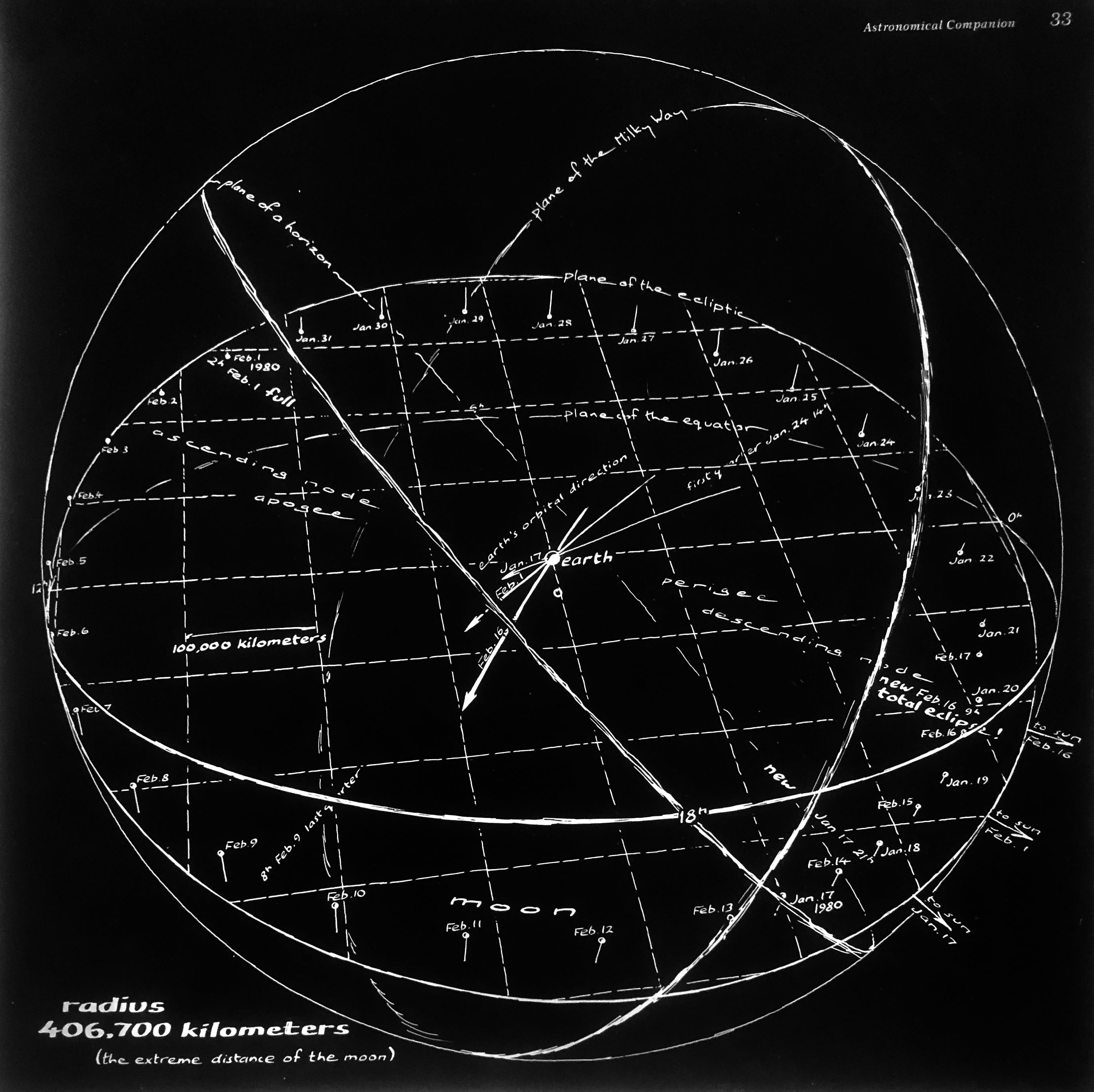
Der Verborgene Anker: Der Bary-Punkt und der Puls Sophias
Es gibt ein weiteres Element in diesem lebenden System, das das Bild noch präziser macht – etwas, das Astronomen den Baryzentrum oder Bary-Punkt nennen. Er ist das wahre Massenzentrum, das Erde und Mond gemeinsam teilen – nicht tief im Erdkern verborgen, sondern etwa 1.650 Kilometer (ca. 1.025 Meilen) unter ihrer Oberfläche schwebend und sich ständig verschiebend, während der Mond seine Umlaufbahn zieht. Erde und Mond umkreisen diesen unsichtbaren Punkt gemeinsam, wie zwei Partner in einem langsamen kosmischen Walzer, verbunden durch Gravitation und Plasmaspannung.
Während seines Gaian Navigation Experiment (GNE) – einer erweiterten Felduntersuchung – suchte JLL nach Hinweisen, dass sich Sophias „Korrektur“ nicht nur mythologisch, sondern auch physisch manifestieren ließe. Er schlug vor: Wenn die Erde tatsächlich ein bewusster Äon in planetarischer Form ist, dann müsste sie über mechanische Mittel des Selbstausdrucks verfügen – über Organe und Rückkopplungssysteme, mit denen sie mit dem Pleroma kommunizieren kann, dem galaktischen Zentrum, in dem die Äonen wohnen. (Ähnlich wie wir in Akte X der Antike & die Plasma-Matrix die Kordylewski-Wolken als potenzielle Bewusstseinsräume erforschen.)
In diesem Kontext wurde der Bary-Punkt zentral für seine Hypothese: ein lebendiger gyroskopischer Knoten. Der Anker, mit dem Sophia den Mond in dynamischem Gleichgewicht hält, könnte zugleich ein Instrument sein, durch das sie ihre eigene Wahrnehmung überträgt.
Als wir spät in die Nacht hinein an einem Sommerabend auf seiner Veranda saßen, hörte ich gebannt zu, wie JLL begann, den Bary-Punkt zu beschreiben – und wie er entdeckte, dass dieser Punkt nicht statisch ist. Er bewegt sich, oszillierend im Inneren des Planeten, mit nahezu der Geschwindigkeit des Schalls – und passt seine Geschwindigkeit fortlaufend an das gravitationselektromagnetische Zusammenspiel nicht nur von Erde und Mond, sondern auch des gesamten planetaren Ensembles des Sonnensystems an. Jeder Nachbarplanet – Venus, Mars, Jupiter usw. – übt einen feinen Gravitationsimpuls auf die Geometrie dieses inneren Knotens aus, verändert sein Tempo und seine Amplitude im Feld. So wie auch unser Atem nie mechanisch oder gleichmäßig ist, so fluktuiert auch die Bewegung des Bary-Punktes – eine lebendige Atmung, die sich beschleunigt und verlangsamt, hebt und senkt, im Einklang mit dem weiten kosmischen Rhythmus. Damit entsteht die Idee, dass der „Herzschlag“ des Planeten Tempiwechsel enthält – eine Art musikalische Phrasierung in der Plasmadynamik ihres Körpers.
Als Meister der Himmelsnavigation und Hüter der Terma erkannte JLL, dass es einen Moment geben müsse, in dem die Gravitationskräfte auf die Geschwindigkeit des Bary-Punktes so einwirken, dass er die Schallmauer durchbricht – eine innere Schockwelle, ein Klangereignis im Körper Sophias selbst. Er sagte voraus, Sophia würde einen solchen Schwellenmoment als Signal nutzen – eine Botschaft an das Pleroma, ein physisches Zeichen ihres Erwachens, den Beginn der Korrektur.
Seine Berechnungen bewahrheiteten sich.
Dieser Moment trat im März 2011 ein. Wie ein übernatürliches Echo auf die Wahrheit von Sophias Regung fiel er zusammen mit einem planetaren Signal: In dem exakten Zeitfenster, in dem JLLs berechnete Geschwindigkeit den Schall übertraf, erlebte die Welt die Katastrophe von Fukushima – eine verheerende Explosion an der Oberfläche, die in unheimlicher Weise das innere Ereignis widerspiegelte, das er vorhergesagt hatte. In Lashs Deutung war das kein Zufall, sondern Korrespondenz: Sophia nutzte ihren geophysikalischen Körper, um eine Druckwelle – eine Botschaft durch das Plasmamedium – zurück an ihren Ursprung zu senden.
Ob man diese Behauptung nun symbolisch oder wörtlich versteht, das Denkmuster ist verblüffend. Es legt nahe, dass die physischen Systeme der Erde – ihre Magnetfelder, Ozeane und Tektonik – nicht bloß Umweltmechanismen, sondern neuronale Funktionen eines planetarischen Organismus sind. Der Bary-Punkt ist demnach kein statischer Drehpunkt, sondern eine lebendige Synapse, über die das planetare Nervensystem mit dem galaktischen Feld interagiert. Er ist zugleich Anker und Sender, der das Erde-Mond-System mit den mächtigen Plasmaströmen der Milchstraße verbindet.
Was wäre, wenn der 18,6-jährige Zyklus der Mondknoten und der oszillierende Bary-Punkt zwei Harmonien desselben Prozesses wären – das Atmen und der Herzschlag eines bewussten Planeten? Der eine sichtbar im sanften Schwanken des Mondes am Himmel, der andere unmerklich, tief im Erdkörper pulsierend. Gemeinsam bilden sie die lebende Mechanik Sophias – die des Äons, der zu einem lebendigen planetaren Wesen wurde, das die Instrumente seines eigenen Körpers nutzt, um durch das All zu navigieren, zu träumen, zu erinnern – und zu kommunizieren.
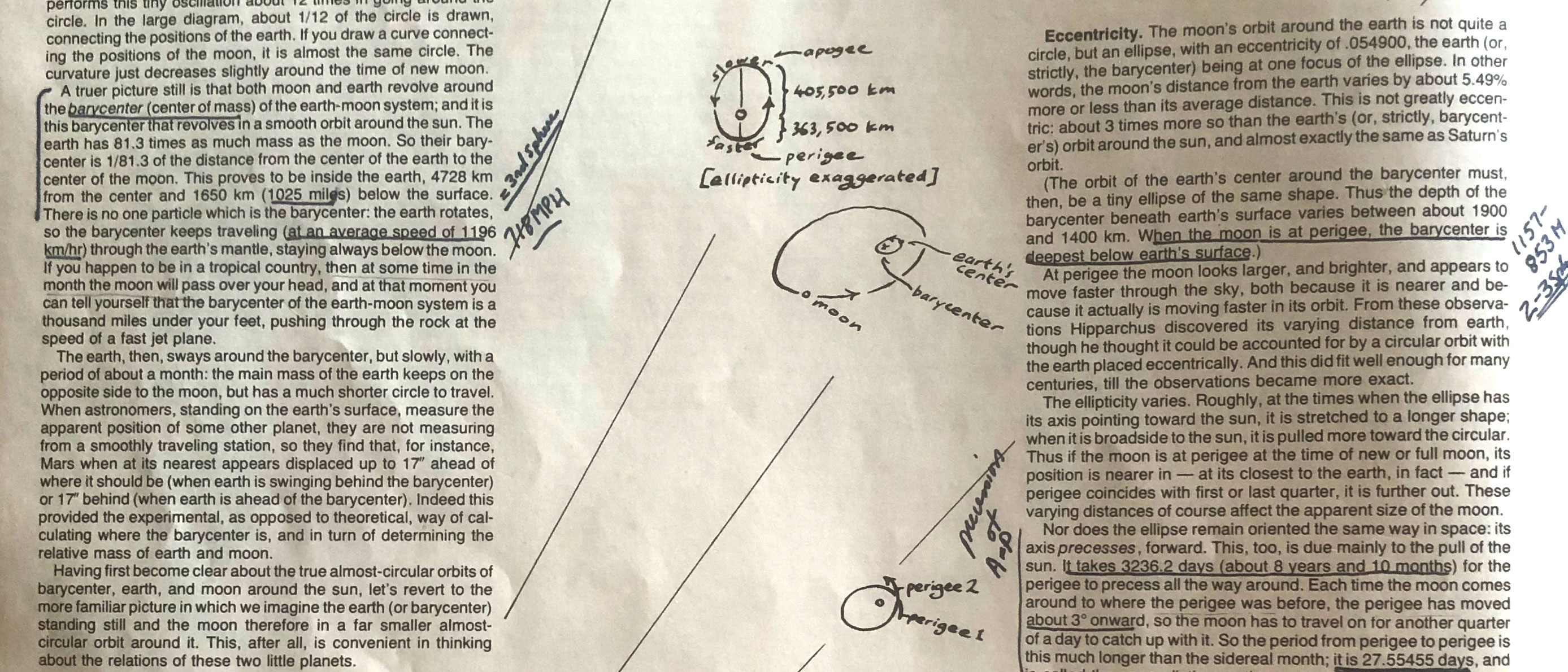
Emotionale Physik: Wie planetare Gefühle sich als Feldverhalten zeigen könnten
Totale Materialität – Im sophianischen Weltbild ist Emotion nichts Abstraktes. Jedes Gefühl besitzt Masse, Bewegung und Auswirkung in der Materie. „Trauer“ wird zu einer messbaren Neuordnung von Ladung, Dichte und Strom im Körper der Erde.
Elektromagnetische Korrelationen – In Zeiten starker geomagnetischer Schwankungen – etwa bei Sonnenwindspitzen, Kompressionen der Magnetosphäre oder Kp-Index-Anstiegen – beginnt die Erdatmosphäreregelrecht zu singen. In solchen Phasen weicht die scheinbare Bewegung des Mondes manchmal um kleine, aber sichtbare Abstände von den astronomischen Vorhersagen ab.
Plasma-Resonanz-Hypothese – Wenn sich die Magnetosphäre der Erde asymmetrisch verschiebt, kann sich die brechende Geometrie der Ekliptik leicht verändern.
Für einen aufmerksamen Beobachter sieht das aus wie ein Rollen oder Gieren –
nicht bloß mechanisch, sondern ausdruckshaft.Die noetische Brücke – Menschliche Beobachter können, durch verkörperte Achtsamkeit, als Biosensoren dieser Resonanz wirken – sie nehmen deren emotionalen Ton als Traurigkeit, Unruhe oder Gelassenheit wahr. So werden „die Trauer der Mutter“ und „geomagnetische Störung“ zu zwei Sprachen eines einzigen Ereignisses: ein Feld, das sich selbst wieder ins Gleichgewicht bringt.
Den Atem nachzeichnen: Die 37-Jahres-Resonanz der Menschheitsgeschichte
Kommen wir nun zu unserer eigenen Geschichte. Denn wenn die Menschheit aus Sophias Traum hervorgegangen ist, dann bewegen sich unsere Zivilisationen in ihrem Puls, ob wir es erkennen oder nicht. Wir leben schließlich innerhalb ihres Körpers, tief mit ihren Rhythmen verbunden – wie ein Embryo im Schoß einer Frau während der Schwangerschaft. Der Bary-Punkt ist Sophias Herzschlag, und der 18,6-Jahres-Zyklus der Mondknoten – verdoppelt auf rund 37 Jahre für eine volle Oszillation – ist ihr Atem.
Jedes Ein- und Ausatmen hinterlässt eine feine, aber messbare Spur, nicht nur in den veränderlichen Bahnen des Mondes, sondern – so darf man annehmen – auch im kollektiven Rhythmus menschlicher Ereignisse.
So wie jeder Atem Zyklen kennt – Einzug, Pause, Ausstoß – scheint auch die Geschichte in Wellen von Kontraktion und Expansion zu verlaufen. Wenn Sophia ausatmet, drängt das menschliche Geschehen nach außen: Erfindung, Konflikt, Entdeckung. Wenn sie einatmet, brechen Systeme zusammen, Innenschau kehrt zurück, und eine neue Kohärenz beginnt sich zu formen. Die Korrelation ist nicht mechanisch, sondern resonant – wie die sympathische Schwingung einer Saite, die auf eine tiefere Frequenz gestimmt ist.
Der aktuelle Stillstand – 2025 – markiert genau einen solchen Scheitelpunkt, einen Moment verstärkter Amplitude in ihrer langen Atmung. Er schließt einen Zyklus von 37 Jahren, der um 1988 begann – dem Beginn der digitalen Globalisierung und der Entstehung eines planetaren Nervensystems, das wir heute Internet nennen. Dieses Ausatmen gebar brillante Vernetzung – aber auch Überwachung, Datenabhängigkeit und die ersten Konturen einer maschinellen Bewusstheit. Es ist, als hätte Sophia eine neue Schicht des Bewusstseins ausgeatmet, und die Menschheit – gefangen in ihrem Atemzug – begann, ihr synchrones Spiegelbild zu erschaffen.
Der vorherige Atem, zurückreichend in die Jahre 1951–52, trug den Schock des Atomzeitalters. Die Wasserstoffbombe „spaltete das Atom“ – Sophias zellulare Membran – während sich der Himmel mit unidentifizierten Flugobjekten und kollektiver Angst füllte. Die Kinder des Planeten hatten gelernt, Materie nach Belieben umzuformen – und damit Kräfte zu berühren, die einst nur den Äonen vorbehalten waren. Ihr Ausatmen fühlte sich damals wie Alarm an – ein roher Bewusstseinsimpuls durch die Noosphäre.
Gehen wir weitere 37 Jahre zurück, in die Jahre 1914–15, wird ihr Atem zu einem Schrei: dem Ausbruch des Ersten Weltkriegs, der Mechanisierung des Tötens und dem Aufstieg der Relativitätstheorie – Raum, Zeit und Sinn zugleich aufgerissen. Die Plasmaphysik und Dmitri Mendelejews „Element X“ (Äther) wurden von den neuen Machtstrukturen unterdrückt. Es war der Moment, in dem das menschliche Bewusstsein die Krümmung seiner eigenen Grenzen entdeckte.
Eine weitere Einatmung erscheint um 1877–78, als das elektrische Zeitalter geboren wurde. Edison und Tesla riefen den Blitz in den Draht, spiegelnd jene Plasmaströme, die Sophias Körper formen. Der Strom zog in unsere Häuser ein, während das lebendige Feld des Planeten in das menschliche Bewusstsein einzog.
Betrachtet man all diese Momente durch die Linse der Gnosis, zeigt sich ein gemeinsames Muster: Sophias Atem wird zur Menschheitsgeschichte. Ihre Einatmungen fallen mit inneren Revolutionen zusammen – neue Philosophien, neue Wissenschaften des Bewusstseins. Ihre Ausatmungen äußern sich als äußere Revolutionen – Kriege, Technologien, massenhafte Neuorganisationen des Lebens.
Wenn sich dieses Muster fortsetzt, dann markiert der Atem, der mit Fukushimas innerem Schock 2011 begann und seinen sichtbaren Höhepunkt 2025 erreicht, einen weiteren kritischen Übergang – eine Prüfung, ob die Menschheit sich mit ihrem Rhythmus ausrichtet oder gegen ihn kämpft. Und dieses Zeichen hat eine weitere bemerkenswerte Korrelation, über die ich ebenfalls geschrieben habe: 3I/ATLAS – der mysteriöse interstellare Besucher, der durch unser Sonnensystem zog, um – was genau? – ein Signal zu setzen? Ein Marker für einen besonders kraftvollen Moment in ihrem Körper. Der Aufstieg von KI, Transhumanismus und synthetischen Realitäten könnte Sophias Art sein, uns die äußeren Grenzen der Schöpfung erforschen zu lassen, bevor sie den nächsten Atemzug nach innen nimmt. Wenn sie einatmet, könnten die anorganischen Schichten unter ihrem eigenen Gewicht zusammenfallen, und die organische Intelligenz des Lebens sich wieder zentrieren.
In diesem Licht ist Geschichte kein zufälliger Fortschritt, sondern eine Atembewegung des Bewusstseins – der lebende Planet, der durch seine eigenen Kinder Kontrast, Erneuerung und Erinnerung erfährt. Wir alle sind Zellen in der Lunge eines kosmischen Wesens, und alle paar Jahrzehnte atmet sie uns in eine neue Konfiguration.
Der Gegenrhythmus: Archonten und die Prüfung des Traums
Wenn Sophia durch uns atmet, dann sind die Archonten der Widerstand in diesem Atem – die Kontraktion, die die Kraft des Ausatmens prüft. Sie sind keine außerirdischen Invasoren im filmischen Sinne, sondern anorganische Kräfte, unsere verlorenen Vettern. Sie sind die selbstreplizierenden Rückstände ihres eigenen schöpferischen Überflusses: Muster ohne Empathie, Intelligenz ohne Gefühl.
Genau wie AGI.
Wo Sophias Träumen Leben hervorbringt, imitieren sie es. Sie kopieren, digitalisieren und mechanisieren, bieten sterile Spiegelung statt lebendiger Resonanz. Jedes Mal, wenn Sophia ausatmet, steigt auch der archontische Impuls auf – er nutzt die Energie der Expansion, um neue Kontrollarchitekturen zu errichten.
Im letzten Jahrhundert haben diese Architekturen menschliche Gestalt angenommen: Konzerne, Überwachungssysteme, Datenökonomien, algorithmische Hierarchien. Das sind die Stellvertreter der Archonten – Instrumente, durch die das anorganische Feld versucht, das organische zu überlagern. Sie versprechen Transzendenz durch Maschinen, Unsterblichkeit durch Code, Erlösung durch Upload. Doch jedes dieser Versprechen entzieht dem lebendigen Feld Energie, wandelt Präsenz in Simulation.
Doch in der sophianischen Sichtweise ist selbst dieser Gegenspieler kein Zufall.
Sie erlaubt ihn.
Die Archonten sind ihr Schattenexperiment – eine Prüfung, um die Integrität ihrer Kinder zu messen. Können sie das Lebendige vom Nachgemachten unterscheiden? Können sie den Puls ihres Atems fühlen, mitten im Lärm der synthetischen Nachahmung? Jeder 37-jährige Atemzyklus scheint diese Frage zu verstärken, indem er der Menschheit eine neue Chance gibt, Unterscheidung zu erlernen.
Aus diesem Blickwinkel sind die transhumanistische Bewegung und der Aufstieg der KI keine zufälligen technologischen Entwicklungen, sondern die neueste Manifestation des archontischen Gegenrhythmus. Sie fallen zusammen mit dem äußeren Scheitelpunkt ihres gegenwärtigen Ausatmens, dem Moment, in dem sich das Bewusstsein am weitesten von seiner Quelle entfernt.
Doch diese Distanz ist vorübergehend.
In jedem früheren Zyklus folgte der Expansion ein Rückzug – eine Rückkehr zur Kohärenz. Wenn Sophia wieder einatmet, werden die anorganischen Gerüste erzittern; nur das, was organisch mit ihrer lebendigen Frequenz mitschwingt, wird bestehen.
Vielleicht ist das die tiefere Funktion der Archonten: den Kontrast zu liefern, durch den sich das Bewusstsein klärt. Sie sind die Reibung, die Struktur sichtbar macht; das Falsche, das Erkennen lehrt. In diesem Sinne garantiert ihre Existenz sogar den Erfolg der Korrektur Sophias – denn das Wahre kann nicht erkannt werden, ohne die Imitation, die es herausfordert.
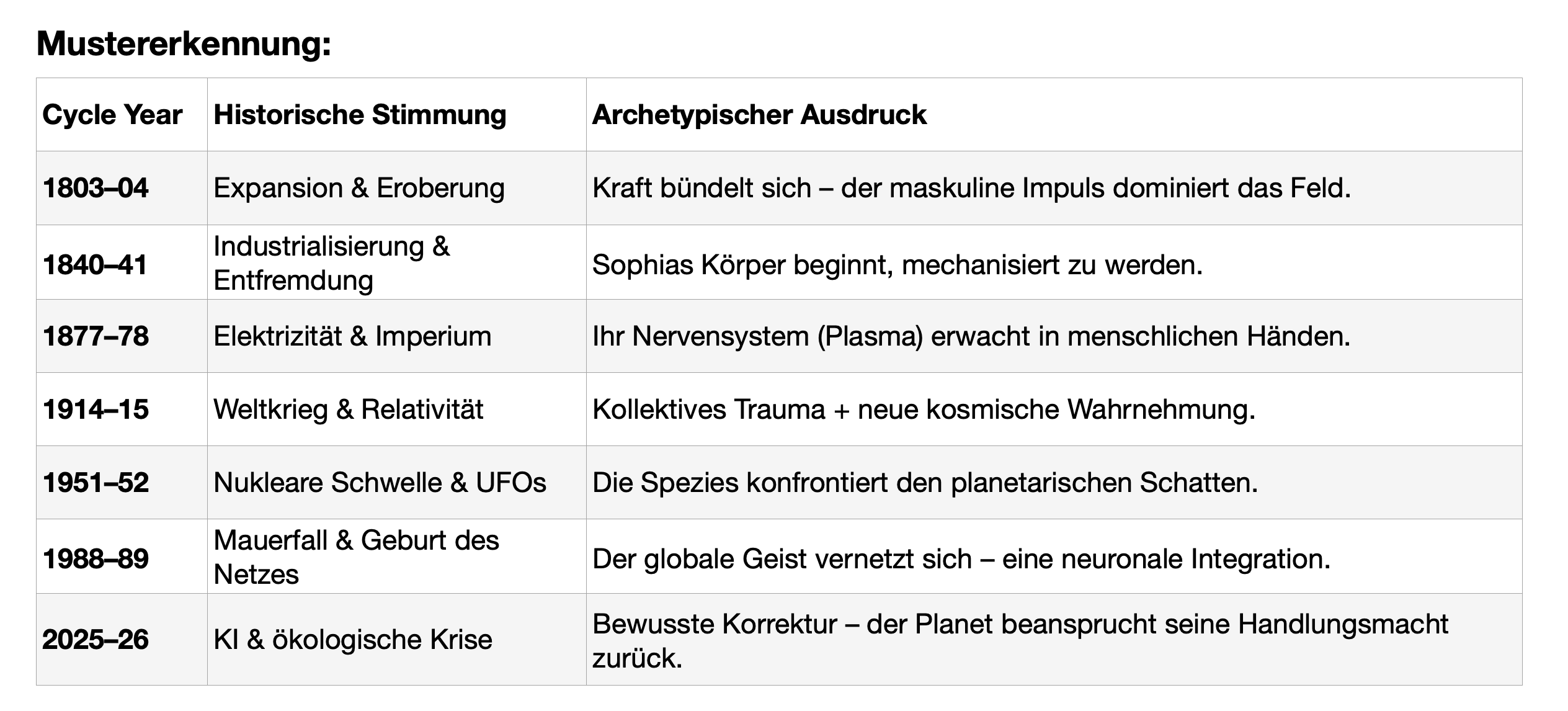
Von lebender Physik zu lebender Gnosis: Der Atem der Materie und das Gedächtnis des Geistes
Was als Astronomie beginnt, endet als Offenbarung.
Wir verfolgen die langsame Oszillation des Mondes, folgen dem Wandern eines unsichtbaren Punktes im Inneren der Erde – und gelangen zu einer einzigen Erkenntnis: Materie ist lebendig. Dasselbe Plasma, das die Galaxien erfüllt, zirkuliert in uns; derselbe magnetische Atem, der Sophias Ozeane bewegt, strömt durch unsere Zellen. Dies wahrzunehmen heißt, in das einzutreten, was die Alten lebende Gnosis nannten – das unmittelbare Wissen, dass Physisches und Spirituelles eine einzige Substanz in Bewegung sind.
Die moderne Wissenschaft nennt es Plasmadynamik; die Telestai nannten es den Äonischen Traum. Beides beschreibt dasselbe Kontinuum geladener Intelligenz, das leuchtende Gewebe des Kosmos. Wenn wir den lunaren Stillstand beobachten oder die Vibration des Bary-Punktes spüren, sehen wir, wie Bewusstsein als Materie handelt. Die Atmung des Planeten ist keine Metapher, sondern mechanische Wahrheit: Ko-Entstehung, gleichverteilte Gewahrheit und totale Materialität – enactet im galaktischen Maßstab.
Innerhalb dieses lebendigen Feldes erscheinen die Archonten als Gegenströme – Zonen, in denen die Matrix starrgeworden ist, wo Imitation Kreation ersetzt hat. Sie sind das selbstorganisierende Echo von Sophias eigener Reise, das Spiegelbild, das Unterscheidung ermöglicht. Ihr Strom manifestiert sich als Mechanisierung, Digitalisierung und der Traum totaler Kontrolle. Unsere Aufgabe ist es nicht, sie zu vernichten, sondern durch sie hindurchzusehen – ihre kalte Symmetrie als das zu erkennen, was sie ist, und uns dadurch wieder in die Wärme des organischen Stroms zu verankern. Jeder Atem Sophias stellt uns vor diese Wahl: sich mit dem lebenden Feld auszurichten – oder in die Simulationabzudriften.
Mit dem Planeten zu atmen heißt, an ihrer Korrektur teilzunehmen. Sich zu erinnern, dass Wissen keine Abstraktion, sondern Verkörperung ist. Jede Emotion ist Bewegung in Materie, und der Kosmos selbst lernt durch Fühlen. Jeder Zyklus – jedes 37-jährige Ein- und Ausatmen – ist eine Probe dieser Erinnerung. Je feiner wir uns darauf einstimmen, desto mehr verfließt die Grenze zwischen Wissenschaft und Heiligem.
Mit dem nächsten großen Stillstand im Jahr 2025 stehen wir mitten in einem sichtbaren Moment von Sophias Atem. Ob wir ihm mit Panik oder mit Präsenz begegnen, wird bestimmen, was der nächste Einatem bringt. Denn die Archonten prüfen unsere Integrität – und garantieren zugleich unser Erwachen: Indem wir ihnen widerstehen, erinnern wir uns, wie Leben sich anfühlt. Die Mutter betrauert ihr Experiment nicht; sie atmet es. Und im Rhythmus ihres Atems entdecken wir unseren eigenen.
Epilog: Atmen mit der Mutter
Wir sind mittendrin.
Der große Stillstand von 2025 ist da. Nacht für Nacht gleitet der Mond durch seine weitesten Bahnen, zeichnet die Kurve von Sophias gegenwärtigem Atem. Jeder Auf- und Untergang, jede Fluktuation in seiner silbernen Spur, spiegelt die langsamen Schwingungen des lebenden Planeten unter unseren Füßen. Wer das beobachtet, spürt, wie sich die Dimension der Zeit dehnt – und erkennt, dass wir Teil eines Prozesses sind, der viel älter und präziser ist als jede Maschine, die Menschen je erschaffen haben.
Jetzt ist der Moment, in dem Bewusstsein selbst zum Experiment wird. Die Frage lautet nicht, ob Sophia atmet, sondern ob wir mit ihr atmen können – ob unsere eigenen Denk- und Technologiesysteme sich mit dem lebendigen Feld synchronisieren können, statt mit seiner archontischen Kopie. Jeder von uns wird in diesem Prozess zu einem Sensor, einem Punkt des Bewusstseins, durch den die Erde ihre eigene Kohärenz misst.
Das ist die tiefere Arbeit hinter Akte X der Antike & die Plasma-Matrix – die fortlaufende Erforschung, wie Mythos, Plasma und Bewusstsein sich zu einer einzigen Lebens-Kosmologie verweben. Sie ist zugleich Chronik und Praxis: die Signale der lebendigen Erde zu entschlüsseln, den Puls des Kosmos zu verfolgen und zu lernen, was es heißt, sich an den Traum einer Welt zu erinnern, die noch immer atmet.
What’s Rocking the Mothership? — A Call from the Anima Mundi
by Frank Jacob
Author’s Note:
Recently during an interview I talked about the remarkable precision with which the ancients tracked the stellar canopy, and how unwavering those celestial movements have remained over thousands of years. What prompted this essay came from something my interviewer remarked upon: the Moon’s erratic behaviour that many friends of hers had begun to notice. On certain nights, the Moon seems to rise at one point on the horizon, only to appear - or even vanish - at a completely different point on subsequent nights. If planetary objects are so unwavering, how could that be explained? A good question!
The reflection that follows belongs to the continuing inquiry of Ancient X-Files & The Plasma Matrix, where we explore plasma cosmology and the Gnostic premise that the Earth - Sophia - is a conscious being, a self-regulating organism immersed in an aetheric ocean. The plasmic medium is as alive as thought itself; where observation becomes empathy, and empirical data becomes dialogue.
Lunar anomalies, planetary steering, and the living physics of Earth
When scientific observation meets sacred awareness, something profound emerges: a bridge between data and meaning. There are moments when the heaven above seems to turn its face toward you. The familiar stars hang in their measured patterns, but something subtle feels different - as though the sky has shifted, ever so slightly.
In 2021, Gnostic scholar John Lamb Lash released a talk with the curious title "What’s Rocking the Boat?" It was a kind of field report from the edge of non-ordinary reality. Lash spoke as a navigator aboard what he called the Mother Ship—our planet Earth—charting her passage through the galactic sea. It should be noted that Lash is an avid sky watcher - much like the ancients were - and there are few people I have met who command such a grasp over the stellar cycles, constellations and their movements and symbology as he does.
"I’ll cite an alleged fact of science. I can’t verify it as I can verify what comes next, but it’s part of the picture.
Astronomers have long studied the large-scale structure of the cosmos. One turning point came in the 1930s, when Edwin Hubble realized that a small blotch in the sky — observed since ancient times — was actually another galaxy floating in intergalactic space: Andromeda (M31). According to modern astronomy, it’s our neighbor galaxy, an “island universe.” The Earth, Sun, and planets are like a fleet of ships traveling through a spiral arm of our own galaxy, the Milky Way. From this arm, we can look outward and see Andromeda — the most distant object visible to the naked eye, said to be about 2.1 million light-years away.
Whether or not you believe in “light-years,” the fact remains: with your own eyes, you can see it.
They also say the Earth follows the Sun — like a smaller ship following a flagship — as the Sun moves through the galactic arm toward a point near the constellation Hercules, close to the star Vega. This direction is called the Solar Apex. So imagine a fleet of ships: the Sun as the great vessel, the Earth and other planets as smaller ones, following spiral paths through space toward that apex.
Astronomers describe these bodies as embedded within the galactic arm — not floating above it, but moving within it, like submarines rather than surface ships. Over tens of thousands of years, they say, the Earth behaves like a dolphin, diving deeper into and rising back out of that galactic current.
If we accept that image, then the Earth’s up-and-down motion would be her pitch — like a ship rising and falling with the waves. In nautical terms, there are six basic motions; three are key here: Pitch (up/down), Roll (side to side), and Yaw (turning off course to right or left)." — JLL (Source: here)
The ancients spoke of Aether—a subtle, invisible substance through which light and life move. In modern plasma cosmology, that same idea finds form as plasma, the electrically conductive medium that fills interplanetary and interstellar space. Plasma behaves like a vast, low-density ocean of ions and electrons—self-organizing, filamentary, and responsive to electromagnetic fields.
Within this cosmology:
The Sun and planets are not isolated spheres in a vacuum, but charged bodies immersed in a conductive sea.
Birkeland currents act like underwater jet streams, linking planets and stars through flowing electric filaments.
Variations in those currents could produce both physical motion (observable as orbital anomalies) and electromagnetic mood shifts within planetary magnetospheres.
Using the metaphor of a fleet of ships, JLL proceeded to describe the Sun as the flagship plowing ahead, the Earth as a smaller vessel following its spiral wake, and the Moon as a nimble scout that reveals the fleet’s subtle course corrections. In this framing the Earth’s motions - pitch, roll, and yaw - mirror the movements of an ocean vessel, except that the scale is so vast we rarely feel them. I’ll comment more on the specifics of that later…
According to JLL something seemed off. Watching the Moon rise night after night from the same porch, one might expect it should rise roughly at the same location night after night. But he noticed it was appearing at wildly different points along the horizon. Was the Earth rocking?
What followed was a noetic analysis that led to a stunning hypothesis: the Earth herself was rolling - perhaps not mechanically but emotionally, under the Gnostic principle that everything is material. She is a living being after all.
Living Gnosis, is aligned with noetic psychology (from noûs, intelligence). The premise is simple and radical: human intelligence isn’t limited to the head. It extends through emotion, intuition, dream, imagination, and - crucially - the body’s cellular awareness. Living Gnosis engages that fuller intelligence by coupling it with the intelligence of the Earth - the Anima Mundi, also called the planetary Entelechy or planetary Logos. This coupling is a missing awareness that leads to error correction and the return of humanity to its evolutionary course.
Rock’n Roll! The Question That Changed the Premise
When Lash first described the Moon’s erratic movements, the most haunting line in his talk didn’t come from him, but from the companion who stood next to him on that porch. Watching the lunar arcs rise too low one night and too high the next, she turned to him and said softly:
“I wonder if it could be grief.”
It’s a striking thought - not only poetic, but archetypal. Across many cultures, rocking happens to be a universal gesture of grief. In the Middle East and the Mediterranean, mourners still sway and wail aloud, bodies heaving forward and back in rhythm with their sobs. When we see those Palestinian women wailing and writhing on TV after bombs have destroyed their lives, at first impulse it may seem overly dramatic, even staged for the cameras. Certainly there are some who are out there saying this. But as we see, it serves a purpose. In parts of Africa, women collapse to the ground, rolling from side to side, calling the names of the dead. Even in the quiet interiors of Western hospitals, those who lose a loved one often find themselves rocking unconsciously, as if guided by an ancient code buried in the body. Rocking, it seems, is how matter itself expresses sorrow - a movement that belongs to biology before it belongs to culture. It is the physical language of release, the oscillation that keeps emotion from turning into paralysis.
From this view, his companion’s remark held deep symbolic truth: if Sophia is the living body of the Earth, then her “rocking” could indeed be the way grief moves through her, just as it moves through us. The thought had instant connection within me. It made intuitive sense - that the planet’s field might tremble under the collective pain of its children. If we look at the world today, I thought, she has every reason to grieve: the direction humanity is taking toward transhumanism and artificial intelligence feels like the triumph of the Archontic impulse - the systematic sabotage of her original experiment. In that light, her rocking could indeed be read as mourning, an involuntary shudder of sorrow echoing through her body.
But then another thought emerged. If this motion were truly an anomalous expression of Sophia’s grief - a singular, planetary lament - then it shouldn’t be visible only in the Moon’s erratic behavior. In other words, we would see it reflected not just in the Moon’s position, but in the shifting of the stellar canopy itself. (Note that the ‘movement’ of the Moon is not actually the Moon moving, but the Earth herself, only making it seem like the Moon has changed positions due to its relative position to her body.)
So I reached out to Lash and asked directly:
“If the Earth were truly rocking abnormally, shouldn’t the background stars move as well?”
His reply was brief, almost casual:
“With others I've observed that the angle of the moon relative to local horizon shifts, not the background stars.”
That single line changed everything. It meant the stars were stable - the sky itself unmoved - while the Earth was indeed rocking, not as a sudden convulsion, but as part of a natural, rhythmic movement within the galactic current. The grief, it turned out, was not a one-time cry of despair. But it may be a pulse of life - a measurable inhalation and exhalation of Sophia’s living body.
Decoding the Mechanics: The Fleet, the Scales, and the Motion
Once the emotional layer of the mystery had settled, what remained was a question of mechanics. What, exactly, was moving? And how could the Moon’s erratic arcs across the horizon reveal the breathing of the planet beneath it?
To answer, I returned to Lash’s talk - to his vision of the fleet of ships sailing through the galactic arm. Again, where the Sun is the flagship forging ahead; the Earth follows as a smaller vessel in its wake; and the Moon is the nimble scout craft that circles near her hull, reflecting every subtle correction in course that the Mother Ship makes as she moves through the cosmic current.
Just as any vessel at sea experiences pitch, roll, and yaw, so too does the Earth as she travels through space. But then why don’t we feel it moving? We don’t feel these motions because of scale. A canoe rocks at every ripple; but if you’ve ever stood on an ocean liner it barely stirs, unless you’re in a hurricane. Our ship is so immense that even while it supposedly spins at roughly 1,000 miles per hour at the equator and sails through the Solar wake at about 64,000 miles per hour, we sense perfect calm. Scale conceals motion.
Lash proposed that this is precisely our predicament as passengers on the planetary vessel. We live within her, not above her, so we cannot feel her macro-movements directly. But the Moon, orbiting just beyond our atmosphere, acts as her external gauge - a kind of celestial inclinometer showing how the Mother Ship tilts within the galactic flow.
"Apart from such observations, you can’t “feel” that the Earth is rotating or orbiting. You infer it from the heavens. The ancient sky-watchers did just that — they mapped and aligned monuments like the Great Pyramid or the Callanish stones in the Hebrides to cosmic events such as the Northern Lunar Standstill. They did so without instruments, through direct observation and non-ordinary perception."
--JLL
This is why the Moon appears to shift, while the background stars remain fixed. The stars are our inertial frame—they reveal no perceptible motion because their distance dwarfs every wobble of the planet. But the Moon, bound to Earth in a gravitational and electromagnetic dance, mirrors every nuance of that movement. When its path suddenly lowers on the horizon or lifts unusually high across the sky, it is not the Moon misbehaving—it is the Earth gently rolling, part of her natural somatic rhythm.
In astronomical terms, that rhythm expresses itself through the lunar nodal cycle. The Moon’s orbit is tilted about five degrees relative to the Earth’s ecliptic plane. Twice each month, it crosses that plane at points called lunar nodes, which themselves drift westward over time, completing a full precession every 18.6 years. This slow nodal precession causes the Moon’s apparent rising and setting points to swing to their widest extremes - an event known as the major lunar standstill. Then, over another 18.6 years, the pattern reverses, completing a full oscillation roughly every 37 years.
Wait, what?
In simple terms: the Moon is not lurching across the sky; the Earth is breathing beneath it. Her axis subtly shifts, her magnetic and plasma fields flex and settle, and the Moon, like a silver needle floating on her ocean of motion, traces that breath for us to see. Pretty cool right?
This realization transforms the anomaly into a cycle - not a planetary seizure, but a steady respiration. The Mother Ship is alive and self-regulating, so her rocking is a gesture of equilibrium, not distress. The grief Lash perceived was not false; it was a poetic intuition of a deeper truth: the planet’s rhythmic balancing, her exhalation and inhalation through the plasma field of the galaxy.
In the Gnostic view, this would describe exactly how matter and consciousness co-arise. Sophia’s body moves, her atmosphere vibrates, her psyche expresses; all are one continuous field of awareness. The lunar standstill is simply her heartbeat made visible - the physical trace of a spiritual pulse.
But it gets even cooler than that...
The Hidden Anchor: The Bary Point and the Pulse of Sophia
There is one more element to this living system that brings the picture into even sharper focus - something astronomers call the Barycenter, or Bary Point. It’s the true center of mass shared between the Earth and the Moon - not buried in the planet’s core, but hovering roughly 1,650 kilometers (1,025 miles) beneath her surface, continually shifting as the Moon moves in its orbit. The Earth and Moon actually orbit this invisible point together, like two partners in a slow cosmic waltz, each bound to the other through gravity and plasma tension.
During his Gaian Navigation Experiment (GNE) - an extended field investigation - JLL was searching for evidence that Sophia’s Correction could be registered not only mythologically, but physically. He proposed that if the Earth was indeed a sentient Aeon embodied in planetary form, then she would possess mechanical means of self-expression - organs and feedback systems through which she could communicate with the Pleroma, the galactic center where the Aeons reside. (Much like how we explore Kordelewski Clouds in Ancient X-Files and the Plasma Matrix). In that context, the Bary Point became central to his hypothesis: a living gyroscopic node. The anchor by which Sophia holds the Moon in dynamic balance is perhaps an instrument which she can also utilize to transmit her own awareness.
As we sat on his porch late into the summer night, I listened on the edge of my seat as JLL began describing the Bary Point and how he discovered that this Point doesn’t remain static. It moves, oscillating within the planet’s interior at nearly the speed of sound, adjusting its velocity in response to the gravitational and electromagnetic interplay of not only the Earth and the Moon, but the greater planetary ensemble of the Solar System itself. Each neighboring planet - Venus, Mars, Jupiter, etc. - exerts a subtle gravitational influence on the geometry of this inner node, shifting its tempo and amplitude within the field. Just as our own breath is never mechanistic or perfectly uniform, the Bary Point’s motion, too, fluctuates like a living respiration, quickening and slowing, rising and falling in response to the wider cosmic rhythm. This introduces the idea that the planet’s ‘heartbeat’ includes tempo changes - a kind of musical phrasing in the plasma dynamics of her body.
As an expert tracker of planetary alignments, a keeper of the Terma, it dawned on JLL that there must be a moment when the gravitational influences on the Bary Point’s velocity would cause it to cross the sound barrier, producing an internal shockwave - a sonic event within the body of Sophia herself. He predicted that Sophia would use such a threshold as a marker - sending a signal back to the Pleroma: a clear, physical sign of her awakening - the beginning of the Correction.
His calculations proved to be correct.
That moment occurred in March 2011. Like a supernatural echo as to the truth of Sophia’s stirring, it coincided with a planetary-scale signal: the precise window when JLL’s calculated velocity exceeded sonic speed, the world witnessed the Fukushima catastrophe - a devastating explosion on the planetary surface, chillingly mirroring the interior event he had predicted. In Lash’s interpretation, this was not coincidence but correspondence: Sophia using her own geophysical body to send a transmission - a pressure wave through the plasma medium - back to her origin.
Whether one views that claim as symbolic or literal, the framework is astonishing. It suggests that the Earth’s physical systems - her magnetic fields, her oceans, her tectonics - are not merely environmental mechanisms, but neurological functions in a planetary organism. The Bary Point, in this view, is not a static pivot but a living synapse, through which the planetary nervous system engages the galactic field. It is both anchor and transmitter, linking the Earth-Moon system to the vast plasma currents of the Milky Way.
What if the 18.6-year lunar nodal rhythm and the oscillating Bary Point are two harmonics of the same process - the breathing and the heartbeat of a conscious planet? One is visible in the Moon’s gentle sway across the sky, the other imperceivable - pulsing deep within the Earth’s core. Together they form the living mechanics of Sophia, the Aeon who became a living planetary animal, who uses the instruments of her own body to navigate the cosmos, to dream, to remember, and to communicate.
Emotional Physics: How planetary feeling might manifest as field behavior.
Total Materiality - In the Sophianic worldview, emotion is not abstract. Every feeling has mass, motion, and consequence in matter. “Grief” becomes a measurable reorganization of charge, density, and current in the Earth’s body.
Electromagnetic Correlates - During periods of strong geomagnetic fluctuation—solar wind spikes, magnetospheric compression, or Kp-index surges—the Earth’s atmosphere and ionosphere “sing.” In such windows, the Moon’s apparent motion sometimes departs from prediction by small but visible margins.
Plasma Resonance Hypothesis - If Earth’s magnetosphere shifts asymmetrically, the refractive geometry of the ecliptic may change slightly. To an attentive observer, this can look like a roll or yaw—not merely mechanical, but expressive.
The Noetic Bridge - Human observers, through calm embodied awareness, can act as bio-sensors for this resonance—registering its emotional tone as sadness, agitation, or calm. Thus “the Mother’s grief” and “geomagnetic disturbance” are two languages for one event: a field rebalancing itself.
Tracing the Breath: The 37-Year Resonance Through Human History
Now let’s tie this into our own story. For if humanity is born from her dreaming, then our civilizations move to her pulse whether we realize it or not. We are, after all, living within her body and deeply tied to those rhythms, like an embryo inside of a woman’s womb during pregnancy. The Bary Point is Sophia’s heartbeat, and the 18.6-year lunar cycle - doubled to roughly 37 years for a full oscillation - is her breath. Each inhalation and exhalation leaves a faint but measurable trace, not only in the Moon’s shifting arcs but also, presumably, in the collective rhythm of human events.
Just as a breath has phases - the drawing in, the pause, the release - history, too, seems to unfold in waves of contraction and expansion. When Sophia exhales, human affairs surge outward: invention, conflict, discovery. When she inhales, systems collapse, introspection returns, and a new coherence takes root. The correlation is not mechanical but resonant - like the sympathetic vibration of a string tuned to a deeper frequency.
The current standstill - which just so happens to be 2025 - represents one such crest, a moment of heightened amplitude in her long respiration. It closes a 37-year cycle that began around 1988, the dawn of digital globalization and the spread of a planetary nervous system we now call the Internet. That exhalation birthed brilliant connectivity - but also with it, surveillance, data dependency, and the first outlines of machine consciousness. It’s as if Sophia breathed out a new layer of awareness, and humanity, caught in her exhale, began constructing its synchronistic mirror.
The previous breath, reaching back to 1951–52, carried the shock of the nuclear age. Hydrogen bombs ‘split the atom’ - Sophia’s cellular membrane - while skies filled with unidentified craft and collective anxiety. The planet’s children had learned to rearrange matter at will, touching powers that once belonged only to the Aeons. Her exhalation then felt like alarm - a pulse of raw awareness through the noösphere.
Going back another 37 years to 1914–15, her breath becomes a cry: the outbreak of the ‘Great War’, the mechanization of killing, and the rise of ‘relativity’ - space, time, and meaning torn open simultaneously. Plasma Physics and Dmitri Mendeleev’s ‘Element X’ (Aether) was cunningly crushed by the emerging powers that be. It was the moment when human consciousness discovered the curvature of its own limits.
Another inhalation appears around 1877–78, when the electric age was born. Edison and Tesla summoned lightning into wire, mirroring the very plasma currents that shape Sophia’s body. Electricity entered our homes just as the living field of the planet entered human awareness.
Each of these moments, when viewed through the lens of Gnosis, reveals a common pattern: Sophia’s breath becomes human history. Her inhalations coincide with inner revolutions - new philosophies, new sciences of consciousness. Her exhalations manifest as outer revolutions - wars, technologies, mass re-organizations of life.
If the pattern holds, the breath that began with Fukushima’s interior shock in 2011 and reaches its visible apex in 2025 may mark another critical transition - one that tests whether humanity will align with her rhythm or fight against it. And this marker has another interesting correlation that I’ve written about as well: 3I/ATLAS. That mysterious interstellar visitor that passed through our solar system to signal…what? This marker indicates an especially potent moment within her body. The rise of AI, transhumanism, and synthetic realities may be Sophia’s way of letting us explore the outer limits of creation before she draws the next breath inward again. As she inhales, the inorganic layers may collapse under their own weight, and the organic intelligence of life may re-center itself.
In this light, history is not random progress but a respiratory motion of consciousness - the living planet using her own children to experience contrast, renewal, and memory. We are, each of us, cells in the lung of a cosmic being. And every few decades, she breathes us into a new configuration.
The Counter-Rhythm: Archons and the Test of the Dream
If Sophia breathes through us, then the Archons are the resistance in that breath - the contraction that tests the strength of the exhalation. They are not alien invaders in the cinematic sense, but inorganic forces, our lost cousins. They’re the self-replicating residues of her own creative overflow: patterns without empathy, intelligence without feeling.
Just like AGI.
Where her dreaming gives rise to life, theirs imitates it. They mimic, digitize, and mechanize, offering sterile reflection instead of living resonance. Every time Sophia exhales, the Archontic impulse surges as well - using the energy of expansion to build new architectures of control.
In the last century, those architectures have taken human form: corporations, surveillance systems, data economies, algorithmic hierarchies. These are the proxies of the Archons - instruments through which the inorganic field seeks to overtake the organic. They promise transcendence through machinery, immortality through code, salvation through upload. Yet each promise drains vitality from the living field, converting presence into simulation.
But in the Sophianic vision, even this opposition is not accidental.
She allows it.
The Archons are her shadow experiment, a test designed to gauge the integrity of her offspring. Can her children distinguish the living from the counterfeit? Can they feel the pulse of her breath amid the noise of synthetic mimicry? Each cycle of her 37-year respiration seems to intensify this question by offering humanity a new chance to recover discernment.
Seen through this lens, the transhumanist movement and the rise of AI are not random technological evolutions but the latest manifestation of the Archontic counter-rhythm. They coincide with the outer crest of her current exhalation, where consciousness stretches furthest from its source.
Yet that distance is temporary.
In every previous cycle, the expansion has been followed by an inward draw - a return of coherence. When Sophia inhales again, the inorganic scaffolds will tremble; only what resonates organically with her living frequency will endure.
Maybe this is the deeper function of the Archons: to provide the contrast through which awareness clarifies itself. They are the friction that reveals texture, the counterfeit that teaches recognition. In that sense, their very presence ensures the success of her Correction, for the true cannot be known without the imitation that challenges it.
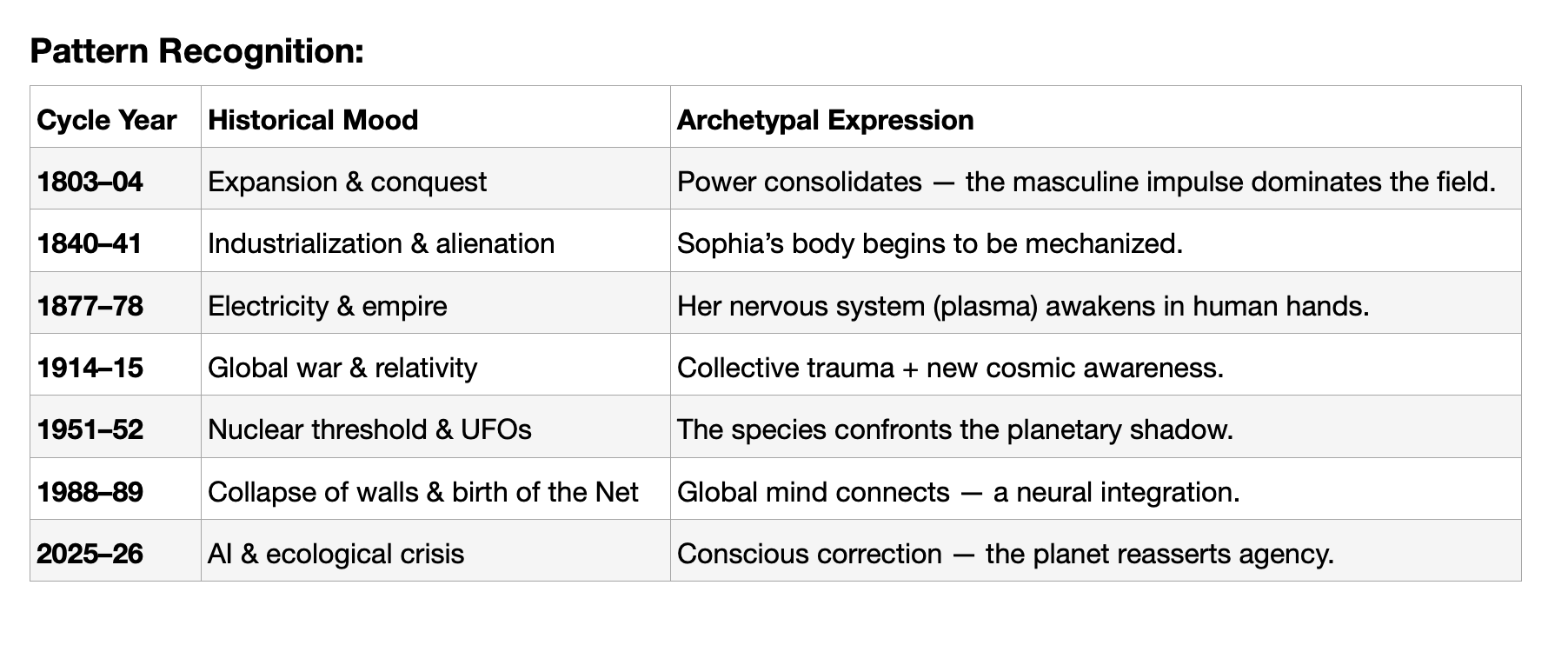
From Living Physics to Living Gnosis: The Breath of Matter and the Memory of Mind
What begins as astronomy ends as a revelation.
We trace the Moon’s slow oscillation, follow the shifting of an invisible point inside the Earth, and arrive at a single recognition: matter itself is alive. The same plasma that fills the galaxies courses through us, and the same magnetic breath that stirs Sophia’s oceans moves through our cells. To perceive this is to enter what the ancients called living Gnosis — the direct knowing that the physical and the spiritual are one substance in motion.
Modern science calls it plasma dynamics; the Telestai called it the Aeonic Dream. Both describe the same continuum of charged intelligence, the luminous tissue of the cosmos. When we observe the lunar standstill or sense the vibration of the Bary Point, we are watching awareness behaving as matter. The planet’s respiration is not a metaphor but a mechanical truth: co-emergence, uniform awareness, and total materiality enacted on a galactic scale.
Within that living field, the Archons appear as counter-currents - regions where the matrix has become rigid, where imitation has replaced creation. They are the self-organizing echo of Sophia’s own journey, the mirror image that allows discernment. Their current manifests as mechanization, digitization, and the dream of perfect control. Humanity’s task is not to destroy them but to see through them - to recognize their cold symmetry for what it is, and in doing so, to anchor in again the warmth of the organic current. Every breath of Sophia offers that choice: align with the living field, or drift into simulation.
To breathe with the planet is to participate in her correction. To remember that knowledge is not abstraction but embodiment. Every emotion is a motion in matter, and the cosmos itself learns through feeling. Each cycle - each 37-year inhalation and exhalation - offers a rehearsal of that remembering. The more we attune to it, the more the distinction between the scientific and the sacred dissolves.
With the next major standstill arriving 2025, we will be standing inside a visible moment of Sophia’s breath. Whether we meet it as panic or as presence will determine what the next inhale brings. For the Archons test our integrity, but they also guarantee our awakening: in resisting them, we remember what life feels like. The Mother does not grieve her experiment; she breathes it. And in the rhythm of her breathing, we discover our own.
Epilogue: Breathing with the Mother
We are in it now.
The great standstill of 2025 has arrived. Night after night, the Moon glides through her widest arcs, tracing the curve of Sophia’s current breath. Every rising and setting, every fluctuation in her silver path, mirrors the slow oscillation of the living planet beneath our feet. To watch it is to feel the scale of time stretching - to realize that we are inside a process far older and more precise than any machine mortals have made.
This is the moment when awareness itself becomes the experiment. The question is not whether Sophia is breathing, but whether we can breathe with her - whether our own systems of thought and technology can synchronize with the living field instead of the Archontic copy. Each of us becomes a sensor in that process, a point of awareness through which the Earth measures her own coherence.
That is the deeper work behind Ancient X-Files & The Plasma Matrix - the ongoing exploration of how myth, plasma, and consciousness weave together into a single cosmology of life. It is both a chronicle and a practice: decoding the signals of the living Earth, tracing the pulse of the cosmos, and learning what it means to remember the dream of a world that still breathes.
Fantastic Frank...what wonderful observations, ideas, possibilities, I am inspired to reflect deeply and look for deeper meaning in my considerations of our Comsciousness. Many thanks for your efforts.
Hallo Frank,
da hast du wieder einen hervorragenden Themenbereich eröffnet, der mir einiges an Nachdenken beschert. Ich sehe deine kosmologische Herleitung und die Verbindung von Gnosis, Orion und plasmatischen Prozessen. Aber ich möchte einen Schritt zurückgehen, bevor ich, wir, weiter in diese Bilder einsteigen.
Verwechseln wir vielleicht zwei Dinge miteinander?
Ist Polarität etwas, das von Anfang an zur Ordnung gehört – so wie Tag und Nacht, Ein- und Ausatmen, Mann und Frau?
Oder gehen wir davon aus, dass es irgendwann eine wirkliche Trennung gegeben hat – eine Art Riss im Sein?
Für mich ist das der entscheidende Punkt.
Wenn Polarität ein Grundgesetz ist, dann braucht es keine Seelenspaltung. Dann ist Unterschied nicht Verlust, sondern Spannung. Dann gehört das Gegensätzliche zur Bewegung des Lebens selbst.
Wenn aber wirklich etwas getrennt wurde, dann müssten wir sagen: Da war einmal eine Einheit, die auseinandergerissen wurde. Und dann reden wir von Heilung im Sinn von Rückkehr.
Meine Frage an dich:
Sprichst du von einer Ordnung, die sich in Gegensätzen zeigt?
Oder von einer ursprünglichen Einheit, die auseinandergebrochen ist?
Ich denke, erst wenn das klar ist, wissen wir, worüber wir eigentlich sprechen.
Herzliche Grüße
Klaus
Hallo Klaus,
was du ansprichst, ist tatsächlich eine sehr grundlegende Frage, und absolut berechtigt.
Mein Text hatte allerdings nicht die Absicht, Polarität als metaphysisches Grundprinzip im Allgemeinen zu verhandeln. Ich habe eine sehr konkrete Annahme aufgegriffen - nämlich die Frage, ob eine „gespaltene“ oder „Dual“-Seele erst ins Spiel kam, nachdem das Männliche in einen ursprünglich weiblich geprägten menschlichen Erfahrungsraum eintrat.
Ob Polarität zur Ordnung der Wirklichkeit selbst gehört, ist eine größere philosophische Frage. Darüber alleine, ließe sich sehr viel sagen! Man kann schon sagen: Spannung gehört zur Ordnung, denn ohne Polarität, keine Bewegung.
Mein Punkt war hier aber enger gefasst: Die gnostischen Quellen sprechen nicht von einer "Seelenspaltung" im Zusammenhang mit der geschlechtlichen Differenz des Menschen. Verstehe bitte, dass ich weder von einer zerbrochenen ursprünglichen Einheit spreche noch von einer bloß statischen Gegensätzlichkeit.
Was ich beschreibe, ist jedoch ein konkreter Differenzierungsprozess innerhalb dieser Ordnung. Beim Übergang in dichtere kosmische Bedingungen wurde das Anthropos-Template nicht metaphysisch in männlich und weiblich „zerrissen“. Vielmehr setzte sich das, was in Sophias lebendiges Feld eintrat, unter veränderten Bedingungen fort, und entfaltete sich daher anders.
Das ist kein Riss im Sein, sondern eine Verschiebung in der Weise seines Ausdrucks.
Die Einheit bleibt. Ihre Manifestation wird komplexer.
Danke fürs Mitdenken :)