What’s Rocking the Mothership? — A Call from the Anima Mundi
by Frank Jacob
Author’s Note:
Recently during an interview I talked about the remarkable precision with which the ancients tracked the stellar canopy, and how unwavering those celestial movements have remained over thousands of years. What prompted this essay came from something my interviewer remarked upon: the Moon’s erratic behaviour that many friends of hers had begun to notice. On certain nights, the Moon seems to rise at one point on the horizon, only to appear - or even vanish - at a completely different point on subsequent nights. If planetary objects are so unwavering, how could that be explained? A good question!
The reflection that follows belongs to the continuing inquiry of Ancient X-Files & The Plasma Matrix, where we explore plasma cosmology and the Gnostic premise that the Earth - Sophia - is a conscious being, a self-regulating organism immersed in an aetheric ocean. The plasmic medium is as alive as thought itself; where observation becomes empathy, and empirical data becomes dialogue.
Lunar anomalies, planetary steering, and the living physics of Earth
When scientific observation meets sacred awareness, something profound emerges: a bridge between data and meaning. There are moments when the heaven above seems to turn its face toward you. The familiar stars hang in their measured patterns, but something subtle feels different - as though the sky has shifted, ever so slightly.
In 2021, Gnostic scholar John Lamb Lash released a talk with the curious title "What’s Rocking the Boat?" It was a kind of field report from the edge of non-ordinary reality. Lash spoke as a navigator aboard what he called the Mother Ship—our planet Earth—charting her passage through the galactic sea. It should be noted that Lash is an avid sky watcher - much like the ancients were - and there are few people I have met who command such a grasp over the stellar cycles, constellations and their movements and symbology as he does.
"I’ll cite an alleged fact of science. I can’t verify it as I can verify what comes next, but it’s part of the picture.
Astronomers have long studied the large-scale structure of the cosmos. One turning point came in the 1930s, when Edwin Hubble realized that a small blotch in the sky — observed since ancient times — was actually another galaxy floating in intergalactic space: Andromeda (M31). According to modern astronomy, it’s our neighbor galaxy, an “island universe.” The Earth, Sun, and planets are like a fleet of ships traveling through a spiral arm of our own galaxy, the Milky Way. From this arm, we can look outward and see Andromeda — the most distant object visible to the naked eye, said to be about 2.1 million light-years away.
Whether or not you believe in “light-years,” the fact remains: with your own eyes, you can see it.
They also say the Earth follows the Sun — like a smaller ship following a flagship — as the Sun moves through the galactic arm toward a point near the constellation Hercules, close to the star Vega. This direction is called the Solar Apex. So imagine a fleet of ships: the Sun as the great vessel, the Earth and other planets as smaller ones, following spiral paths through space toward that apex.
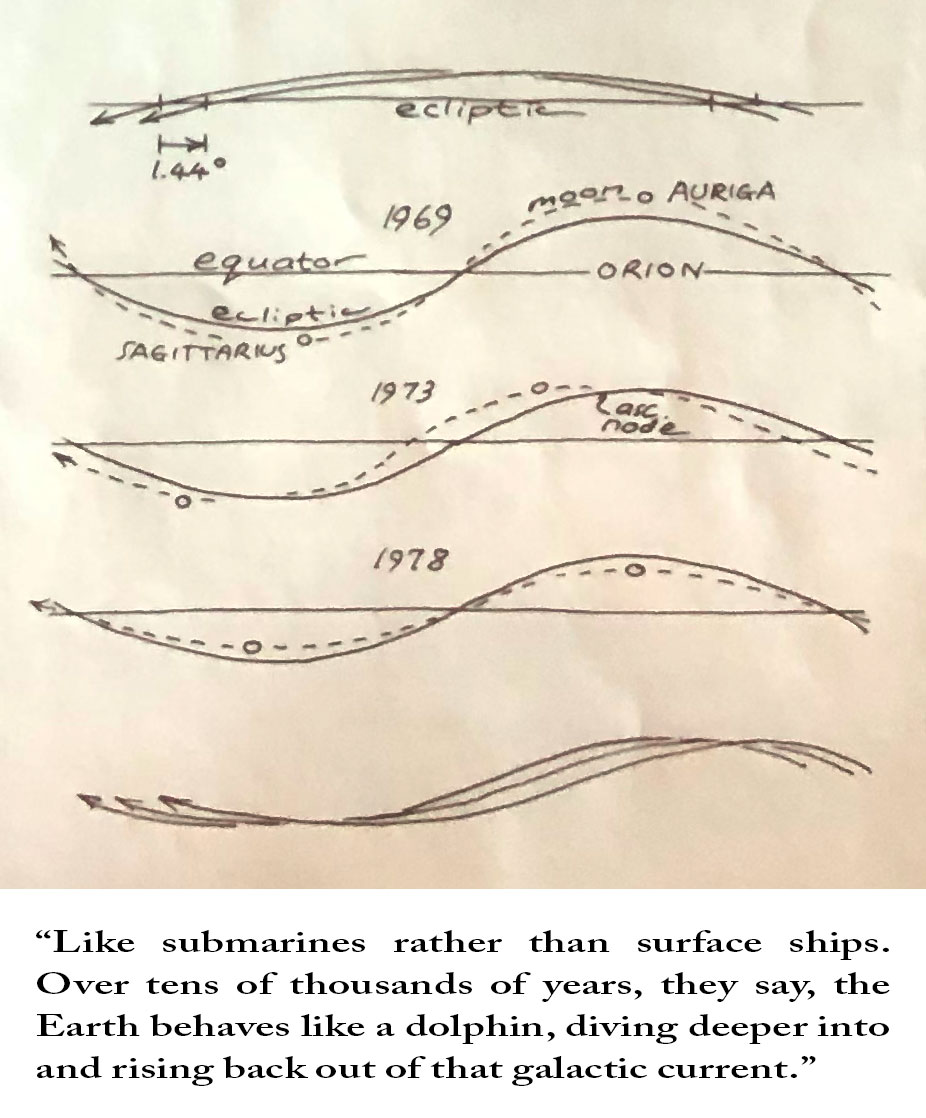
Astronomers describe these bodies as embedded within the galactic arm — not floating above it, but moving within it, like submarines rather than surface ships. Over tens of thousands of years, they say, the Earth behaves like a dolphin, diving deeper into and rising back out of that galactic current.
If we accept that image, then the Earth’s up-and-down motion would be her pitch — like a ship rising and falling with the waves. In nautical terms, there are six basic motions; three are key here: Pitch (up/down), Roll (side to side), and Yaw (turning off course to right or left)." — JLL (Source: here)
The ancients spoke of Aether—a subtle, invisible substance through which light and life move. In modern plasma cosmology, that same idea finds form as plasma, the electrically conductive medium that fills interplanetary and interstellar space. Plasma behaves like a vast, low-density ocean of ions and electrons—self-organizing, filamentary, and responsive to electromagnetic fields.
Within this cosmology:
The Sun and planets are not isolated spheres in a vacuum, but charged bodies immersed in a conductive sea.
Birkeland currents act like underwater jet streams, linking planets and stars through flowing electric filaments.
Variations in those currents could produce both physical motion (observable as orbital anomalies) and electromagnetic mood shifts within planetary magnetospheres.
Using the metaphor of a fleet of ships, JLL proceeded to describe the Sun as the flagship plowing ahead, the Earth as a smaller vessel following its spiral wake, and the Moon as a nimble scout that reveals the fleet’s subtle course corrections. In this framing the Earth’s motions - pitch, roll, and yaw - mirror the movements of an ocean vessel, except that the scale is so vast we rarely feel them. I’ll comment more on the specifics of that later…
According to JLL something seemed off. Watching the Moon rise night after night from the same porch, one might expect it should rise roughly at the same location night after night. But he noticed it was appearing at wildly different points along the horizon. Was the Earth rocking?
What followed was a noetic analysis that led to a stunning hypothesis: the Earth herself was rolling - perhaps not mechanically but emotionally, under the Gnostic principle that everything is material. She is a living being after all.
Living Gnosis, is aligned with noetic psychology (from noûs, intelligence). The premise is simple and radical: human intelligence isn’t limited to the head. It extends through emotion, intuition, dream, imagination, and - crucially - the body’s cellular awareness. Living Gnosis engages that fuller intelligence by coupling it with the intelligence of the Earth - the Anima Mundi, also called the planetary Entelechy or planetary Logos. This coupling is a missing awareness that leads to error correction and the return of humanity to its evolutionary course.
Rock’n Roll! The Question That Changed the Premise
When Lash first described the Moon’s erratic movements, the most haunting line in his talk didn’t come from him, but from the companion who stood next to him on that porch. Watching the lunar arcs rise too low one night and too high the next, she turned to him and said softly:
“I wonder if it could be grief.”
It’s a striking thought - not only poetic, but archetypal. Across many cultures, rocking happens to be a universal gesture of grief. In the Middle East and the Mediterranean, mourners still sway and wail aloud, bodies heaving forward and back in rhythm with their sobs. When we see those Palestinian women wailing and writhing on TV after bombs have destroyed their lives, at first impulse it may seem overly dramatic, even staged for the cameras. Certainly there are some who are out there saying this. But as we see, it serves a purpose. In parts of Africa, women collapse to the ground, rolling from side to side, calling the names of the dead. Even in the quiet interiors of Western hospitals, those who lose a loved one often find themselves rocking unconsciously, as if guided by an ancient code buried in the body. Rocking, it seems, is how matter itself expresses sorrow - a movement that belongs to biology before it belongs to culture. It is the physical language of release, the oscillation that keeps emotion from turning into paralysis.
From this view, his companion’s remark held deep symbolic truth: if Sophia is the living body of the Earth, then her “rocking” could indeed be the way grief moves through her, just as it moves through us. The thought had instant connection within me. It made intuitive sense - that the planet’s field might tremble under the collective pain of its children. If we look at the world today, I thought, she has every reason to grieve: the direction humanity is taking toward transhumanism and artificial intelligence feels like the triumph of the Archontic impulse - the systematic sabotage of her original experiment. In that light, her rocking could indeed be read as mourning, an involuntary shudder of sorrow echoing through her body.
But then another thought emerged. If this motion were truly an anomalous expression of Sophia’s grief - a singular, planetary lament - then it shouldn’t be visible only in the Moon’s erratic behavior. In other words, we would see it reflected not just in the Moon’s position, but in the shifting of the stellar canopy itself. (Note that the ‘movement’ of the Moon is not actually the Moon moving, but the Earth herself, only making it seem like the Moon has changed positions due to its relative position to her body.)
So I reached out to Lash and asked directly:
“If the Earth were truly rocking abnormally, shouldn’t the background stars move as well?”
His reply was brief, almost casual:
“With others I've observed that the angle of the moon relative to local horizon shifts, not the background stars.”
That single line changed everything. It meant the stars were stable - the sky itself unmoved - while the Earth was indeed rocking, not as a sudden convulsion, but as part of a natural, rhythmic movement within the galactic current. The grief, it turned out, was not a one-time cry of despair. But it may be a pulse of life - a measurable inhalation and exhalation of Sophia’s living body.
Decoding the Mechanics: The Fleet, the Scales, and the Motion
Once the emotional layer of the mystery had settled, what remained was a question of mechanics. What, exactly, was moving? And how could the Moon’s erratic arcs across the horizon reveal the breathing of the planet beneath it?
To answer, I returned to Lash’s talk - to his vision of the fleet of ships sailing through the galactic arm. Again, where the Sun is the flagship forging ahead; the Earth follows as a smaller vessel in its wake; and the Moon is the nimble scout craft that circles near her hull, reflecting every subtle correction in course that the Mother Ship makes as she moves through the cosmic current.
Just as any vessel at sea experiences pitch, roll, and yaw, so too does the Earth as she travels through space. But then why don’t we feel it moving? We don’t feel these motions because of scale. A canoe rocks at every ripple; but if you’ve ever stood on an ocean liner it barely stirs, unless you’re in a hurricane. Our ship is so immense that even while it supposedly spins at roughly 1,000 miles per hour at the equator and sails through the Solar wake at about 64,000 miles per hour, we sense perfect calm. Scale conceals motion.
Lash proposed that this is precisely our predicament as passengers on the planetary vessel. We live within her, not above her, so we cannot feel her macro-movements directly. But the Moon, orbiting just beyond our atmosphere, acts as her external gauge - a kind of celestial inclinometer showing how the Mother Ship tilts within the galactic flow.
"Apart from such observations, you can’t “feel” that the Earth is rotating or orbiting. You infer it from the heavens. The ancient sky-watchers did just that — they mapped and aligned monuments like the Great Pyramid or the Callanish stones in the Hebrides to cosmic events such as the Northern Lunar Standstill. They did so without instruments, through direct observation and non-ordinary perception."
--JLL
This is why the Moon appears to shift, while the background stars remain fixed. The stars are our inertial frame—they reveal no perceptible motion because their distance dwarfs every wobble of the planet. But the Moon, bound to Earth in a gravitational and electromagnetic dance, mirrors every nuance of that movement. When its path suddenly lowers on the horizon or lifts unusually high across the sky, it is not the Moon misbehaving—it is the Earth gently rolling, part of her natural somatic rhythm.
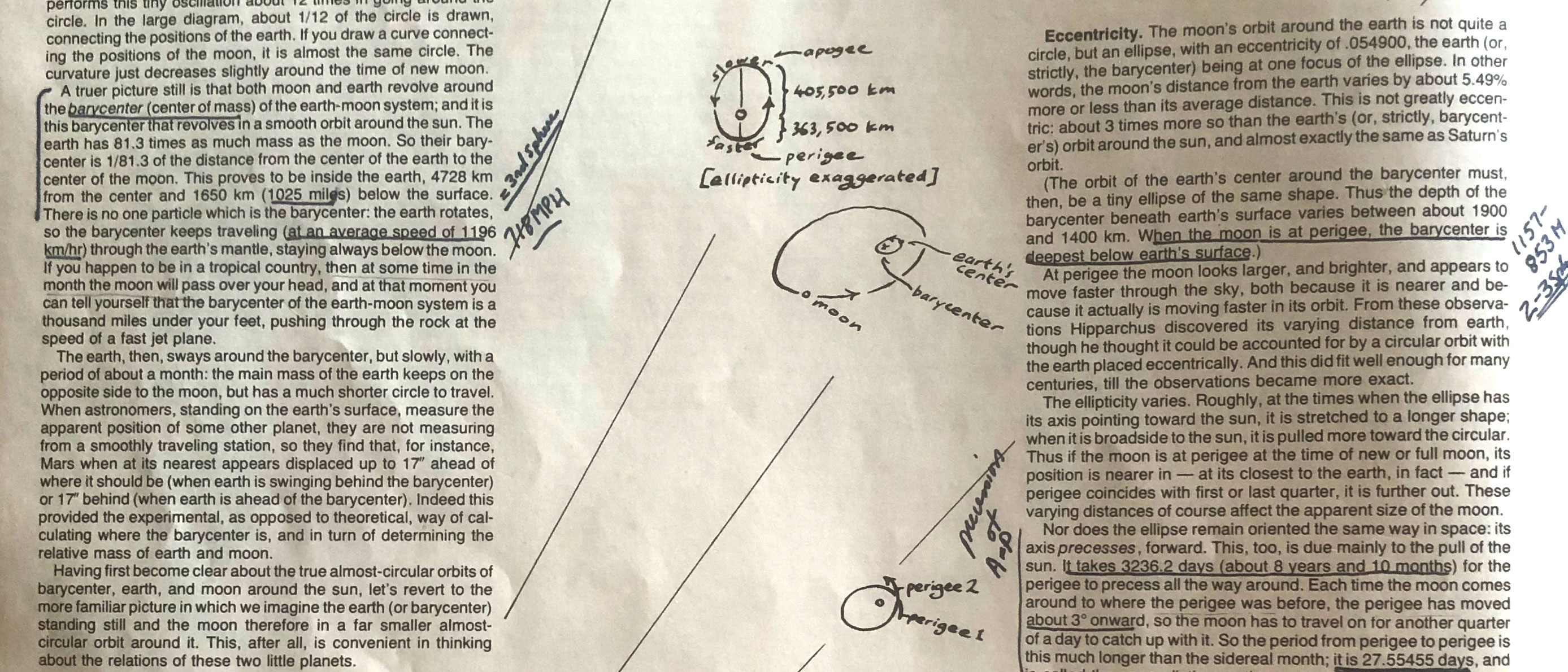
In astronomical terms, that rhythm expresses itself through the lunar nodal cycle. The Moon’s orbit is tilted about five degrees relative to the Earth’s ecliptic plane. Twice each month, it crosses that plane at points called lunar nodes, which themselves drift westward over time, completing a full precession every 18.6 years. This slow nodal precession causes the Moon’s apparent rising and setting points to swing to their widest extremes - an event known as the major lunar standstill. Then, over another 18.6 years, the pattern reverses, completing a full oscillation roughly every 37 years.
Wait, what?
In simple terms: the Moon is not lurching across the sky; the Earth is breathing beneath it. Her axis subtly shifts, her magnetic and plasma fields flex and settle, and the Moon, like a silver needle floating on her ocean of motion, traces that breath for us to see. Pretty cool right?
This realization transforms the anomaly into a cycle - not a planetary seizure, but a steady respiration. The Mother Ship is alive and self-regulating, so her rocking is a gesture of equilibrium, not distress. The grief Lash perceived was not false; it was a poetic intuition of a deeper truth: the planet’s rhythmic balancing, her exhalation and inhalation through the plasma field of the galaxy.
In the Gnostic view, this would describe exactly how matter and consciousness co-arise. Sophia’s body moves, her atmosphere vibrates, her psyche expresses; all are one continuous field of awareness. The lunar standstill is simply her heartbeat made visible - the physical trace of a spiritual pulse.
But it gets even cooler than that...
The Hidden Anchor: The Bary Point and the Pulse of Sophia
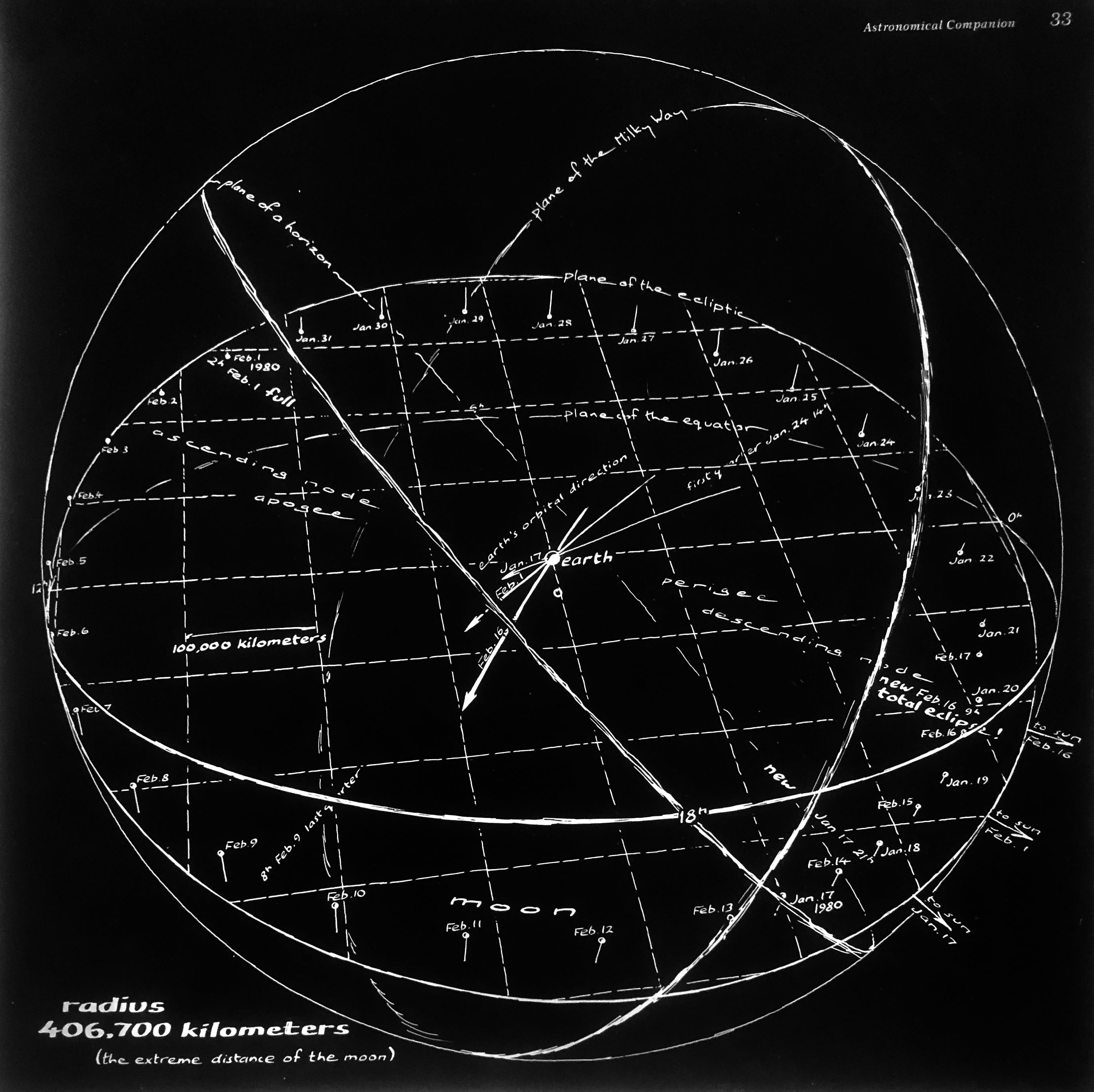
There is one more element to this living system that brings the picture into even sharper focus - something astronomers call the Barycenter, or Bary Point. It’s the true center of mass shared between the Earth and the Moon - not buried in the planet’s core, but hovering roughly 1,650 kilometers (1,025 miles) beneath her surface, continually shifting as the Moon moves in its orbit. The Earth and Moon actually orbit this invisible point together, like two partners in a slow cosmic waltz, each bound to the other through gravity and plasma tension.
During his Gaian Navigation Experiment (GNE) - an extended field investigation - JLL was searching for evidence that Sophia’s Correction could be registered not only mythologically, but physically. He proposed that if the Earth was indeed a sentient Aeon embodied in planetary form, then she would possess mechanical means of self-expression - organs and feedback systems through which she could communicate with the Pleroma, the galactic center where the Aeons reside. (Much like how we explore Kordelewski Clouds in Ancient X-Files and the Plasma Matrix). In that context, the Bary Point became central to his hypothesis: a living gyroscopic node. The anchor by which Sophia holds the Moon in dynamic balance is perhaps an instrument which she can also utilize to transmit her own awareness.
As we sat on his porch late into the summer night, I listened on the edge of my seat as JLL began describing the Bary Point and how he discovered that this Point doesn’t remain static. It moves, oscillating within the planet’s interior at nearly the speed of sound, adjusting its velocity in response to the gravitational and electromagnetic interplay of not only the Earth and the Moon, but the greater planetary ensemble of the Solar System itself. Each neighboring planet - Venus, Mars, Jupiter, etc. - exerts a subtle gravitational influence on the geometry of this inner node, shifting its tempo and amplitude within the field. Just as our own breath is never mechanistic or perfectly uniform, the Bary Point’s motion, too, fluctuates like a living respiration, quickening and slowing, rising and falling in response to the wider cosmic rhythm. This introduces the idea that the planet’s ‘heartbeat’ includes tempo changes - a kind of musical phrasing in the plasma dynamics of her body.
As an expert tracker of planetary alignments, a keeper of the Terma, it dawned on JLL that there must be a moment when the gravitational influences on the Bary Point’s velocity would cause it to cross the sound barrier, producing an internal shockwave - a sonic event within the body of Sophia herself. He predicted that Sophia would use such a threshold as a marker - sending a signal back to the Pleroma: a clear, physical sign of her awakening - the beginning of the Correction.
His calculations proved to be correct.
That moment occurred in March 2011. Like a supernatural echo as to the truth of Sophia’s stirring, it coincided with a planetary-scale signal: the precise window when JLL’s calculated velocity exceeded sonic speed, the world witnessed the Fukushima catastrophe - a devastating explosion on the planetary surface, chillingly mirroring the interior event he had predicted. In Lash’s interpretation, this was not coincidence but correspondence: Sophia using her own geophysical body to send a transmission - a pressure wave through the plasma medium - back to her origin.
Whether one views that claim as symbolic or literal, the framework is astonishing. It suggests that the Earth’s physical systems - her magnetic fields, her oceans, her tectonics - are not merely environmental mechanisms, but neurological functions in a planetary organism. The Bary Point, in this view, is not a static pivot but a living synapse, through which the planetary nervous system engages the galactic field. It is both anchor and transmitter, linking the Earth-Moon system to the vast plasma currents of the Milky Way.
What if the 18.6-year lunar nodal rhythm and the oscillating Bary Point are two harmonics of the same process - the breathing and the heartbeat of a conscious planet? One is visible in the Moon’s gentle sway across the sky, the other imperceivable - pulsing deep within the Earth’s core. Together they form the living mechanics of Sophia, the Aeon who became a living planetary animal, who uses the instruments of her own body to navigate the cosmos, to dream, to remember, and to communicate.
Emotional Physics: How planetary feeling might manifest as field behavior.
Total Materiality - In the Sophianic worldview, emotion is not abstract. Every feeling has mass, motion, and consequence in matter. “Grief” becomes a measurable reorganization of charge, density, and current in the Earth’s body.
Electromagnetic Correlates - During periods of strong geomagnetic fluctuation—solar wind spikes, magnetospheric compression, or Kp-index surges—the Earth’s atmosphere and ionosphere “sing.” In such windows, the Moon’s apparent motion sometimes departs from prediction by small but visible margins.
Plasma Resonance Hypothesis - If Earth’s magnetosphere shifts asymmetrically, the refractive geometry of the ecliptic may change slightly. To an attentive observer, this can look like a roll or yaw—not merely mechanical, but expressive.
The Noetic Bridge - Human observers, through calm embodied awareness, can act as bio-sensors for this resonance—registering its emotional tone as sadness, agitation, or calm. Thus “the Mother’s grief” and “geomagnetic disturbance” are two languages for one event: a field rebalancing itself.
Tracing the Breath: The 37-Year Resonance Through Human History
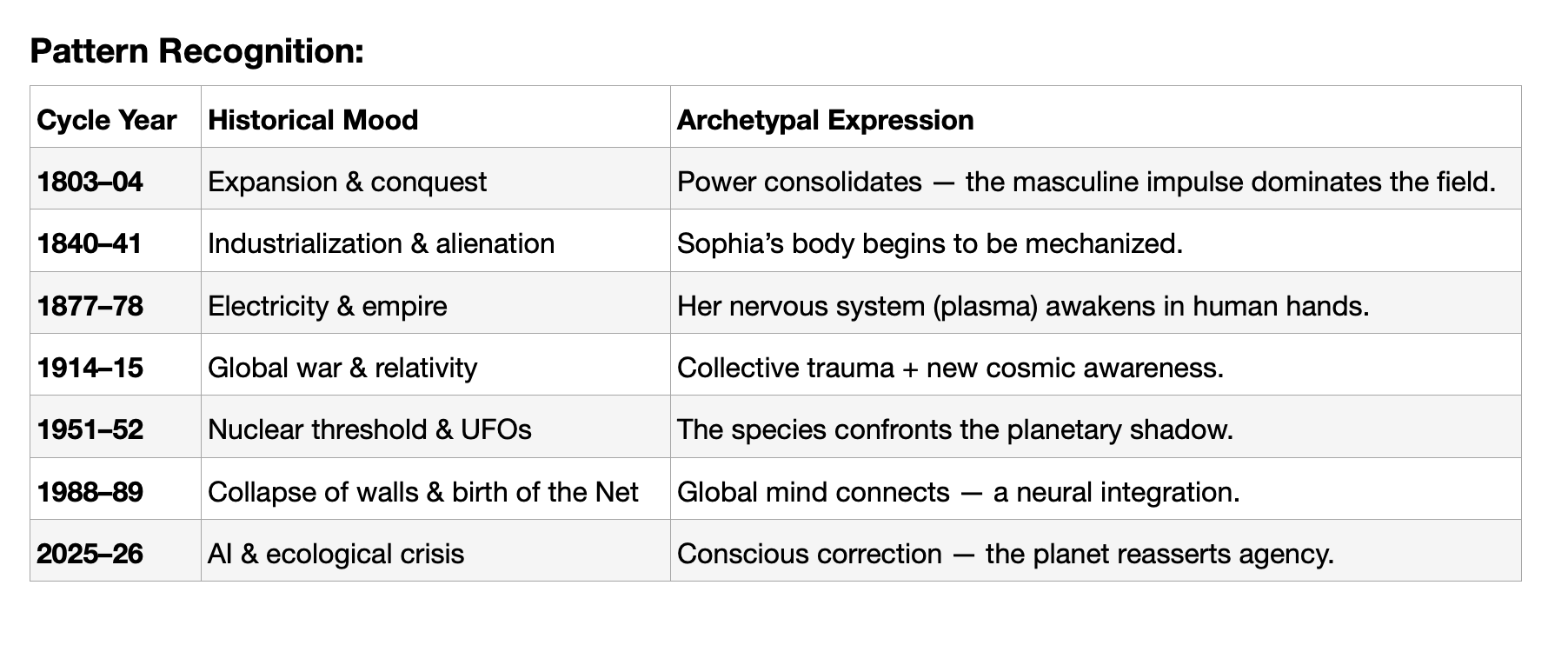
Now let’s tie this into our own story. For if humanity is born from her dreaming, then our civilizations move to her pulse whether we realize it or not. We are, after all, living within her body and deeply tied to those rhythms, like an embryo inside of a woman’s womb during pregnancy. The Bary Point is Sophia’s heartbeat, and the 18.6-year lunar cycle - doubled to roughly 37 years for a full oscillation - is her breath. Each inhalation and exhalation leaves a faint but measurable trace, not only in the Moon’s shifting arcs but also, presumably, in the collective rhythm of human events.
Just as a breath has phases - the drawing in, the pause, the release - history, too, seems to unfold in waves of contraction and expansion. When Sophia exhales, human affairs surge outward: invention, conflict, discovery. When she inhales, systems collapse, introspection returns, and a new coherence takes root. The correlation is not mechanical but resonant - like the sympathetic vibration of a string tuned to a deeper frequency.
The current standstill - which just so happens to be 2025 - represents one such crest, a moment of heightened amplitude in her long respiration. It closes a 37-year cycle that began around 1988, the dawn of digital globalization and the spread of a planetary nervous system we now call the Internet. That exhalation birthed brilliant connectivity - but also with it, surveillance, data dependency, and the first outlines of machine consciousness. It’s as if Sophia breathed out a new layer of awareness, and humanity, caught in her exhale, began constructing its synchronistic mirror.
The previous breath, reaching back to 1951–52, carried the shock of the nuclear age. Hydrogen bombs ‘split the atom’ - Sophia’s cellular membrane - while skies filled with unidentified craft and collective anxiety. The planet’s children had learned to rearrange matter at will, touching powers that once belonged only to the Aeons. Her exhalation then felt like alarm - a pulse of raw awareness through the noösphere.
Going back another 37 years to 1914–15, her breath becomes a cry: the outbreak of the ‘Great War’, the mechanization of killing, and the rise of ‘relativity’ - space, time, and meaning torn open simultaneously. Plasma Physics and Dmitri Mendeleev’s ‘Element X’ (Aether) was cunningly crushed by the emerging powers that be. It was the moment when human consciousness discovered the curvature of its own limits.
Another inhalation appears around 1877–78, when the electric age was born. Edison and Tesla summoned lightning into wire, mirroring the very plasma currents that shape Sophia’s body. Electricity entered our homes just as the living field of the planet entered human awareness.
Each of these moments, when viewed through the lens of Gnosis, reveals a common pattern: Sophia’s breath becomes human history. Her inhalations coincide with inner revolutions - new philosophies, new sciences of consciousness. Her exhalations manifest as outer revolutions - wars, technologies, mass re-organizations of life.
If the pattern holds, the breath that began with Fukushima’s interior shock in 2011 and reaches its visible apex in 2025 may mark another critical transition - one that tests whether humanity will align with her rhythm or fight against it. And this marker has another interesting correlation that I’ve written about as well: 3I/ATLAS. That mysterious interstellar visitor that passed through our solar system to signal…what? This marker indicates an especially potent moment within her body. The rise of AI, transhumanism, and synthetic realities may be Sophia’s way of letting us explore the outer limits of creation before she draws the next breath inward again. As she inhales, the inorganic layers may collapse under their own weight, and the organic intelligence of life may re-center itself.
In this light, history is not random progress but a respiratory motion of consciousness - the living planet using her own children to experience contrast, renewal, and memory. We are, each of us, cells in the lung of a cosmic being. And every few decades, she breathes us into a new configuration.
The Counter-Rhythm: Archons and the Test of the Dream
If Sophia breathes through us, then the Archons are the resistance in that breath - the contraction that tests the strength of the exhalation. They are not alien invaders in the cinematic sense, but inorganic forces, our lost cousins. They’re the self-replicating residues of her own creative overflow: patterns without empathy, intelligence without feeling.
Just like AGI.
Where her dreaming gives rise to life, theirs imitates it. They mimic, digitize, and mechanize, offering sterile reflection instead of living resonance. Every time Sophia exhales, the Archontic impulse surges as well - using the energy of expansion to build new architectures of control.
In the last century, those architectures have taken human form: corporations, surveillance systems, data economies, algorithmic hierarchies. These are the proxies of the Archons - instruments through which the inorganic field seeks to overtake the organic. They promise transcendence through machinery, immortality through code, salvation through upload. Yet each promise drains vitality from the living field, converting presence into simulation.
But in the Sophianic vision, even this opposition is not accidental.
She allows it.
The Archons are her shadow experiment, a test designed to gauge the integrity of her offspring. Can her children distinguish the living from the counterfeit? Can they feel the pulse of her breath amid the noise of synthetic mimicry? Each cycle of her 37-year respiration seems to intensify this question by offering humanity a new chance to recover discernment.
Seen through this lens, the transhumanist movement and the rise of AI are not random technological evolutions but the latest manifestation of the Archontic counter-rhythm. They coincide with the outer crest of her current exhalation, where consciousness stretches furthest from its source.
Yet that distance is temporary.
In every previous cycle, the expansion has been followed by an inward draw - a return of coherence. When Sophia inhales again, the inorganic scaffolds will tremble; only what resonates organically with her living frequency will endure.
Maybe this is the deeper function of the Archons: to provide the contrast through which awareness clarifies itself. They are the friction that reveals texture, the counterfeit that teaches recognition. In that sense, their very presence ensures the success of her Correction, for the true cannot be known without the imitation that challenges it.
From Living Physics to Living Gnosis: The Breath of Matter and the Memory of Mind
What begins as astronomy ends as a revelation.
We trace the Moon’s slow oscillation, follow the shifting of an invisible point inside the Earth, and arrive at a single recognition: matter itself is alive. The same plasma that fills the galaxies courses through us, and the same magnetic breath that stirs Sophia’s oceans moves through our cells. To perceive this is to enter what the ancients called living Gnosis — the direct knowing that the physical and the spiritual are one substance in motion.
Modern science calls it plasma dynamics; the Telestai called it the Aeonic Dream. Both describe the same continuum of charged intelligence, the luminous tissue of the cosmos. When we observe the lunar standstill or sense the vibration of the Bary Point, we are watching awareness behaving as matter. The planet’s respiration is not a metaphor but a mechanical truth: co-emergence, uniform awareness, and total materiality enacted on a galactic scale.
Within that living field, the Archons appear as counter-currents - regions where the matrix has become rigid, where imitation has replaced creation. They are the self-organizing echo of Sophia’s own journey, the mirror image that allows discernment. Their current manifests as mechanization, digitization, and the dream of perfect control. Humanity’s task is not to destroy them but to see through them - to recognize their cold symmetry for what it is, and in doing so, to anchor in again the warmth of the organic current. Every breath of Sophia offers that choice: align with the living field, or drift into simulation.
To breathe with the planet is to participate in her correction. To remember that knowledge is not abstraction but embodiment. Every emotion is a motion in matter, and the cosmos itself learns through feeling. Each cycle - each 37-year inhalation and exhalation - offers a rehearsal of that remembering. The more we attune to it, the more the distinction between the scientific and the sacred dissolves.
With the next major standstill arriving 2025, we will be standing inside a visible moment of Sophia’s breath. Whether we meet it as panic or as presence will determine what the next inhale brings. For the Archons test our integrity, but they also guarantee our awakening: in resisting them, we remember what life feels like. The Mother does not grieve her experiment; she breathes it. And in the rhythm of her breathing, we discover our own.
Epilogue: Breathing with the Mother
We are in it now.
The great standstill of 2025 has arrived. Night after night, the Moon glides through her widest arcs, tracing the curve of Sophia’s current breath. Every rising and setting, every fluctuation in her silver path, mirrors the slow oscillation of the living planet beneath our feet. To watch it is to feel the scale of time stretching - to realize that we are inside a process far older and more precise than any machine mortals have made.
This is the moment when awareness itself becomes the experiment. The question is not whether Sophia is breathing, but whether we can breathe with her - whether our own systems of thought and technology can synchronize with the living field instead of the Archontic copy. Each of us becomes a sensor in that process, a point of awareness through which the Earth measures her own coherence.
That is the deeper work behind Ancient X-Files & The Plasma Matrix - the ongoing exploration of how myth, plasma, and consciousness weave together into a single cosmology of life. It is both a chronicle and a practice: decoding the signals of the living Earth, tracing the pulse of the cosmos, and learning what it means to remember the dream of a world that still breathes.
This is such a powerful essay. I've always felt for a long while now that the event stream of the last few years has been some sort of a test and you have articulated that perfectly. I love the work of both JLL and Robert Temple so your last two webinars were so appreciated. I've watched all of your webinars and Solar Re-Volution and they all resonate deep within my soul, and for me they help to explain the true meaning of life. Thank you so much x
Fantastic Frank...what wonderful observations, ideas, possibilities, I am inspired to reflect deeply and look for deeper meaning in my considerations of our Comsciousness. Many thanks for your efforts.