Peace, Cannon Fire, Christmas, and Our Phylogenetic Memory
On inherited memory, seasonal ritual, and the echo of ancient rhythms
by Frank Jacob
Berchtesgaden, Bavaria: December 20th, 3:00PM. Rifles and cannons echo throughout the valley. It's part of a local Advent custom said to welcome the "Christ child". Leaning out the window and taking in the explosive, sonic violence, two ironies immediately surfaced in my ever-so-rebellious mind.
The first is obvious: here they are, welcoming the 'saviour' - a figure remembered as a man of peace - with gunfire and cannons.
The second runs deeper. This ritual survives in Bavaria, a region whose pre-Christian inhabitants were once dismissed as pagans and heretics, their worldviews - deeply tied to a living Earth, what later Gnostics would call Sophia - systematically dismantled by Rome and, later, the Church. Today, there is virtually no overt trace left of the celebrated Sophianic mysteries once imprinted in the memory of the native Bavarians.
But perhaps this isn’t irony at all. Perhaps it is something older - a long-standing, cellular memory carried forward by descendants who no longer remember why they do what they do.
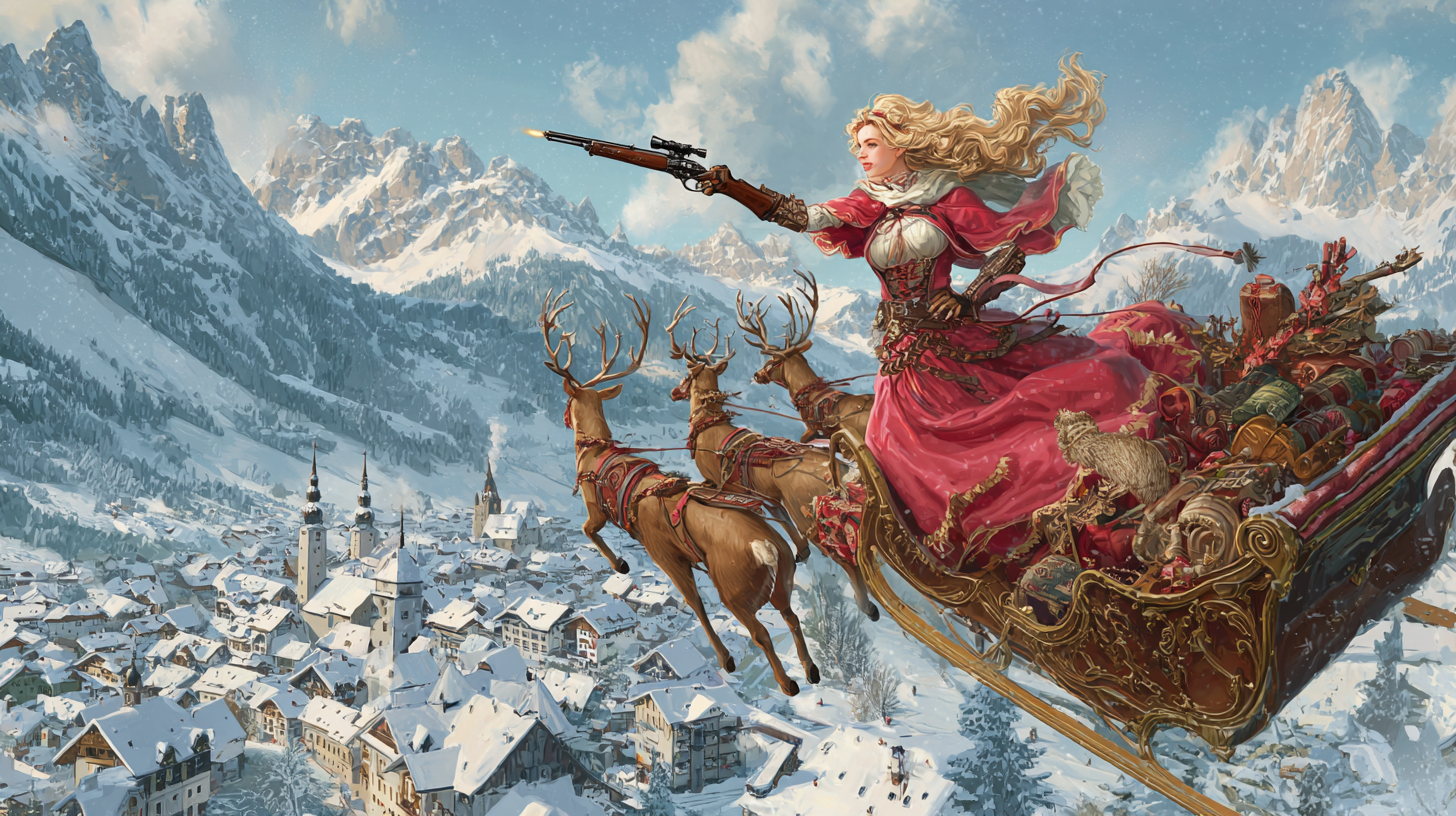
Long before Christianity, loud sound marked the most precarious moment of the year: the winter solstice. When the sun appeared to stall and darkness reached its furthest extent, noise was a way of asserting continuity. Before the age before rifles, it’s quite possible that the men and women of ancient tribes took to mountains, cliffs, and river embankments, vocalizing their mock ferocity in loud, guttural cries - a primal reminder that they were still very much present and unwilling to fade quietly into winter. It wasn’t violence, but declaration - a collective act of presence. A way of beating back the dark, of signaling that life, community, and the human instinct to survive still had the edge when raw perseverance was put to the test. Even the grotesque figures of midwinter - Krampus among them - served this function: embodiments so fearsome that chaos itself was driven away.
Among the ancient Germanic peoples, such rites were not symbolic beliefs layered onto nature. They arose from a lived relationship with the land itself. The Earth was experienced as animated, responsive, cyclical. Time was not abstract; it was felt in the body - in cold and hunger, scarcity and return, darkness and light.
Earlier still, initiatory traditions in the ancient world - such as the Telestai of the mystery schools, emerging from regions like the Urmian plateau and later Persia - developed disciplined methods for engaging this living reality more consciously. These were not ecstatic mystics chasing visions, but trained observers of perception. Encounters with what later Gnostic language translated as the organic light were not simply revered; they were examined, contextualized, and transmitted. Knowledge was experiential, but it was also analytic.
When Rome rose to dominance, it tolerated ritual but feared implication - much as Indigenous freedom dances later threatened invading colonists in the Americas. What endangered centralized authority was not seasonal celebration, but the idea that meaning and intelligence could be encountered directly, without priest, hierarchy, or doctrine. Ritual forms could survive. Cosmology could not.
So the meanings were stripped away. The solstice became Christmas. Ancient sound-rites were reframed as celebration. Libraries were emptied. Teachers silenced. Indigenous tribes cut off from their ways of life. Heretics banned - and, in many cases, tortured. The land was 'desacralized', though never entirely forgotten.
And yet, the ritual remains...
Here in Bavaria, cannons still fire at the darkest point of the year. Bodies still gather. Sound still marks the threshold.
The explanation has changed, but the impulse has not.
Which leaves a question worth holding as we enter the peak of the 'holiday season': if these practices persist long after their original cosmologies have been erased, what human instinct - or what relationship to the Earth - continues to call them back? And what, in an older world, might once have listened in return?
The irony that a “saviour” ultimately presided over the dismantling of cultures that once lived in direct contact with the rhythms of a living Earth is largely lost on the modern world. Yet perhaps the future is not nostalgic, nor a return to belief systems long gone, but a quiet re-engagement with what these rites once pointed toward.
To recapture such rituals - using the word sacred not in a dogmatic or institutional sense, but as an acknowledgment of something deep, embodied, and foundational to life itself - may be part of what lies ahead in re-establishing what JLL so aptly calls the beauty to come.
(Some phrases survive for the same reason rituals do.)
I wish you all a quiet, powerful winter and a grounded close to the year!
As always, I appreciate the depth of your contemplation, knowledge, and insightful articulation. The “invitation” for us to remember, re-engage and embody is ever-present. 🙏🏻💜🌎
Thank you Frank. In return, I wish you and yours a peaceful, reflection of the Beauty that is still here, despite this "distorted" season! I have finally realised I am the Divine Light backstage directing my play out front. And so I am redirecting my play back to beauty and lightness! And so it is 🔆💫
This is very much how I feel Frank, thank you for such wonderful words describing it all.
I remember the Bavarian Alps at this December time in Berchtesgaden... all four corners were lit up with fireworks, the men and women who blew the horns (cant remember the name?), and then the big SIGN on one of the mountains, at midnight December 31st, would blow up changing to the New Year number.
And the traditional Krampus!
i do miss B'Gaden so very much.
love to you and Tonya.
Pamela🎶🌺
This observation shows, once again, your keen mind.
People in the past were much more conscious, wiser, and stronger than we are today.
But we will come full circle and remember the ancient wisdom step by step.
Tomorrow is my birthday, and the older I get, the more I appreciate this date—born too early, but my soul must have wanted it this way.
As I read with you Frank, my heart is telling me that I am not alone at all.I am lead to reach deep into my soul and touch the past that we have always been apart of. To understand the loneliness that seems to not quite go away. We need each other, all of us, and for that I am very grateful.