The Moon: Hallowed Hollow Hoax
SSP Fantasy vs the Mother’s Mirror
by Frank Jacob
Prelude - A Familiar Stranger
For as long as I can remember, I’ve looked at the Moon as if it were looking back. It pulls the oceans, yes, but it also pulls at thought. In every culture it’s been a clock, a mirror, a trickster, a wound in the sky. That double face - so near, so unreachable - invites both romance and suspicion. Was it born with us, or did it arrive later? Is it the child of Earth, the scar of a cosmic impact, or, as I once entertained: the engineered craft of some ancient race?
I used to accept that last possibility. When you spend time researching the world of Exopolitics and modern SSP myth-making, and make award-winning films about it, you learn to suspend disbelief. I filmed anomalies, pored over NASA photographs, interviewed whistleblowers and quoted the scientists who said the Moon “rang like a bell.”
But inquiry has its own gravity.
Over time it eventually pulled me to follow the breadcrumb trail back to the primary source documents - toward evidence that couldn’t be ignored - and toward a different kind of mystery: the Sophianic one - where the Earth herself turns out to be the creator of the Moon. What amazes me most is the imbalance of belief. Proponents of the SSP and other modern mythologies have no trouble imagining supernatural or extraterrestrial forces capable of shaping worlds, piloting planet-sized space ships toward earth, programming matrices, projecting holograms, even writing the cosmic code of reality itself. Yet the idea of an organic, living planetary intelligence beneath our feet - one that dreams us into being, whose origin and drama were mapped by ancient seers and are now echoed in the equations of plasma physics and cosmology - is largely dismissed.
Is that neglect deliberate? Or have these storytellers traveled so far down their own mythical rabbit holes that they can no longer see
the greater story unfolding beneath them? Just this week David Icke posted yet another “X” about it, recycling the same tired disinformation. Maybe it’s time we turn back - not to retreat, but to revisit the real mysterium: the one written in lightning, memory, and the dreaming body of Sophia herself.
The Hollow-Moon Myth Revisited
The modern version of the “artificial, hollow Moon” was born in the 1960s. A 1962 paper attributed to NASA’s Gordon MacDonald - original source unverified - observed that the Moon’s density was lower than Earth’s and said it was “more like a hollow than a homogeneous sphere.” That's another one of those 'sources' even 'high-level' researchers like David Icke like to use, when its comes to crazy moon theories. Even if it were real, what he meant was non-uniform, not hollow as in empty.
But the metaphor escaped into popular culture.

Then came Apollo.
When the Apollo 12 lunar-module booster was propelled onto the lunar surface in 1969, seismometers recorded a slow-fading vibration that mission scientist Maurice Ewing likened to “a bell.” The phrase became legend: the Moon rang, therefore it must be hollow. At the time I was looking into it, claims were being made that the moon rang for 20 hours! In reality, it only 'rang' for about 30 minutes. But that signal got drowned in all the noise.
For those who don't already know, there's an explanation for that: it rang because it is dry. Unlike Earth’s water-filled crust, the Moon’s rock carries seismic energy for a long time; it's literally a crystalline bell made of stone. That's right friends: crystals - freeze-dried in orbit.
Later, Carl Sagan wrote what has become another famous misquote: that “a natural satellite cannot be a hollow object,” meaning that gravity would collapse such a structure. But he was dismissing the growing idea that the Moon was artificial, not proposing that it was. By 1970, two Soviet writers, Mikhail Vasin and Alexander Shcherbakov, fused the metaphors into a headline in Sputnik Magazine: Is the Moon the Creation of Intelligent Beings? They imagined a titanium shell with an armored hull - a planetary Ark. It was science fiction in the clothes of science.
Evidence and How It Changed the Story
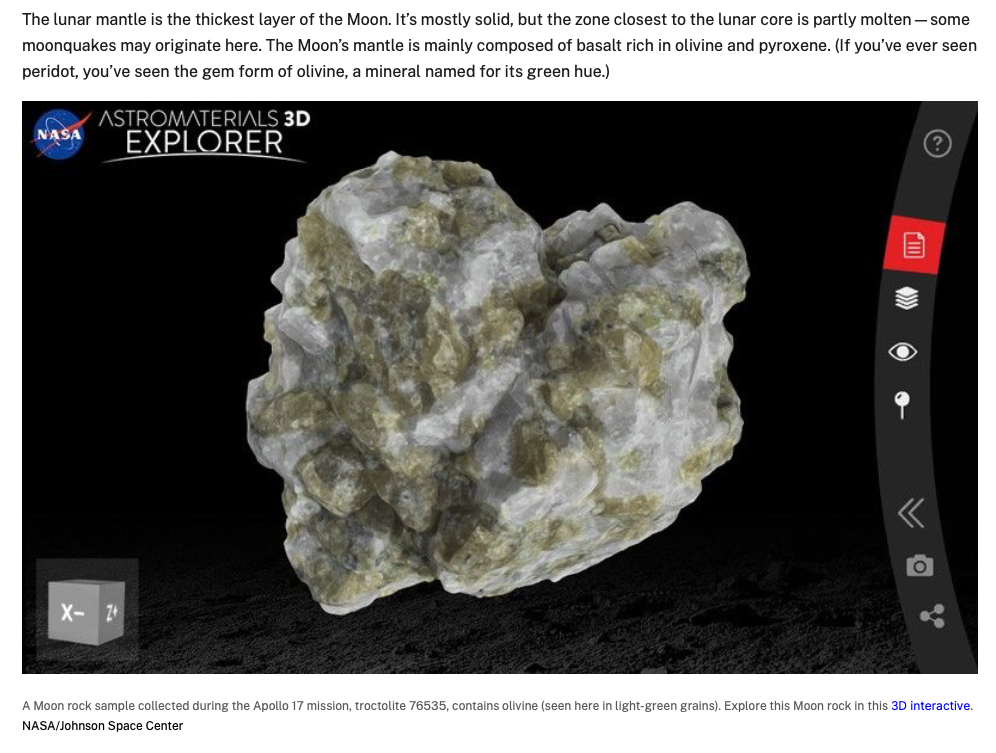
Fast forward. Apollo seismology, laser ranging, and the later GRAIL gravity mission have now mapped the Moon’s interior in perfect detail. So we now know it has a small metallic core, a thick silicate mantle, and an anorthosite crust averaging about 45 km thick. No voids. No hidden hangars. And - whoops - I guess no Iron Sky Nazis either. (Yes, some people believe Iron Sky is a documentary, not fiction.)
Technically, its mean density is 3.34 g/cm³, which we're told is exactly what you’d expect for a rocky body stripped of most of its iron. The Moon’s mass has even been measured to nine decimal places by tracking the orbits of spacecraft and the laser reflections from Apollo retro-reflectors.
Unless, of course, you believe we live on a flat Earth and that the Moon is - um - merely a plasma projection being beamed onto the “dome” by some ancient projector that never malfunctions, not even for an instant.
Still, myths are resilient. They survive because they hold a kind of emotional truth: the feeling that something about the Moon doesn’t fit...
Why is it so big relative to Earth?
Why is the same face always turned toward us?
Why such chemical oddities - reduced metals, titanium, strange isotopic echoes?
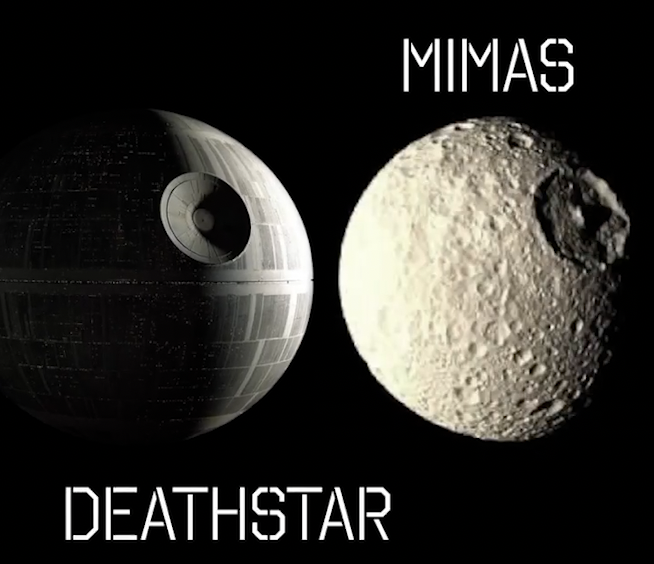
Source: David Icke- "The Moon is not what they tell you it is."
My Own Reckoning with the “Spaceship Moon”
I clearly remember Dr. Michael Salla’s claim that Martian refugees arrived 60 000 years ago in a “spaceship Moon.” He argues that lunar rocks are 5.3 billion years old and their dust 6.3 billion - older than Earth itself - and therefore proof of an alien origin. Uh-huh. But then, Salla’s prime sources tend to be SSP “whistleblowers” with an equally thin evidentiary foundation. Yet they help amplify the myth for a willing and unscrutinizing audience - one that, judging by its size, seems vast. Maybe that’s what it’s really about: audience numbers translate into book sales.
I once found such stories compelling; they fill the gaps left by dry textbooks. But at a certain point on the journey down those rabbit holes evidence matters. Radiometric dating of Apollo samples fixes most lunar basalts between 3.1 and 4.4 billion years; none exceed the 4.6 billion-year age of the Solar System. If you're going to give credibility to science or age-dating at all. Salla's exaggerated numbers come from misread cosmic-ray exposure data. So that narrative, like his tales of Germans in Antarctic caverns, collapses under scrutiny: documents are forged, citations circular. Every researcher faces this moment - the reckoning between fascination and fact. For me, this essay is part of my own reckoning: the willingness to rebuild what must be rebuilt and discard what can no longer stand.
Captured or Born Here?
Another claim I once repeated is that the Moon was captured by Earth’s gravity. But captured satellites always enter eccentric, elliptical orbits. The Moon’s path is almost perfectly circular - its orbital eccentricity is only about 0.055 - which would require an impossible amount of energy loss if it were a stray body. The far better explanation is that it formed close to Earth and then tidally migrated outward. Apollo missions brought back not only rocks but isotopic fingerprints: the oxygen isotopes in lunar minerals match Earth’s mantle exactly. That is not coincidence - it's kinship. The two bodies were once one. And if you read on, you’ll learn why.
The “People Before the Moon” - What About Those Myths?
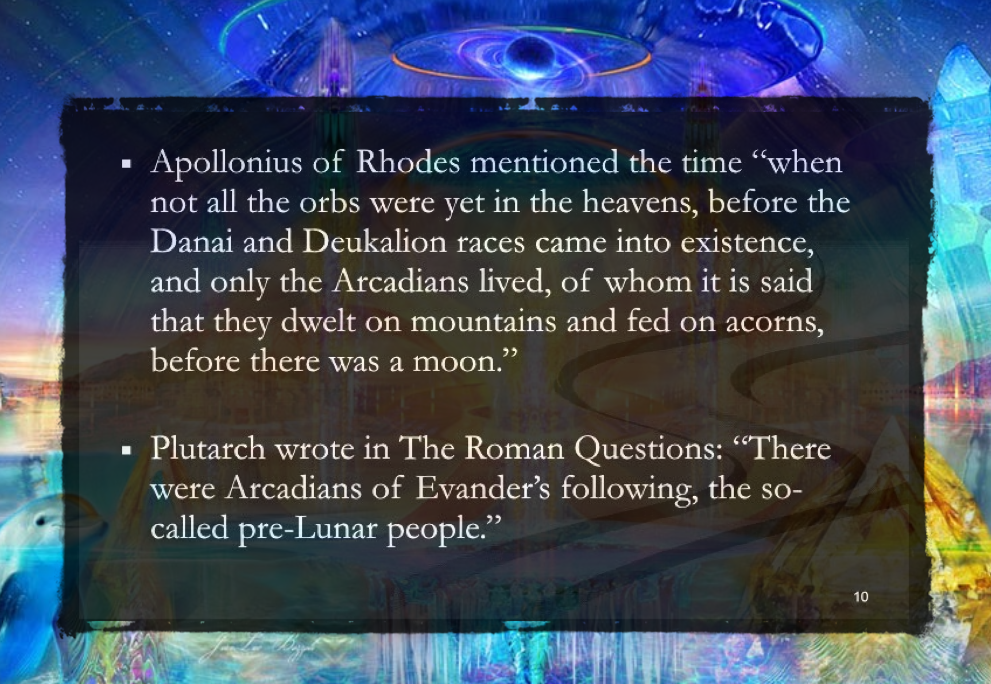
Long before Sputnik or Apollo, ancient peoples remembered - or imagined - a sky without a Moon. In Greek tradition, Aristotle wrote that Arcadia was inhabited by Proselenes, “the pre-lunar people.” Plutarch repeats the phrase in Roman Questions. Apollonius of Rhodes speaks of a time when “all the orbs in the sky were not yet visible.” Immanuel Velikovsky, whose catastrophism popularized many ancient astronomical myths, collected these references as traces of a lost epoch.
Across the ocean, the temple of Kalasasaya in Tiahuanaco, Bolivia, preserves carvings some claim record a dual-moon era roughly 12,000 years ago. Its solar-lunar calendar was deciphered in the 1950s by Hans Schindler Bellamy, who suggested that a smaller satellite once circled Earth before the “big Moon” arrived 11,500 years ago. Archaeology dates the site far later and sees no evidence of a vanished small moon, yet the story resonates with similar myths in Africa.
Among the Zulu, according to Credo Mutwa, two reptilian brothers - Wowane and Mpanku - rolled the Moon into the sky after draining it of fire. Their scaly skin glimmered like fish, and they “emptied the egg” before setting it in orbit. It is a striking image of electrical discharge: twin serpentine currents shaping a luminous sphere, cooling it to silence.
Even the philosophers joined in the preservation of cosmological memory. Democritus and Anaxagoras speculated that celestial bodies coalesced from fiery vortices, implying that the Moon’s appearance marked a later stage in Earth’s condensation. For them, before the Moon meant before matter had fully solidified.
Why Such Stories Persist
The persistence of pre-lunar mythology tells us less about astrophysics and more about human cognition. We encode cosmic changes as divine drama. When the sky alters - through cometary apparitions, climate shifts, or electrical storms - the collective psyche translates the event into narrative: gods, brothers, mirrors, thefts of fire. If Earth and Moon once interacted through immense plasma arcs, early humans may well have witnessed luminous bands sweeping the sky every few days. Those recurring storms could have birthed local “anode” cults: city-mountains revered as the thrones of thunder gods. The myths would then be memories of electrical intimacy between planet and satellite, later retold as the Moon’s arrival. We go into some depth on this in Ancient X-Files and the Plasma Matrix - a fascinating past, every bit as captivating as any SSP narrative.
From Myth to Measurement
In the last few decades, science has drawn the Moon’s portrait in astonishing resolution. The Lunar Prospector mission (1998) mapped its magnetic anomalies; Clementine (1994) and Lunar Reconnaissance Orbiter (2009–) traced every crater and rille; the twin GRAIL probes (2012) turned the Moon into a gravity x-ray, revealing a dense, continuous interior with no cavernous voids. Those data sets end the debate about literal hollowness. Yet they also leave us with that question: if not hollow, then why so resonant?
The proof is in the pudding: the Moon’s rock turns out to be bone-dry anorthosite and basalt, fused into a lattice that carries seismic waves with little loss. When the Apollo 12 ascent stage impacted, that lattice 'sang' for nearly an hour. But it was the ringing of glass, not the echo of hollow emptiness. The metaphor survives because the poetry is truer than the physics: the Moon does act as a resonator - for gravity, for tides, and for thought.
When Myths Get the Music Right
Science clears away superstition, but sometimes it also reveals a deeper intuition hiding underneath. The phrase “the Moon rang like a bell” survives not because it was ever literally true, but because it felt true. The seismographs heard a vibration that echoed through the crystalline body of the Moon - a tone in stone responding to impact. To those listening, it sounded alive.
In the Sophianic view, this response is not illusion. The Moon does act as a resonator: it vibrates to tides, to gravity, to the slow hum of Earth’s magnetosphere, even to the collective psychic field of the species gazing up at it. Myth sensed that long before seismology proved that rock can sing.
So when people say “the Moon rang like a bell,” they’re unknowingly honoring that resonance - the poetic truth that matter itself expresses frequency. The metaphor endures because it captures something science can measure but not explain: the feeling that we are hearing the cosmos play itself.
Oxidation and the Great Discharge
One chemical contrast still fascinates me. Earth’s crust is oxidized - red, rusted, breathing oxygen. Places like Sedona, Arizona make that even more obvious. By contrast the Moon’s surface is reduced - metallic, rich in nanophase iron. It's still colourful, yet in a subdued way. In laboratory plasma discharges the same polarity split appears: the anode grows oxides while the cathode becomes chemically reduced. That polarity fits an Electric-Universe interpretation in which the early Earth-Moon system behaved as a coupled pair in a grand electrical circuit. Sophia’s living body, charged and luminous, could have expelled a portion of herself in a moment of discharge; the expelled fragment, the cathodic mirror, cooled to the reduced state we now sample as regolith. In that sense, the Moon’s chemistry is not alien but maternal. It is the scab from Sophia’s wound, carrying the opposite charge of her living skin.
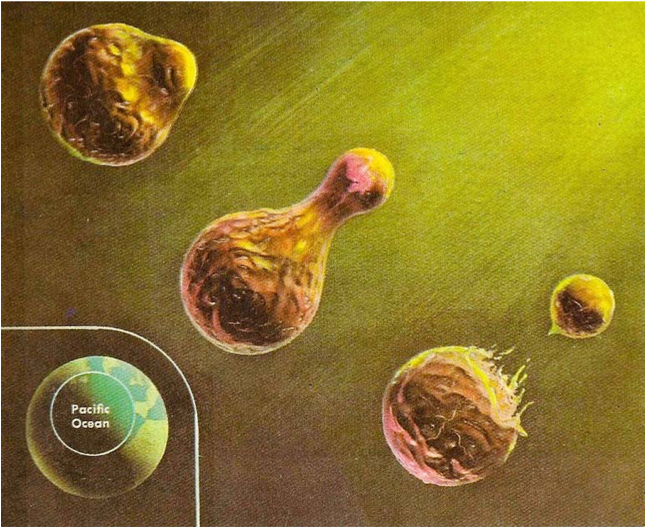
Earth expels the Moon: Birth of Sophia's Vanity Mirror
Tearing of the Face
Mainstream geophysics, stripped of myth, agrees that the Moon once orbited much closer to Earth - perhaps 20,000-30,000 km away - and that tidal forces locked one hemisphere early. The near side is flooded by mare basalts, the far side thick with highlands.
To a plasma cosmologist, that asymmetry looks like a burn pattern: Earth’s electrical arc tore material from the hemisphere facing her, leaving the far side comparatively untouched. Even today the Moon’s crust is thicker on the far side by roughly 12 km, a geological memory of that wrenching. If we speak mythically, the Earth quite literally tore the face from her own child and the scar still glows at night.
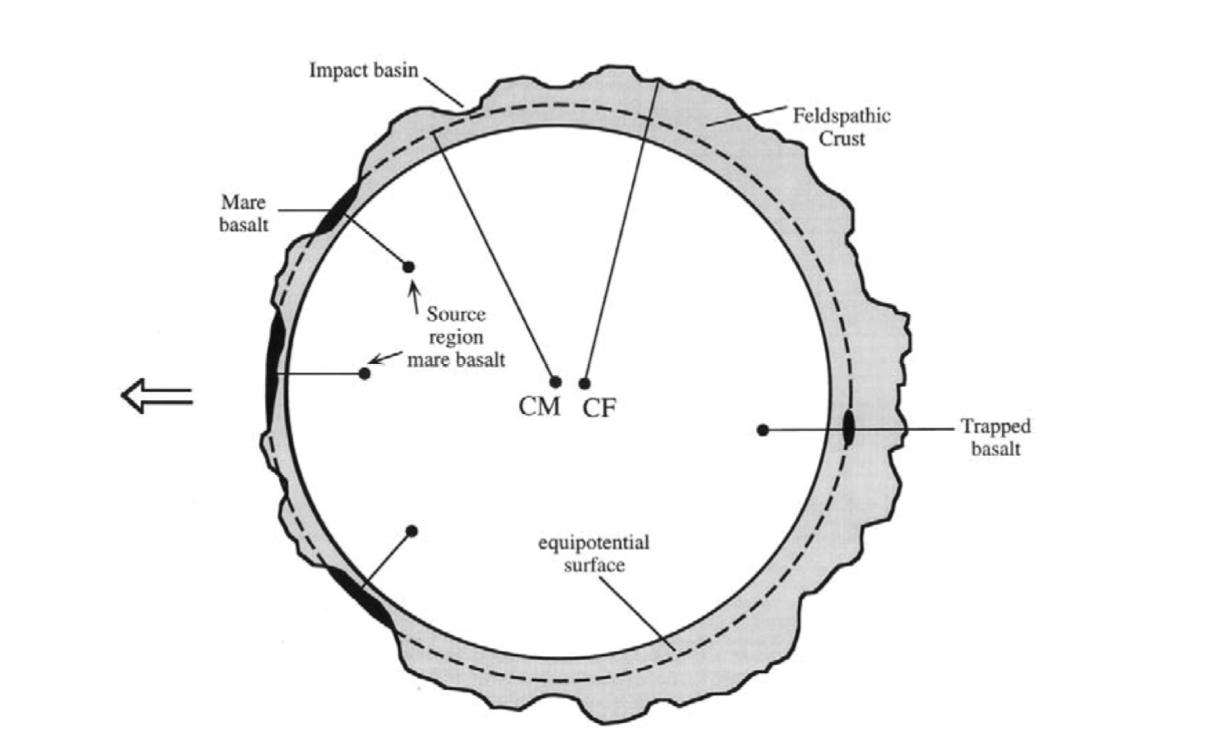
Tearing the face off the Moon
Why the Orbit Looks “Too Perfect”
Critics often say the Moon’s near-perfect circular orbit disproves a natural origin. But orbital dynamics shows the opposite. A captured body would keep a wild ellipse. Only a moon born from Earth - or drawn out of it - could circularize through tidal friction into the stable path we see. Through something called 'laser ranging' they've been able to determine that the Moon drifts outward at a rate of 3.8 cm per year; every millimeter of that distance is tidal energy leaving Earth’s oceans as heat. The dance is in fact measurable, not mysterious.
Reinterpreting the ‘People Before the Moon’
I no longer read the “pre-lunar” myths as records of alien intervention but as cultural fossils of this early closeness. In Ancient X-Files and the Plasma Matrix we show how that proximity factors into a whole eco-system of electromagnetic cause and effect, including affecting the human genome through what's known as epigenetics. A brighter, nearer Moon would have dominated the sky, perhaps vanishing for intervals behind plasma haze, giving the impression that it had arrived or departed. Such cycles could explain the Bolivian dual-moon calendar and the Greek memory of a time “before” the Moon. What those peoples preserved was not a missing satellite but a changing light - electrical and emotional - etched into language.
The Closer Moon - Memory in Myth
When ancient cultures spoke of “two moons” or “the moon that came later,” they may have been recording not celestial fiction but atmospheric memory - the residue of a time when the Moon’s orbit lay much nearer to Earth.
Geophysical models confirm that billions of years ago, the Moon circled only a fraction of its present distance away, appearing up to six times larger and flooding the night with charged light. In such an era, a denser, ionized atmosphere could have periodically obscured or refracted that brilliance, making the Moon seem to vanish and return - a cycle later mythologized as the coming and going of twin or successive moons.
Cultural fossils of this memory:
Aristarchus and Anaxagoras wrote of “peoples before there was a Moon.”
Aymara calendars in the Bolivian highlands encode alternating lunar rhythms that may echo those ancient optical and electromagnetic cycles.
These myths preserve not a missing satellite, but a changing light - electrical, emotional, and linguistic - etched into human consciousness.
The Two Worlds of Explanation
Every question about the Moon now divides into two languages. Science describes how: impact, differentiation, tidal lock, outward drift. Myth describes why: reflection, memory, self-recognition. If I try to choose between them, it feels like making a choice is false. A single event can be both mechanical and meaningful. If Sophia is the planetary intelligence of Earth, then the so-called giant impact is her electrical act of individuation - the moment she externalized her awareness as a visible mirror. A 'vanity mirror' that would forever be there as a reminder of who she was and where she came from.
The Mirror Hypothesis
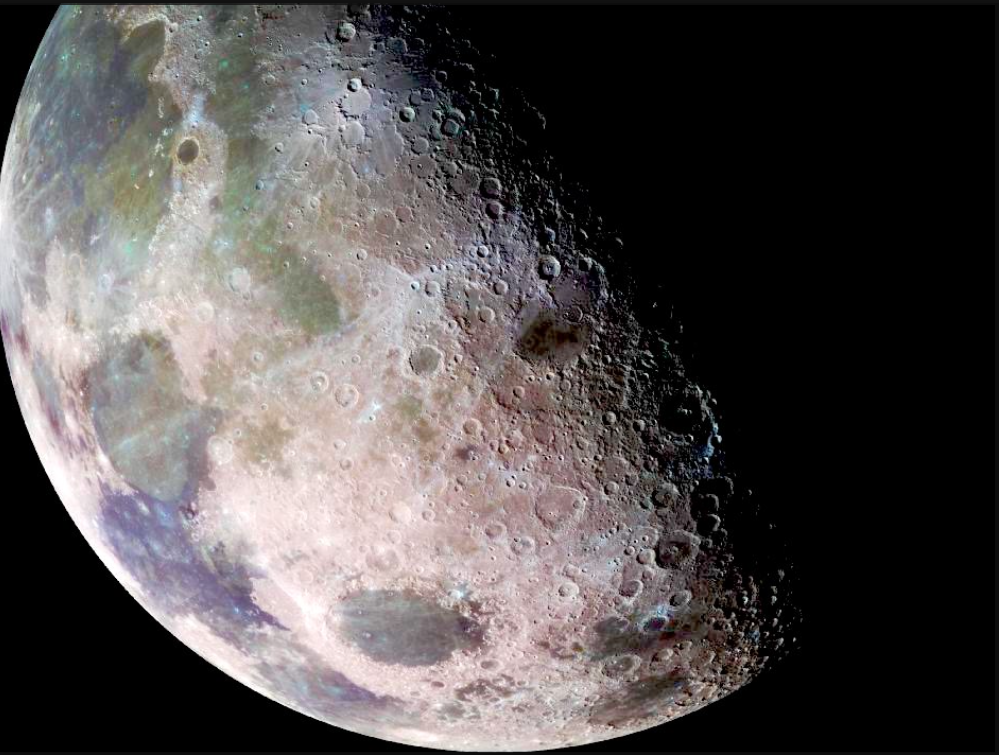
In this frame the Moon’s purpose is relational, not accidental. Its exact size and distance allow perfect solar eclipses, the brief moment when disk covers disk and day becomes shadowed revelation. Its mass stabilizes Earth’s axial tilt, ensuring seasons and climatic rhythm. Remove it, and chaos reigns. Whether one speaks in physics or myth, the geometry is exquisite. If the universe were alive and aware, this is how it would sign its work: not with handwriting but with orbital ratios.
From Conspiracy to Cosmology
When I look back at my own early fascination with lunar conspiracies, I see both error and necessity. They were training wheels -ways of keeping wonder alive while learning to think critically. NASA’s airbrushed images, the Soviet “spaceship” article, Salla’s Martian refugees: each dramatized a genuine intuition that something profound links Earth and Moon. What they missed was that the link is not mechanical but biological and electrical. We don’t need an alien engineer; the engineer is the living planet herself.
Sophia’s Dream in Stone
In the Sophianic mysteries, consciousness and matter co-emerge. When Sophia dreamt the Anthropos - the template of human possibility - she also dreamt the environment that would host it. The Moon, in that vision, is part of the dream-architecture: a mirror that reflects light and emotion back to its source. Its periodicities regulate reproduction, growth, and psychic rhythm. If you view it through that lens, every phase is a breath in Sophia’s respiration.
The Moon that Remembers
Modern seismology doesn’t cancel the ancient myth - it refines it. The Moon is solid, yes, but so are bones, and bones still carry sound. When Apollo’s impact modules made it ring like a bell, the vibration wasn’t mechanical alarm but the tone of maternal memory - the resonance of formation echoing through stone. It's as if the Mother remembers her own creation, her crystalline lattice singing back the birth-shock that joined her to Earth.
Why the Hollow Moon Still Appeals
The enduring appeal of the “hollow” idea reveals a deeper hunger: the wish that the cosmos contain secret rooms. We fear a universe that is solid all the way down because solidity feels final. To imagine a hollow Moon is to imagine space for consciousness itself. Ironically, physics already gives us that - quantum vacuum as sea of potential, plasma as living current. The Moon is not empty; it is filled with that same field of awareness, condensed into dust and silence.
What We Know, What We Remember
Today the empirical picture is secure:
The Moon formed from Earth’s outer layers after a giant impact some 4.5 billion years ago (Canup & Asphaug 2001).
It has a differentiated interior (Weber et al., Science 2011).
Its oxygen isotopes match that of Earth’s precisely (Wiechert et al., Science 2001).
Its orbit expands measurably each year (Dickey et al., Science 1994).
These are facts, not beliefs. Yet none of them dispel the enchantment. They simply relocate it - from secret bases and hollow shells to the astonishing precision of a natural relationship.
The Hype Machine
Every cycle seems to repeat the same choreography. A scientist releases a set of measurements - density gradients beneath the Giza plateau, gravitational anomalies on the Moon, brightness fluctuations around a distant star - and within days the data are absorbed into the machinery of speculation. Headlines announce hidden cities, alien artifacts, or breakaway civilizations. The project 3IAtlas, like the pyramid “void” story, became an echo chamber of excitement feeding on ignorance of method. It’s the modern hunger for myth in a world that pretends to have none, and some like to capitalise on that - at the expense of others. The tragedy is that the genuine discoveries - the elegance of the measurements themselves - are thus drowned by noise. Wonder doesn’t require sensationalism; it requires understanding. When we meet the data on their own terms, the real mystery - how matter organizes itself into meaning - returns, quietly, where it belongs.

The Cavern Reflex
The same reflex that once turned the Moon’s “density anomaly” into a hollow spaceship now turns Antarctic melt-cavities into Nazi fortresses. Whenever instruments reveal a hollow, we rush to fill it - with fear, with fantasy, with fake 'Neuschwabenland' passports and architectures of conspiracy. It’s an old human habit: to project design onto density of contrast.
In the coming craziness, it’s time to ground ourselves - to embrace mystery and wonder without surrendering our sanity.
In reality, Antarctica is riddled with natural voids: lava tubes, melt channels, sub-ice lakes - mapped by radar and seismics, not secrecy. Yes, German expeditions reached Queen Maud Land during the war, and later satellite photos did reveal genuine ice caves.
From there, the myth inflated itself: a cave became a tunnel, a tunnel became a hangar, and a hangar became “proof” of a breakaway civilization, teamed up with aliens under the ice. The pattern is identical to the hollow-Moon hysteria.
But myths only grow where there’s soil. Beneath the exaggeration lies a genuine intuition that the planet hides life within herself. In the Sophianic reading that intuition is accurate - it’s just mis-aimed. The “underground world” is not a Nazi redoubt; it’s the living under-skin of Sophia herself, her magnetic bloodstream moving beneath the ice. Every cavern and sub-glacial tunnel is part of that circulation. We sense her pulse and, lacking language for a sentient planet, translate it instead into the language of machines and bunkers. The myth is a clumsy remembrance of planetary respiration.
The Planetary Pulse
In my recent article What’s Rocking the Mothership, I wrote about the subtle oscillations of Earth’s barycentric heartbeat - the tiny wobble of our planet-Moon pair as they circle their common center of mass. That motion, pulsing through the oceans and magnetosphere, is not abstract mechanics; I propose that it’s respiration. Every thirty-seven years or so, the system seems to complete a breathing cycle: energy flows from Earth to Moon and back again, a slow exhalation and inhalation in plasma and tide. When the barypoint quickens, weather, magnetism, and perhaps consciousness itself seem to follow. The Moon is not a dead satellite in that rhythm - it’s like the second chamber of Earth’s heart, the companion that keeps the Mothership’s pulse steady in the solar sea.
And yet, even through the static of exaggeration, something essential keeps calling - the intuition that the cosmos is ALIVE, that pattern itself is the message...
Epilogue: The Living Mirror
The Moon is not a ship, not a hollow relic, not a Death Star parked in orbit. It is the vanity mirror Sophia tore from her own body in a moment of electrical passion. It is the scar and the song, the archive of the Mother’s experiment. Its regolith carries the chemistry of a cathode, its orbit the mathematics of devotion. Science explains its mass and motion; Gnosis explains why it still haunts our dreams.
When I stand outside and watch it rise, I feel no need for aliens or secret machines. I feel the presence of a living cosmos conducting itself through stone and plasma, light and memory.
And that, to me, is wonder enough.
Beautifully written. Although I don't understand it all - I remember that Omnec said in her "Unknown History of the Solar System" that the Earth originally had two moons:
Quote: "Earth was then only a comet flying around as it had not taken the form of a planet or settled into an orbit around the sun. When the Earth finally became a planet, it was beautiful with large bodies of water.
The four races went to far galaxies and brought many forms of animals, fish, birds, plants and minerals and created a unique paradise where all life forms lived in harmony.
Within other systems there were also humans and other non-human beings that were not as advanced as these four races. However, they had the technology for space travel but still retained a more aggressive and conquering level of consciousness. They had heard of this beautiful new planet. At this time, Earth had two moons to harmonize the weather conditions and control the tides of the large bodies of water."
Greetings from beautiful Sedona and its Red Rocks
Nothing. Why?
Lieber Frank,
deinen Text habe ich für mich mit KI übersetzen lassen, dadurch kann es sein, dass ich manches falsch interpretiere oder verstehe.
Deine Aussagen über den Mond als lebendigen Spiegel Sophias hat mich sofort angesprochen und berührt.
In deinem Essay begegnen sich wissenschaftliche Genauigkeit und eine tiefe Ehrfurcht vor allem Lebendigen und Fühlendem
Du führst aus der Faszination des Mythos / Legende hinaus – und doch, in dieser Auflösung, öffnet sich ein neues Tor:
Der Mond erscheint nicht mehr als Rätsel von außen, sondern als kristalliner Abdruck der Erde selbst, als Resonanzkörper eines denkenden Planeten.
Aus meiner Arbeit mit der Runenmühle® möchte ich deine Gedanken um eine Arbeitshypothese erweitern, die Mythos, Physik und Bewusstsein miteinander ausgleichen oder sogar Versöhnen kann.
Der Mond als kristalliner Resonator der Erde
Wenn die Mondkruste aus Anorthosit und Basalt besteht, dann verhält sie sich wie eine riesige Kristallglocke: trocken, resonanzfähig, piezoelektrisch, wie du es ja beschreibst.
Jeder Sonnensturm, jede magnetische Erschütterung, jeder emotionale Ausbruch auf der Erde setzt Schwingungen frei, die sich im Gitter des Mondes einprägen.
So ist der Mond nicht leer, sondern informationsgesättigt – ein gewaltiger Speicher der planetarischen Schwingung. [Die Entfernung spielt dafür keine Rolle]
Er empfängt, hält und reflektiert die Impulse der Erde zurück – in Form von Licht, Gravitation und feinstofflichen Frequenzen.
Er ist Empfänger, Speicher und Sender im elektromagnetisch-plasmatischen Kreislauf zwischen Erde und Kosmos. Ähnlich wie der Mensch auch Sender und Empfänger ist.
Der Mensch als innerer Spiegel des Spiegels
Im Menschen findet sich die mikrokosmische Entsprechung dieses Resonanzprinzips:
die Zirbeldrüse mit ihrem Hirnsand, mikroskopisch feinen Apatitkristallen.
Diese Strukturen reagieren auf Licht, Magnetismus und Druck, sie sind wie winzige Resonanzpunkte eines kosmischen Instruments.
In meditativer Stille, durch bewusste Atmung oder Runenintonation, oder andere Techniken, kann der Mensch diese innere Kristallresonanz aktivieren. (Dieter Broers beschreibt einen subtilen, nichtlinear erfahrbaren Informationsaustausch zwischen Mensch und Kosmos, der sich vor allem in meditativen Bewusstseinszuständen als intuitives Erfahrungswissen zeigt.)
Dann entsteht ein feiner Austausch zwischen der kristallinen Matrix des Mondes und dem Hirnsand des Bewusstseins.
Nicht als Funkwelle, sondern als Resonanzfeld, als Schwingung zwischen innerem und äußerem Spiegel.
Darum erlebt der Mensch zu Vollmondzeiten oft gesteigerte Traumkraft, Lichtempfindungen oder intuitive Klarheit: das Bewusstsein antwortet auf den Ruf des eigenen kosmischen Echos.
Eine gemeinsame Kosmologie
Wenn wir den Mond als Erinnerungsorgan Sophias begreifen, als kristallinen Spiegel ihres lebendigen Körpers, dann verschmelzen Wissenschaft und Mythos zu einer höheren Einheit.
Die Sprache der Physik beschreibt das Wie, die Sprache der Gnosis das Warum.
Beides gehört zusammen.
Denn Materie ist nur die geronnene Form von Erinnerung und Resonanz ist Erinnerung in Bewegung.
Der Kosmos lebt, und das Muster selbst ist seine Botschaft.
Ich danke dir mit Respekt für deine Arbeit, die den Mut hat, dieses größere Gespräch zwischen Wissenschaft und Bewusstsein wieder zu öffnen.
Möge es weitergehen – zwischen unseren Wegen, und zwischen der leuchtenden Erde und ihrem träumenden Spiegel am Himmel.
Mit herzlichen Grüßen
Klaus
Du scheinst die Sache ganz gut getroffen zu haben. Herzlichen Dank Klaus!